


A Distinctive Approach to Research
Ōmura’s research projects proved beneficial to the Kitasato Institute as its finances were in shambles around the time that joint research began, and Ōmura’s research lab was at risk of being shuttered. As Ōmura visited major pharmaceutical companies around the world, he was impressed by how many people knew and respected Kitasato Shibasaburō. Through these interactions, he came to see protecting the institute as his mission.
With Merck distributing ivermectin free of charge for human use, the institute earned royalties only on animal use. Even so, revenues from this one drug came to more than ¥22 billion, and the institute’s finances were quickly returned to a sound footing. The achievements of the Ōmura group were not limited to ivermectin. The group identified nearly 500 compounds created by microbes, of which 26 are being used as pharmaceuticals, agrochemicals, and reagents.
These achievements were supported by a distinctive approach to research. It is not easy to look for substances with a specific biological activity. Ōmura reversed this process by first discovering new compounds and then investigating their biological activity. One group worked at isolating the thousands of microbes living in one gram of soil and at identifying the functions they may have. Another group was concerned with chemical synthesis. Ōmura’s team exceeded 100 people, including students. There is little that compares to their systematic approach to discovering new substances with biological activity.
Kitasato Shibasaburō, who Ōmura highly reveres, is said to have been a candidate for the first Nobel Prize awarded in 1901. A century later, Ōmura won the Nobel Prize himself for his achievements at the institute founded by Kitasato that he worked to rehabilitate. Through the work of Ōmura, Kitasato’s desire to conquer infectious diseases has come to fruition.
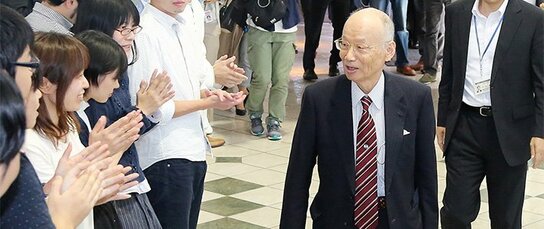
(Originally written in Japanese and published on October 13, 2015. Banner photo: Ōmura Satoshi (right) being greeted with applause as he enters the Kitasato Institute the day after being awarded the Nobel Prize in Physiology or Medicine © Jiji.)






 Read in other languages