


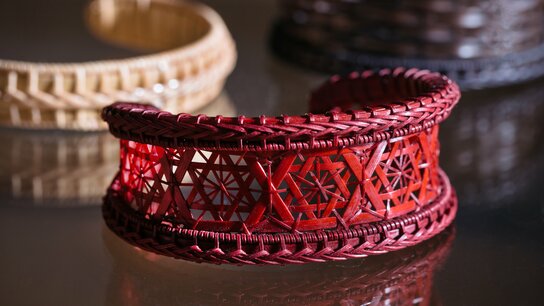
Kyoto-based artist Ogura Chiemi uses age-old techniques to shape bamboo into delicate, lace–like patterns, creating captivating accessories and ornaments. Her traditional bamboo craftworks have been featured in magazines and exhibited around Japan and abroad.
Lovely Lace-Like Bamboo Craftwork

 This embroidery-like piece will be part of a finely woven bamboo box.
Traditional bamboo craft, supple and tough, has been part of people’s lives in Japan since prehistoric times. Kyoto-based artist Ogura Chiemi continues the tradition while infusing a modern sense into her creations.
Ogura says as an artist she was drawn to bamboo for its environmental friendliness. Unlike other natural materials such as wood, bamboo grows quickly, reaching about 15 meters in 60 days, and can be harvested with minimal disturbance to the surrounding environment.
Traditional bamboo craft spans a broad number of genres, including musical instruments and bamboo armaments. Ogura focuses on braiding thinly sliced strands of bamboo. Traditionally, farmers around Kyoto would collect bamboo and create elegantly woven baskets in the off season. These were used in such disciplines as the tea ceremony and flower arrangement, and there are now more than 100 ways of braiding.
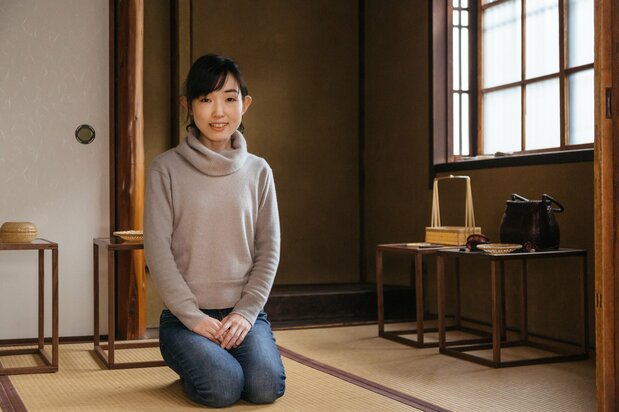 Ogura at her workshop set up in an old Kyoto house.
Ogura’s specialty is creating delicate hexagonal patterns called mutsume ami that was commonly used for farming items like baskets. Similar to lace embroidery, she uses a thin bamboo thread to create delicate floral patterns resembling peonies and chrysanthemums.
“I’ve loved flowers and plants from a young age,” she explains. “I like to infuse the gentle and delicate feeling of nature into my designs.” This requires a considerable amount of skills and concentration, however, as the shape and impression of a piece can change dramatically if a stitch is off by even a single millimeter. While braiding, Ogura says she uses deep breathing techniques to help her focus.
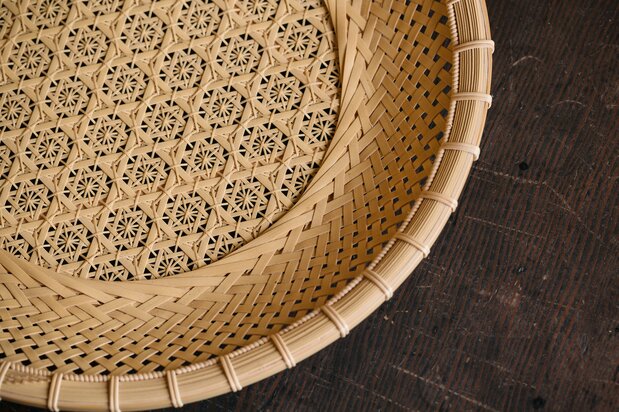 When held up to the light a peony watermark emerges on this white bamboo bowl.
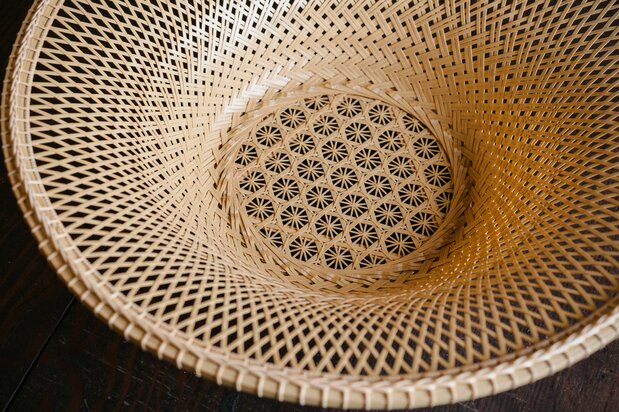 A white bamboo serving bowl featuring a lovely chrysanthemum design.
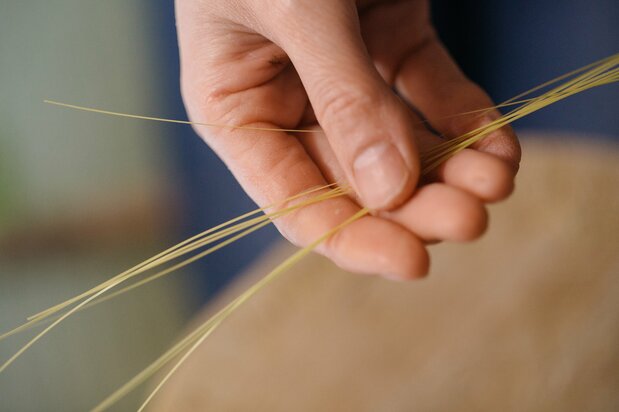 Ogura makes thin bamboo strands by hand.
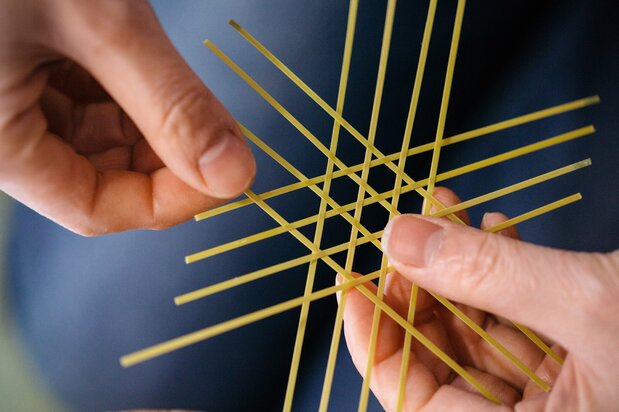 Ogura starts braiding a basket by overlapping bamboo strands.
Ogura says she is motivated by a desire to “convey to people the traditional beauty of bamboo crafts.” With the help and advice of other designers she has learned to make bangles and rings that have since made her name widely known.
Modern with sophisticated shapes and colors, the beauty of precisely woven bamboo is eye-catching. Natural peony, laurel tree, and pine tree motifs show Ogura’s love of nature.
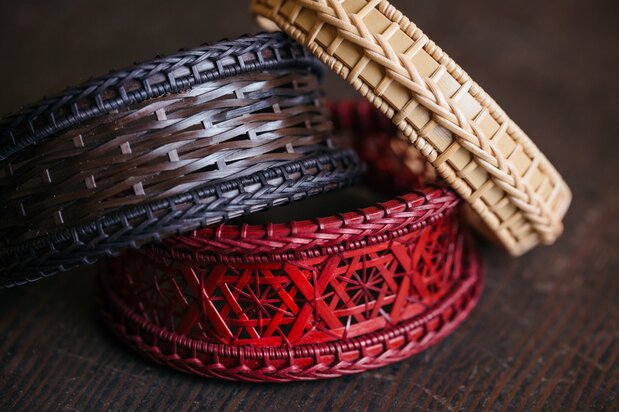 Modern bangles featuring, from top to bottoms, laurel tree, pine needle, and peony motifs.
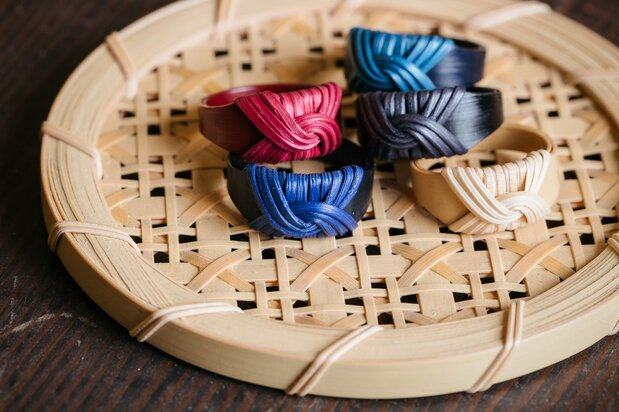 Ogura makes her own dyes for her elegantly colored rings.
Ogura has also collaborated with a female ceramic artist in Kyoto on a novel work that fuses porcelain with bamboo to create an elegant representation of a chrysanthemum blossom. The vibrant sensitivities of the two women and their delicate techniques unique to Kyoto produce a stunning piece.
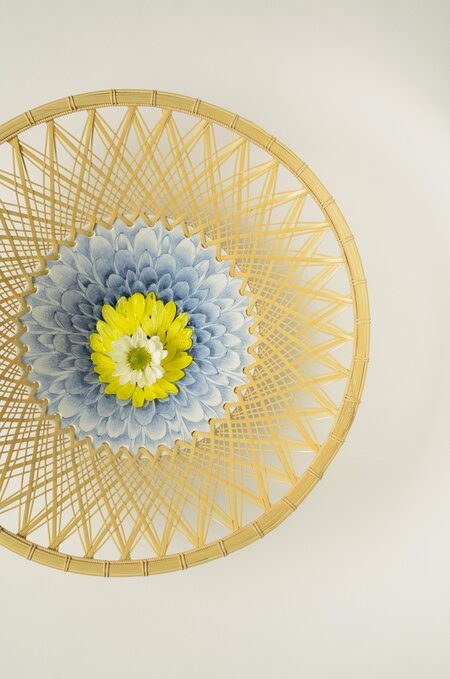 Chrysanthemum from the Shikunshi series depicting plum blossom, orchid, bamboo, and chrysanthemum, known in Chinese as the “four gentlemen among flowers.” Series organized in collaboration with Asano Yukiko. (© Hayashiguchi Tetsuya)
Each Strand Made with Care
Ogura says she prefers to work with young bamboo rather than mature plants. “Bamboo is said to live from 60 to 120 years, but the ones suitable for my work are young, supple bamboos three to five years old.”
To make thin strands Ogura starts by cutting a piece of bamboo with a wide-blade knife. By cutting parallel to the vertically running fibers of the plant she is able to easily split the hollow bamboo into smaller pieces.
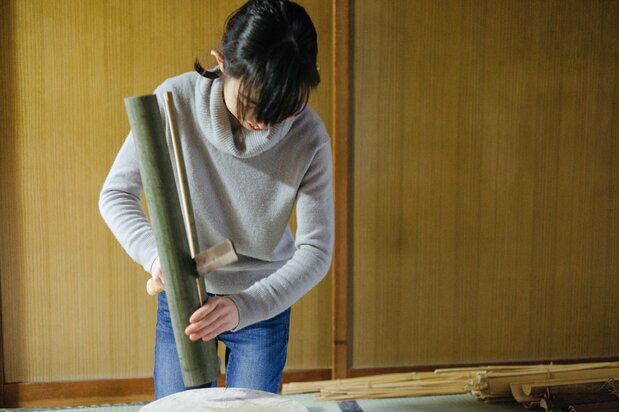 Ogura uses a wide-blade knife to cut a piece of bamboo.
Bamboo from Kyoto and surrounding areas is in high demand, and Ogura uses different varieties depending on the type of piece.
“The hot summers and cold winters of Kyoto produce beautiful, hard bamboo with thick walls,” she explains. “Craftsmen create what is called white bamboo from green bamboo by oiling, burning, and simmering it with caustic soda. The resulting pieces, themselves works of art, have an elegant whiteness and gloss that is quite unique to Kyoto.”
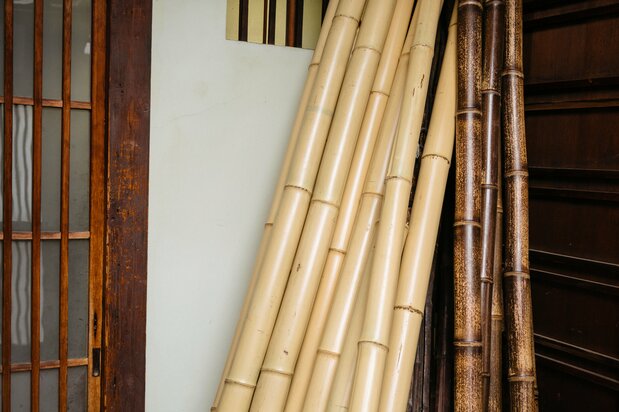 Ogura’s workshop contains different types of bamboo.
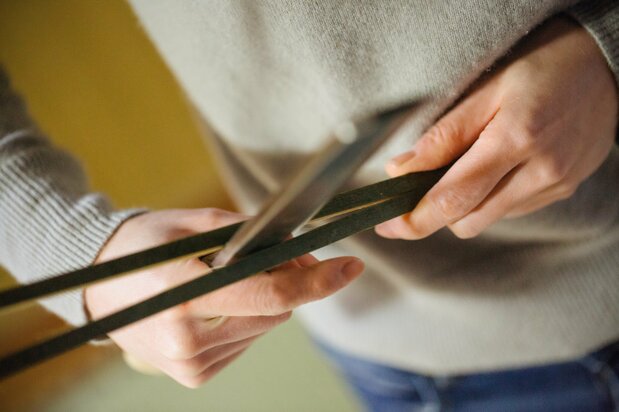 Ogura uses a wide-blade knife to cut bamboo into fine strands.
When working with green bamboo Ogura cuts the bamboo into increasingly finer strands, strips off the outer green skin, and then smooths the edges and sides until all pieces are of uniform thickness. Only once this laborious process is complete is Ogura ready to form the strips into delicate patterns and shapes.
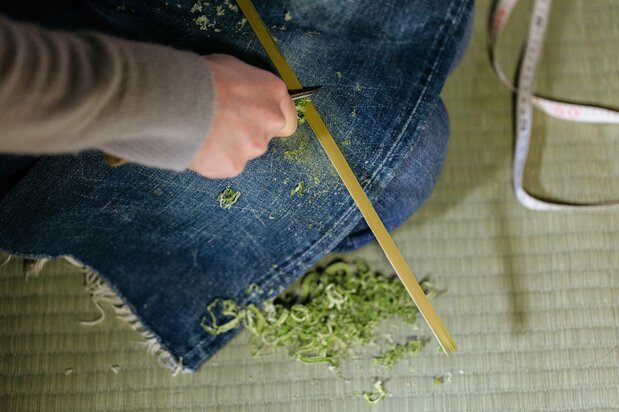 Stripping green bamboo with a small knife.
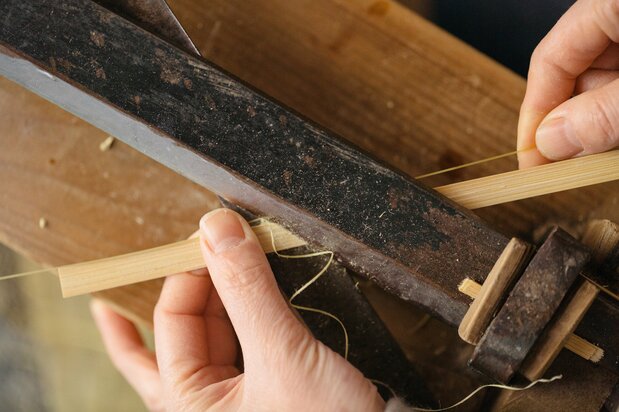 Ogura makes thread-like strands to use in her pieces.
Ogura, who has been independently creating bamboo art for the past nine years, has won critical acclaim for her original works. From May to July of this year her pieces were on display as part of an exhibition at the Portland Japanese Garden in Portland, Oregon.
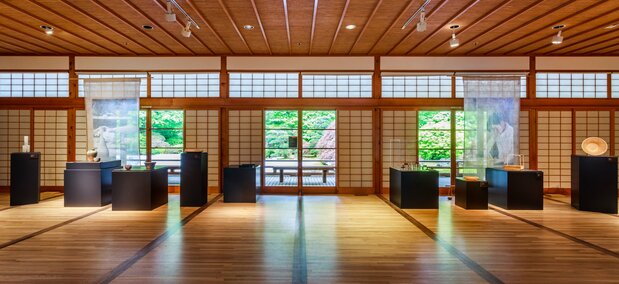 The exhibition at the Portland Japanese Garden included pieces by five Kyoto artisans. (© Jonathon Ley)
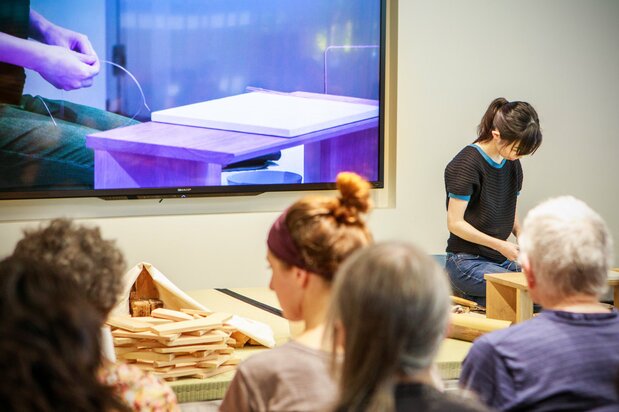 A live demonstration at the Portland exhibit. (© Jonathon Ley)
Ogura states that while working it is important for her to keep her mind on the task at hand. “When I’m making a piece, sometimes my indecision or impatience will show itself in my work. I have to keep my mind on track and not think about unnecessary things. I have to live in the moment, like a flower blooming in a field. This is the feeling I hope to foster as I continue to pursue my work.”
Kyoto Bamboo Basket Flower Heart
https://www.facebook.com/kyotakekago.hanakokoro/ (Japanese only)
(Originally published in Japanese on June 28, 2018. Reporting and text by Yamaguchi Noriko. Photographs by Yamazaki Yoshinori, unless otherwise noted.)






 Read in other languages