


The director Miyazaki Hayao and other leading anime creators have a surprising number of connections to Nagano in central Japan. The prefecture’s Suwa region, steeped in prehistoric Jōmon culture, is home to one of Japan’s oldest Shintō shrines.
Nagano Roots
In an earlier article, I wrote about how Miyazaki Hayao was connected to Tezuka Osamu via the philosopher Umehara Takeshi’s play Gilgamesh. Umehara also spoke about the significance of the forest culture of Japan’s Jōmon period (ca. 10,000–300 BC), including the Onbashira Festival at Nagano Prefecture’s Suwa Taisha, which is one of the country’s oldest Shintō shrine complexes. The festival, held every six years, is a series of sacred rituals in which shrine sanctuaries are rebuilt and tree trunks chosen, felled, and dragged down from the mountains and floated along the river to be erected as the shrine’s pillars. It is based on the spiritual belief that as wood ages, the kami or deity transmigrates into a fresh tree, renewing its life.
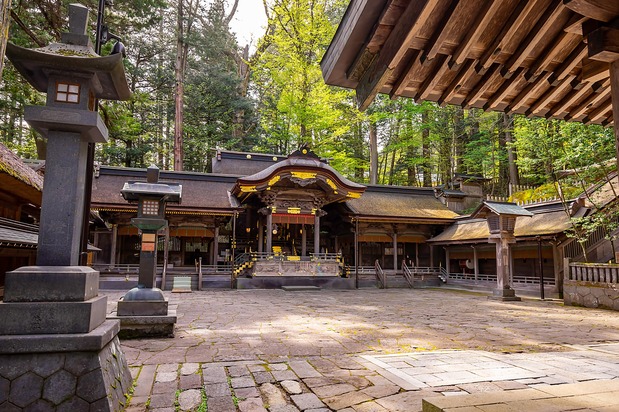
 The Ritual Hall (heihaiden) at the Honmiya shrine within Suwa Taisha. (© Pixta)
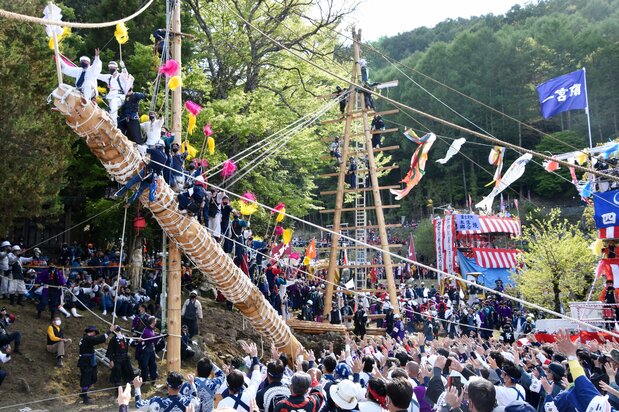 A tree trunk is hauled into position during the Onbashira Festival in May 2022. (© Jiji)
As well as its links to theories about Jōmon culture, the Suwa area in southern Nagano has deep ties for Miyazaki. As far as I know, the literary critic Fujita Naoya was the first person to comprehensively explore this connection in a book exploring animism in Ghibli films.
The Suwa area flourished during the mid-Jōmon period as a major source of obsidian, which was used to make stone tools. Ancient animistic customs and beliefs connected to hunter-gatherer culture remain today at Suwa Taisha, as represented by traditional kajikimen talismans granting dispensation to consume venison without spiritual impurity during eras when meat-eating was forbidden. In the 1950s, the artist Okamoto Tarō was inspired by prehistoric culture, famously documenting the Onbashira Festival after having previously highlighted the artistic merits of Jōmon flame-shaped pottery. Furthermore, the independent archaeologist Fujimori Eiichi (1911–73) conducted excavations at the Idojiri Ruins in the town of Fujimi in Suwa, which led him to argue that mid-Jōmon people practiced early farming alongside hunting and gathering.
As many Miyazaki fans know, the director owns a mountain cabin in Fujimi, the Nagano town southwest from the Yatsugatake range where the Onbashira timber is felled. This previously belonged to his father-in-law Ōta Kōshi (1909–98), a prominent art educator who was involved in Japan’s postwar woodblock print education movement. For a time, Miyazaki hosted annual summer retreats at this cabin, inviting fellow directors like Oshii Mamoru and Anno Hideaki, as well as the children of friends—one tale from these years tells how a friend’s daughter became the model for Chihiro in Spirited Away (2001). The original comics behind Ghibli adaptations such as Whisper of the Heart (1995) and From Up on Poppy Hill (2011) were also discovered among the countless girls’ manga that Ōta had left on the cabin’s bookshelves.
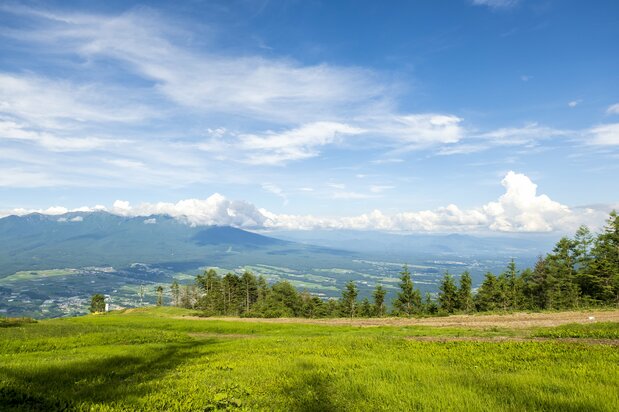 View of the Yatsugatake mountains from Mount Nyūkasa in Fujimi, Nagano. (© Pixta)
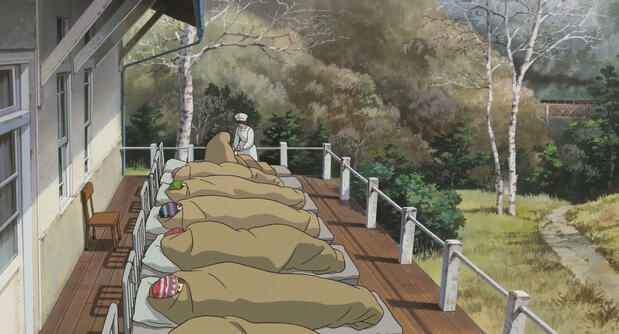 Fujimi Kōgen Sanatorium, where Naoko is treated in The Wind Rises. (© 2013 Hayao Miyazaki/Studio Ghibli, NDHDMTK)
Several of the character names in Princess Mononoke are taken from place names in Fujimi, including Eboshi, Kohroku (Kōroku), and Okkoto. In Miyazaki’s later film The Wind Rises, the main female character Satomi Naoko is admitted to Fujimi Kōgen Sanatorium for treatment. Above all, Miyazaki was profoundly influenced by Fujimori’s book on Jōmon culture based on his excavations, and Fujimori is the model for Satsuki’s and Mei’s father, who teaches archaeology as a part-time university lecturer in My Neighbor Totoro (1988). As the critic Fujita notes through his field research in the area, Suwa can truly be called “the fundamental source of Miyazaki’s philosophy, which links animistic purity with the raw, chaotic vitality of insects and small creatures, as well as the bloody realities of survival.”
The Next Generation
Suwa, and Nagano Prefecture as a whole, has an unexpected significance when considering the creative vision of the artistic successors to Ghibli directors Miyazaki Hayao and Takahata Isao, as well as twenty-first century Japanese animation as a whole.
From around the mid-2000s, Studio Ghibli began fully entrusting new feature films to a younger generation of directors to succeed Miyazaki and Takahata.
These were Miyazaki’s son Gorō (now 59) and the animator-turned-director Yonebayashi Hiromasa (53). Miyazaki Gorō initially trained as a landscape architect in urban greening and park design, and his full-fledged involvement with the studio began when he took charge of the overall design for the Ghibli Museum in Mitaka, which opened in 2001. He later supervised the recreation of Satsuki’s and Mei’s House for the 2005 Aichi Expo before stepping into directing with Tales from Earthsea in 2006. His subsequent works include From Up on Poppy Hill, the 2014 animated TV series Ronja, the Robber’s Daughter, and Earwig and the Witch, a 2021 feature. Most recently, he designed the landscaping for Ghibli Park, which opened inside the Expo 2005 Aichi Commemorative Park (Moricoro Park) in 2022.
Meanwhile, Yonebayashi debuted as a director with The Secret World of Arrietty (2010), which he followed up with When Marnie Was There (2014). After this, he departed Ghibli to help establish Studio Ponoc. Here, he directed the feature film Mary and the Witch’s Flower (2017) and the animated short Kanini & Kanino (2018).
The two directors share unexpected connections to Nagano Prefecture—or Shinshū to give the area its traditional name. Yonebayashi’s When Marnie was There is adapted from a children’s book by the British author Joan G. Robinson, but relocates the action from England to contemporary Japan. The film is set in an imaginary town inspired by Hokkaidō wetlands like Kushiro Marsh, but the Marsh House where Marnie lives is modeled on the Suikyūsō villa built in Karuizawa, Nagano, in 1931 for the businessman Asabuki Tsunekichi (1877–1955), which was designed by William Merrell Vories.
 The Marsh House in When Marnie Was There. (© 2014 Joan G. Robinson/Keiko Niwa/Studio Ghibli, NDHDMTK)
Gorō earned a degree in agriculture at the Matsumoto, Nagano, campus of Shinshū University. He later reflected on his student years: “When I went to school, my father gave me just one piece of advice. He said that university gives you four years of pure leisure, so I should properly savor it, as university is a place with a unique sense of time. Shinshū was a wonderful place in which to do so.”
 Miyazaki Gorō at the 2024 Cannes Film Festival, where Studio Ghibli received an honorary Palme d’Or. (© Marechal Aurore/ABACA/Kyōdō)
Gorō’s From Up on Poppy Hill was also based on one of the girls’ manga in his father’s mountain cabin. But the real significance of his connection to Nagano is that during his student days in this nature-rich region, he did not study animation. Instead, he gained specialized knowledge in environmental conservation and landscape design.
Fans Around the World
Apart from Takahata Isao’s Grave of the Fireflies (1988), which is bound by different rights agreements, Studio Ghibli films are not available via streaming in Japan. This has contributed to a lower level of interest in Ghibli among young Japanese viewers. Internationally, however, the films became available on various subscription services from 2019, sparking an explosive surge in global popularity. For example, Miyazaki Hayao’s first feature in a decade, the 2023 The Boy and the Heron, became the first original Japanese production ever to top the US weekend box office upon its release, despite the fact that, frankly, it was not a film with typical mainstream appeal. It went on to earn Miyazaki his second Oscar for Best Animated Feature at the 2024 Academy Awards. This success has been attributed to Ghibli’s rapidly expanding international fan base.
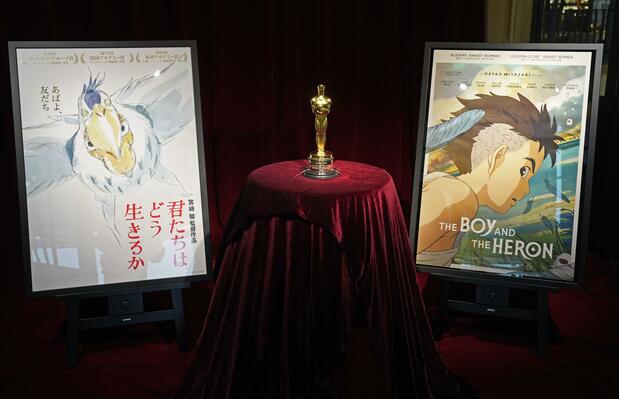 Posters for The Boy and the Heron flank the Academy Award for Best Animated Feature. Photo taken in March 2024. (© Kyōdō)
As mentioned earlier, Miyazaki Gorō has put his background and expertise to work taking sole charge of the landscape design for facilities such as the Ghibli Museum in Mitaka and Ghibli Park. Visiting these venues, or the Takahata Isao Exhibition held last year, I was immediately struck by the overwhelming presence of international tourists. The professional expertise Gorō cultivated in Nagano has, unexpectedly, served directly to meet the demand of overseas fans eager to experience the world of Ghibli in real, physical space.
Anno, Hosoda, and Shinkai
The Shinshū spirit that Miyazaki Hayao brought to Studio Ghibli, based on twentieth-century thinking, has continued to show surprising significance in the twenty-first century. This extends to the works of other prominent directors outside Ghibli who define contemporary Japanese animation.
In Neon Genesis Evangelion (1995–96) by Anno Hideaki, who has close ties to Miyazaki and Takahata, Tokyo-2 is built in Matsumoto, Nagano, after Japan’s capital is devastated in the Second Impact (in the story, this provisional capital is later replaced by Tokyo-3). Ueda, Nagano, which was considered as a site for Tokyo-2 in Evangelion, is famous as the site for Summer Wars (2009) by Hosoda Mamoru. Meanwhile, Shinkai Makoto is from Koumi, which borders Ueda and the Suwa region.
Starting around Children Who Chase Lost Voices (2011), which pays overt homage to Miyazaki’s anime worldview, Shinkai began highlighting motifs from Japanese classic texts, Shintō, and animism. The critic Fujita Naoya has written about how more recent films like Weathering with You (2019) show subtle Jōmon cultural themes beneath the surface.
This is still a preliminary sketch of an idea, but it might be possible to use the history of Studio Ghibli as a point of departure for reflecting on a distinct Shinshū creative imagination or geopolitics that reverberates like a bass note throughout the history of Japanese animation.
Studio Ghibli and its creative legacy still loom large before us as a monumental enigma, inviting endless inquiry.
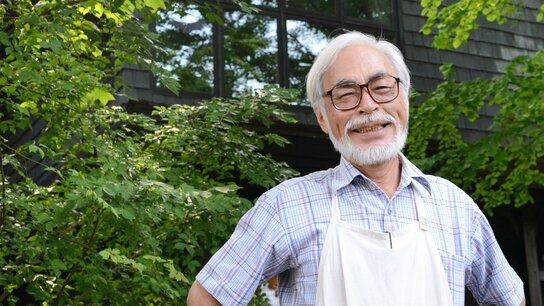
(Originally published in Japanese on September 30, 2026. Banner photo: Miyazaki Hayao in front of his studio in Koganei, Tokyo, in July 2013.)










 Read in other languages