Walking the Ginza Line: Evocative Views Along Tokyo’s Oldest Subway Route
Guideto Japan
Travel- English
- 日本語
- 简体字
- 繁體字
- Français
- Español
- العربية
- Русский
A Tour of Tokyo’s Free Time
After exploring the areas around the Yamanote Line, I’m devoting my new walking project to the subway system—and what better way to start than the Ginza Line. The section between Ueno and Asakusa opened on December 30, 1927, marking the birth of Tokyo’s subway. Work on this line progressed in fits and starts, shaped as much by economic shocks and war as by urban planning, but demand was immediate and overwhelming. Riders reportedly queued for hours to experience a journey that lasted barely five minutes. But the novelty of traveling underground was too good to be resisted. Everybody wanted to experience firsthand a new mode of transportation that promised speed and modernity.
By the way, only in 1953 was the name Ginza attached to this line, adopted to distinguish it from the newer Marunouchi Line. By then, what had begun as a fragile experiment had become an essential transport artery.
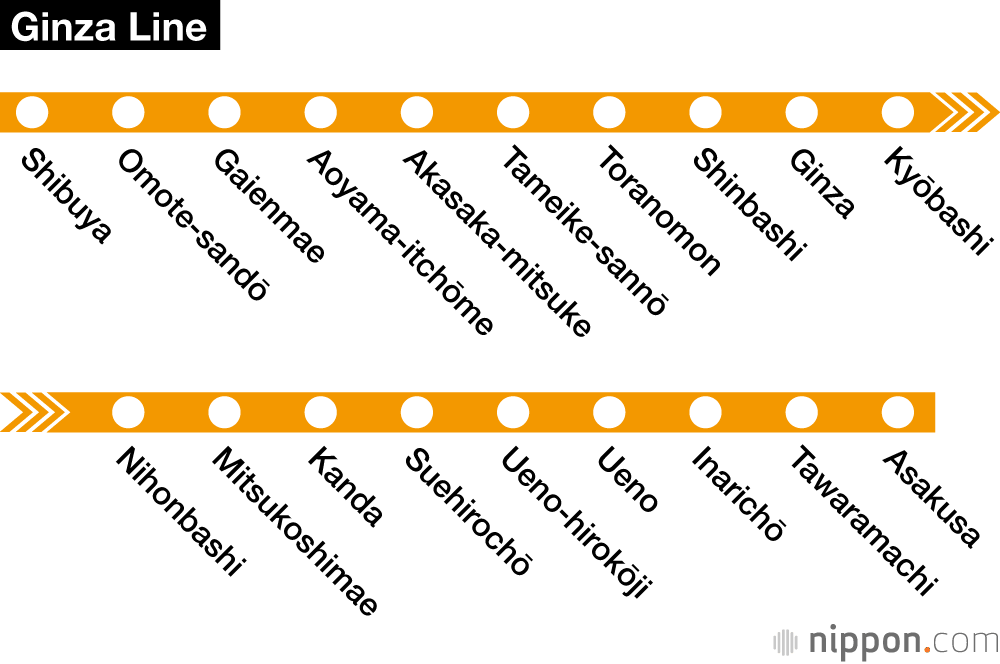
As I follow the Ginza’s orange line snaking its way around central Tokyo on a city map, I discover a recurring theme: This subway traces not just a route but a sequence—almost a chronology—of how Tokyo has learned to spend its free time.
Beginning in Asakusa, the line taps into the city’s first modern entertainment quarter, a place where, in the late Meiji (1868–1912) and Taishō (1912–25) periods, crowds gathered for theater, sideshows, and the novelty of cinema. At Ginza Station, one enters a more self-conscious stage of leisure: a district that has continually reinvented itself since the late nineteenth century, from a brick-lined showcase of Western modernity to a postwar consumer paradise and, later, a polished enclave of luxury. By the time the line reaches Shibuya, the mood has changed again. Here, in the late Shōwa (1926–89) and Heisei (1989–2019) years, leisure fragments into youth culture, fashion tribes, and the restless churn of trends, where people no longer gather simply to watch or to stroll and leisure becomes faster, more self-directed.
Old Homes, Older Shrines
But the Ginza Line is not only about having fun. Tourists and locals treat the stretch between Tawaramachi and Inarichō stations as an uninteresting buffer zone between Asakusa and Ueno, but it is actually one of those hidden urban gems that deserve more attention. Here I find an area full of temples and shrines where craft, commerce, and faith overlap. The street Asakusa-dōri, in particular, has a long parade of stores displaying memorial tablets, incense, bells, and other religious paraphernalia. These are not souvenir shops; they cater to families, temples, and funeral homes, supplying the material grammar of mourning and remembrance.
Most impressive are the lacquered butsudan, those small Buddhist altars that people keep at home to pray for their ancestors—and into which sometimes an evil spirit pulls an unsuspecting person, at least in some J-horror flicks such as The Grudge.
Spooky tales aside, this area is also worth visiting for its old-time atmosphere and relatively high percentage of very old buildings. After a quick visit to Seikyōji, a quiet, local temple where I pay my respects at the grave of the ukiyo-e artist Katsushika Hokusai, I walk the backstreets between Moto-Asakusa and Higashi-Ueno. Many of the buildings in these districts are covered with plates of corrugated iron, probably to protect them from fire. There are also a few prewar houses where, according to a local guide, the mistresses of important people of the past used to live.
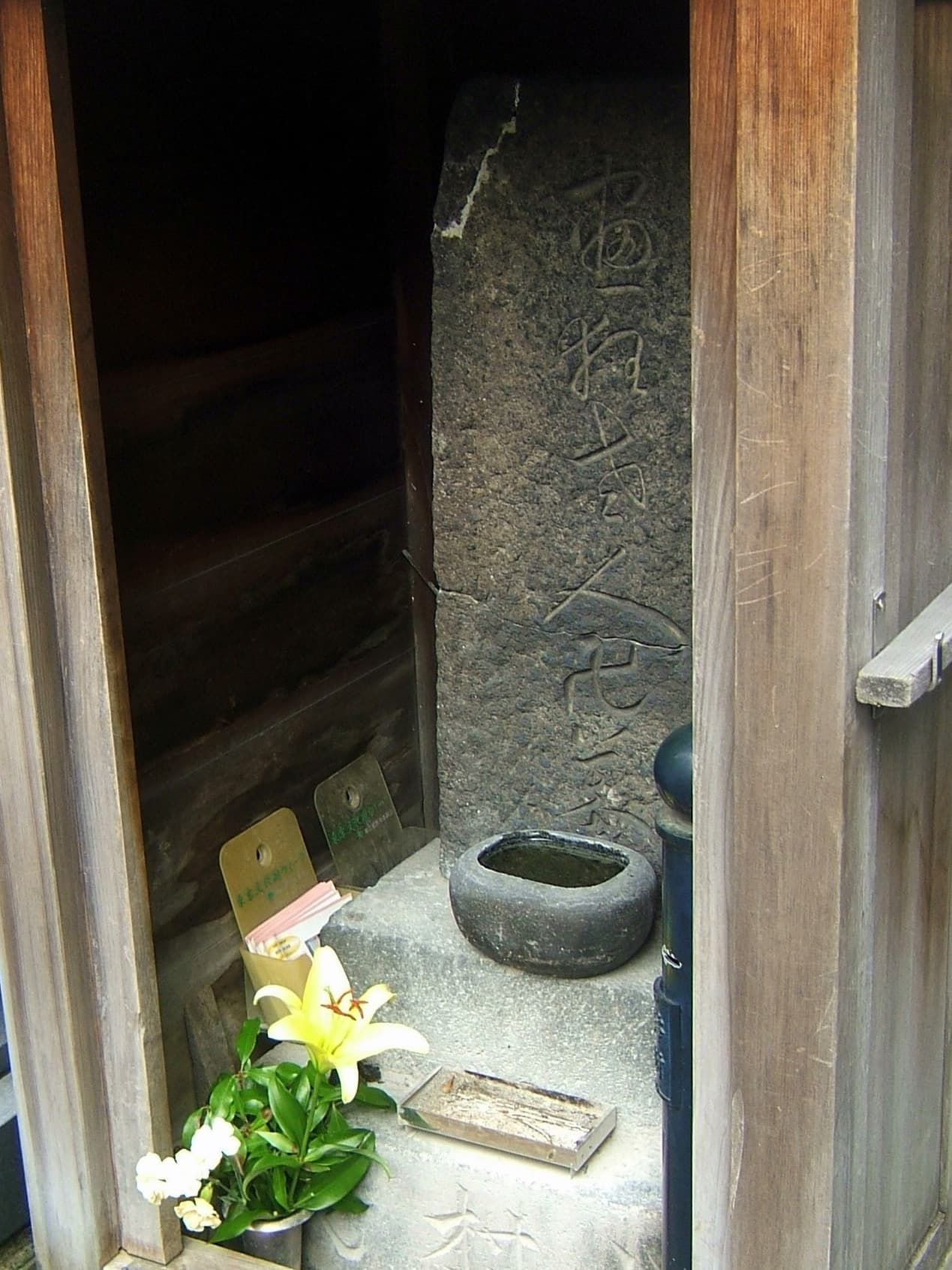
An unassuming grave for Katsushika Hokusai, one of Japan’s great artists. (© Gianni Simone)
These neighborhoods still move to the rhythms of shitamachi life—small houses and trades, local shrines woven into daily routines. They are very worth a visit, especially if you are into historical architecture. Until just a few years ago five old nagaya, the traditional urban “long homes” with their narrow frontages, were still standing side by side, having miraculously survived fires, earthquakes, and the wartime bombings. Unfortunately, only two are left now, so if you want to check them out you had better hurry.
In Inarichō, fox shrines hide between buildings. The station name itself reflects the presence of Inari worship nearby: small shrines dedicated to a deity associated with rice, prosperity, and protection. You don’t find a grand complex, just fox statues flanking modest altars, sometimes wearing red bibs tied by anonymous hands. Shitaya Shrine, just south of the subway station, is arguably the most important of them, if nothing else because, founded in 730 CE, this is Tokyo’s oldest Inari shrine.
Timeless Discoveries Amid the Towers
Speaking of shrines, my next stop is Toranomon. It’s not so much a tourist spot as a place you pass through. Even with the recent addition of Toranomon Hills, one of the massive, multitower redevelopments that have mushroomed around Tokyo, you feel the absence of narrative. Apparently, there are no reasons to slow down. T‑Market, W Toranomon the Market, Toranomon Marché, Toranomon Yokochō—these spaces borrow the language of markets without carrying their substance. They feel like replicas of something that once existed elsewhere: the original street‑level markets displaced by the very forces that now repackage their atmosphere in cleaner, safer, more profitable form.
However, if you leave the main thoroughfares and start exploring Toranomon’s backstreets, you quickly lose yourself trying to navigate short, angled lanes that don’t align with the modern grid, and sudden dead-ends or kinked streets. Most of Edo was not laid out as a regular merchant grid but as a patchwork of samurai estate boundaries, and in areas like Toranomon or Akasaka, streets often follow the edges of those estates and the pull of topography – ridges and slopes – rather than any overarching plan. That’s why Tokyo still produces those subtle irregularities: bends, truncated streets, and odd alignments that betray an older order beneath the modern surface.
For me the district’s highlights are not the new skyscrapers but two religious spots: Toranomon Kotohiragū and Atago Shrine represent two distinct ways the old Tokyo survives within the modern city. At Toranomon Kotohiragū, the shrine is seamlessly folded into a glass-and-steel office tower, its compact courtyard offering a moment of calm and stillness amid corporate density. A short walk away, Atago Shrine rises unexpectedly above the streets on top of Atago-yama, at 25.7 meters of altitude the highest natural point in its part of the city center.
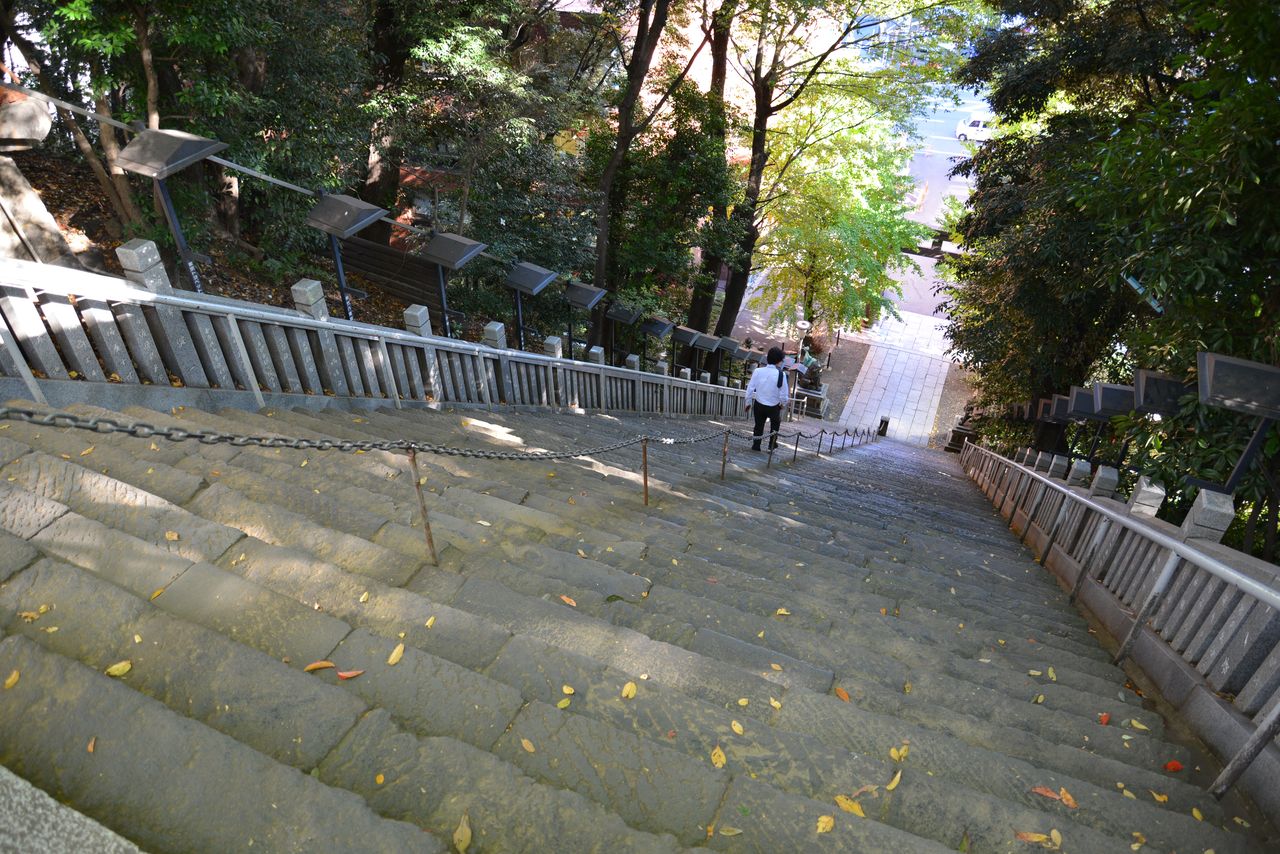
Atago Shrine’s famed staircase comes complete with a chain to grip as you navigate its steep steps. (© Nippon.com)
You reach the shrine by a steep stone staircase that lifts you out of the business district and into a space where you breathe history and a lingering sense of retreat.
Fine Living at the Line’s West End
When I arrive in Omote-sandō, the obvious move would be to stroll down the zelkova-lined avenue giving the station its name and drift into Ura-Harajuku’s youth fashion district, but that ground has been covered to death. Then, at the crossing south of Harajuku Station, I notice a vintage condominium stretching along the slope descending from Harajuku toward Meiji-dōri. I must have walked past it millions of times without ever really seeing it.
From a quick online search, I learn that Coop Olympia is one of Harajuku’s defining landmarks, completed in March 1965, just months after the Tokyo Olympics (hence its name). The building’s zig-zag grey façade is striking enough, but its real beauty only reveals itself when I walk around to the back and see that the structure opens into a clean, deliberate V shape. Up close, it certainly shows its age; it would benefit from a new coat of paint. Or maybe not: the faded patches add to its retro charm.
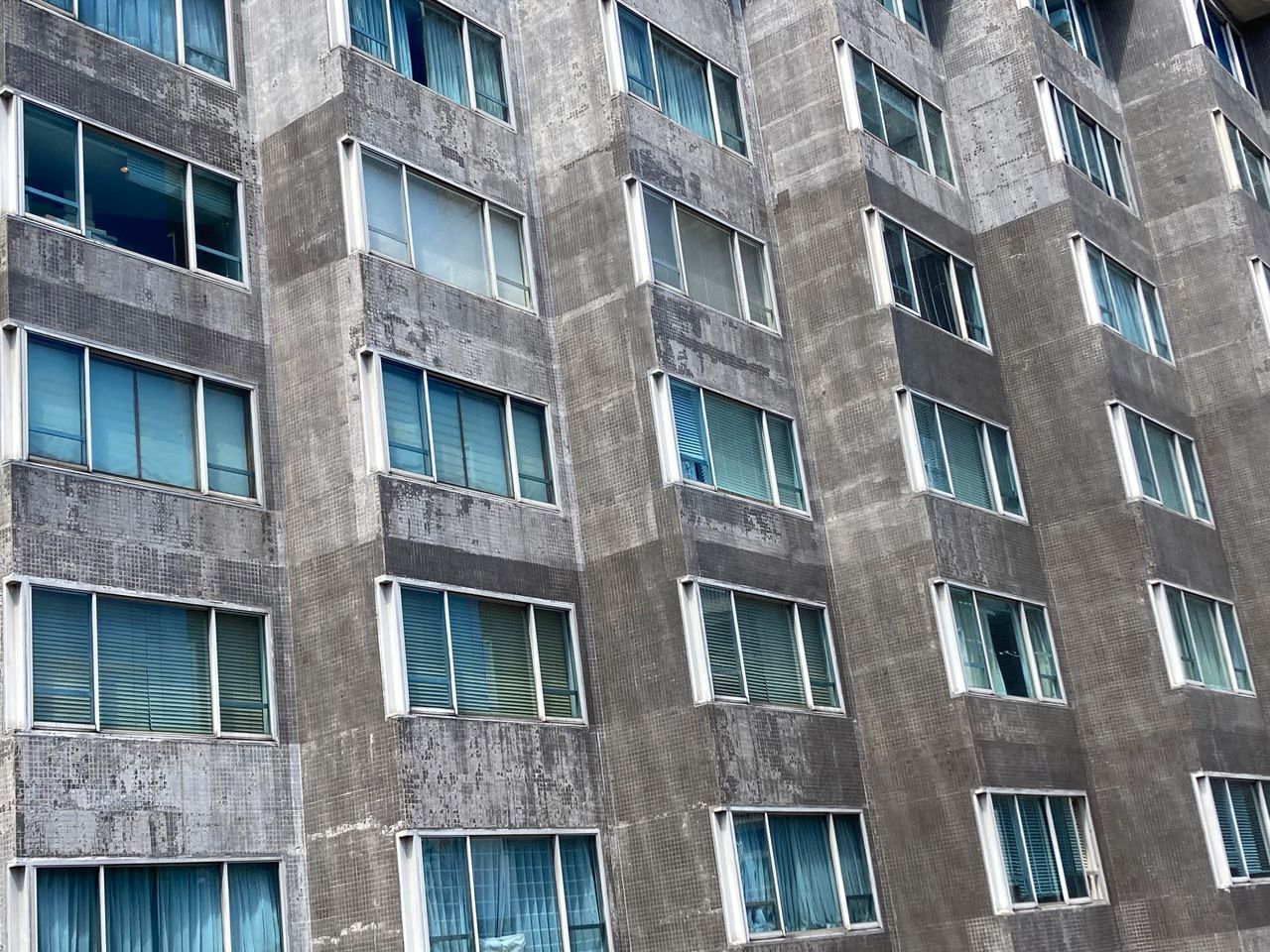
The gray façade of the Coop Olympia was the height of urban luxury living in the 1960s. (© Gianni Simone)
When it debuted, Coop Olympia was widely regarded as Japan’s first true luxury apartment, with some units priced above 100 million yen. The steel-reinforced concrete condo introduced amenities that were revolutionary for mid-1960s Japan: elevators, central air conditioning, and hotel-like front desk service. It quickly became a symbol of modern, aspirational urban living in post-Olympic Tokyo. Even today, looking down from my vantage point, the parking lot is full of Mercedes, Porsches, and other high-end cars.
And Coop Olympia is only the tip of the iceberg. As I walk the backstreet behind the condominium, I discover an exclusive neighborhood of fine detached houses and exclusive apartments with exotic names like La Maison de Rose.
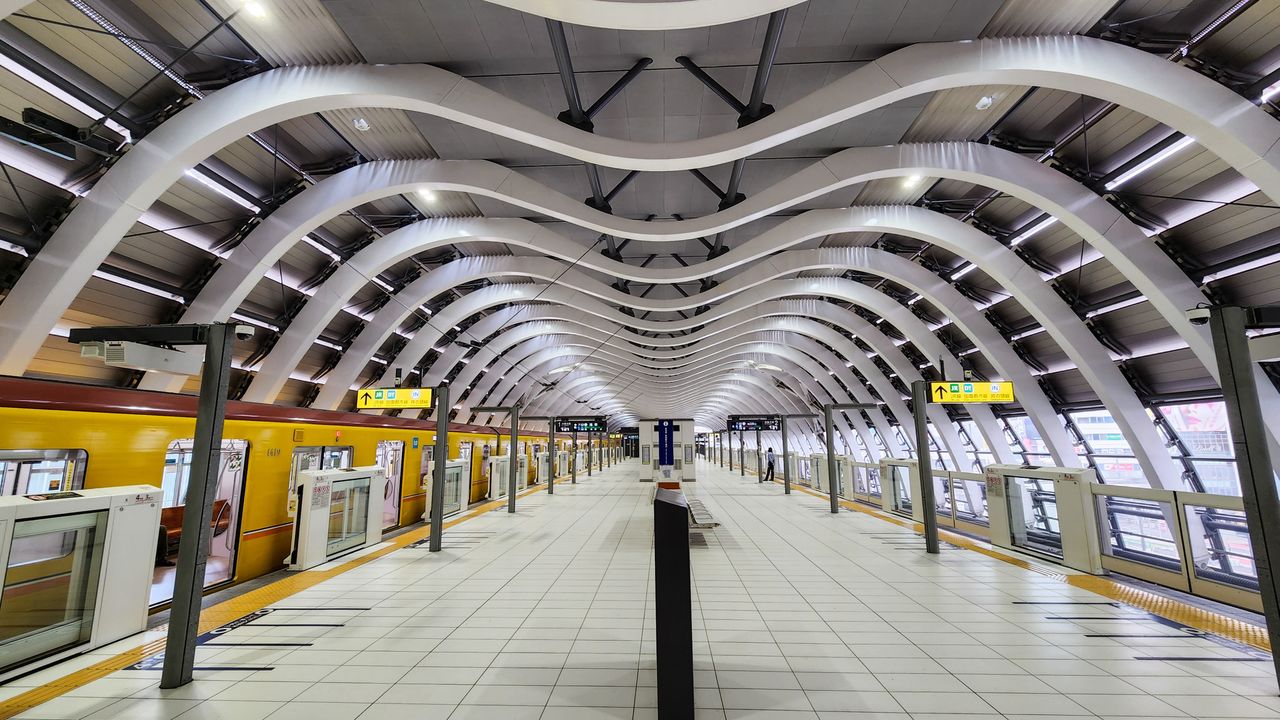
For the very last stretch between Omote-sandō and Shibuya I take the subway because I want to experience the train surfacing above ground. Since Shibuya sits at the bottom of a valley, developers decided to turn this section into an elevated track. Once this meant that the trains burst into open air; today, unfortunately, they move through glass-filtered light, the city visible but softened.
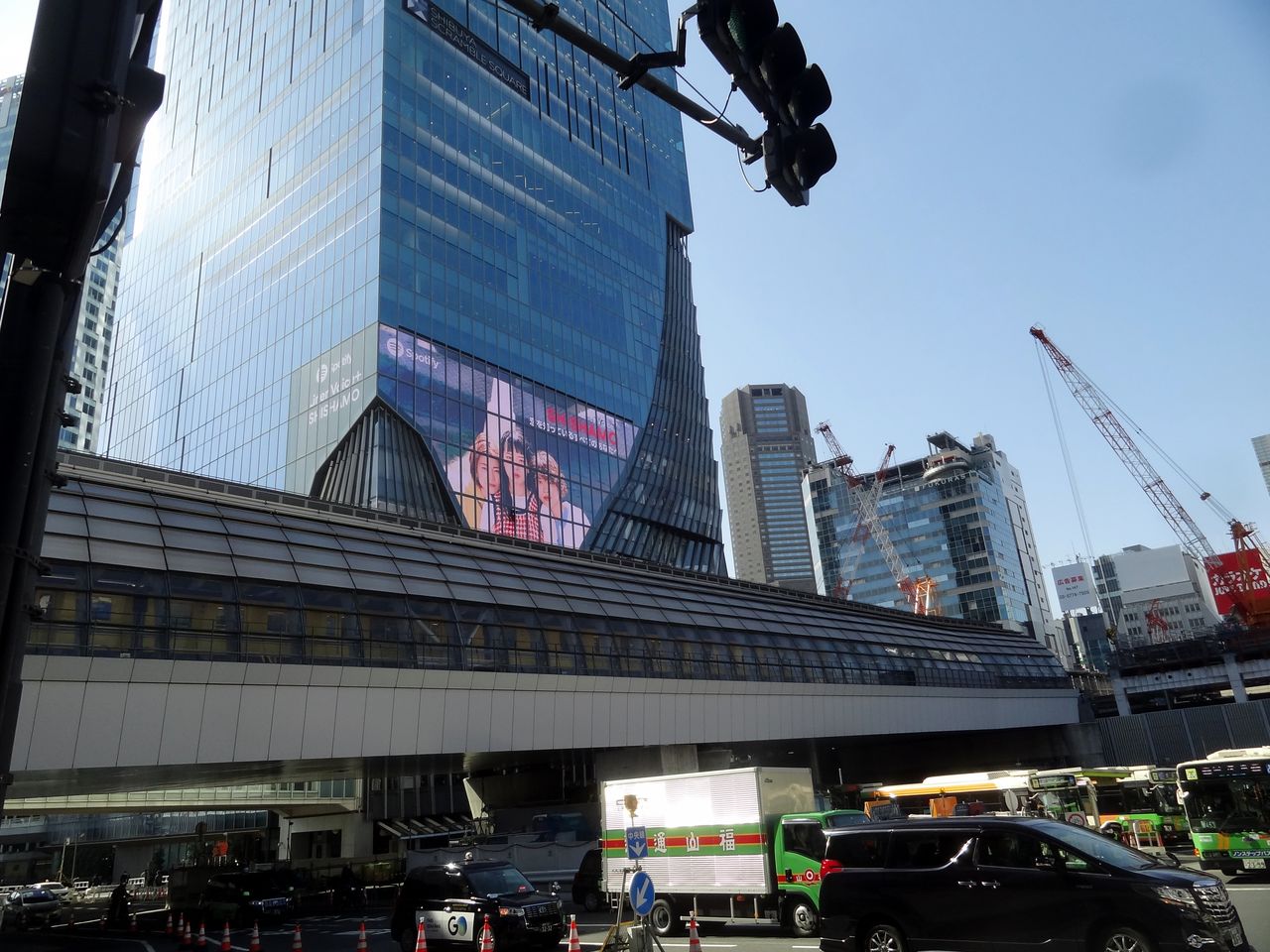
The line comes above ground in Shibuya, but remains cocooned in its own tunnel. (© Gianni Simone)
The line no longer breaks the surface so much as threads into an urban machine, absorbed rather than released. It’s an experience that matches contemporary Shibuya’s choreography of decks, managed flows, and transparency without exposure.
Visit the Tokyo Metro website to view the complete map of Tokyo’s subway network.
(Originally written in English. Banner photo: The Ginza Line’s terminal platform at Shibuya Station. © Pixta.)