


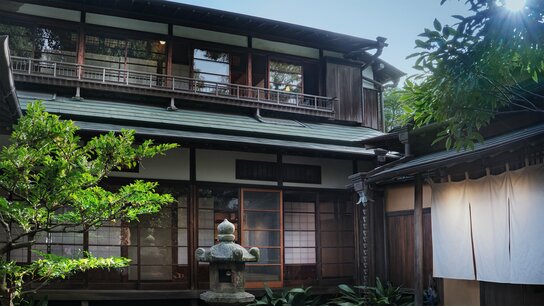
The former villa of a Cambridge-educated marquis now welcomes visitors to its converted wartime storehouse for Japanese sweets infused with British charm.
A Day Trip from Tokyo
It takes about 15 minutes to walk from Odawara Station to the café Seikantei. There are buses and taxis, too, but I recommend enjoying the leisurely stroll through Odawara Castle Park. The route to the café makes a beautiful prelude.
Seikantei stands on ground that was once inside the third bailey (sannomaru) of Odawara Castle, built 400 years ago by the Hōjō clan. This puts it inside a nationally recognized historic site—combined with architecture designated as a registered tangible cultural property, it is a remarkably rare setting.
The Japanese restaurant and café operating in the tatami-floored zashiki inside the building serves courses and sweets made using local ingredients. It is one hour from Tokyo Station via Odoriko express train, or 70 minutes via Tōkaidō Shinkansen—just the right length for a day trip to experience the trifecta of history, culture, and gourmet cuisine.
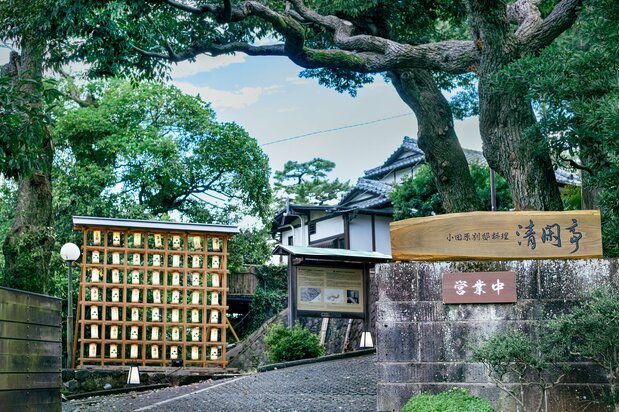
 The entrance to Seikantei is enswathed in green. The decoration to the left is changed four times throughout the year, once for each season. (© Kawaguchi Yōko)
One autumn afternoon, I step through the gate and climb the winding path to the entranceway. My first welcome comes from a decoration outside the gate using traditional Odawara lanterns.
Seikantei was built in 1906 as a holiday residence for Marquis Kuroda Nagashige, then-head of the Kuroda family and former head of Fukuoka domain. Nagashige was a direct descendant of Kuroda Kanbei, the brilliant strategist who worked for powerful leaders like Oda Nobunaga and Toyotomi Hideyoshi.
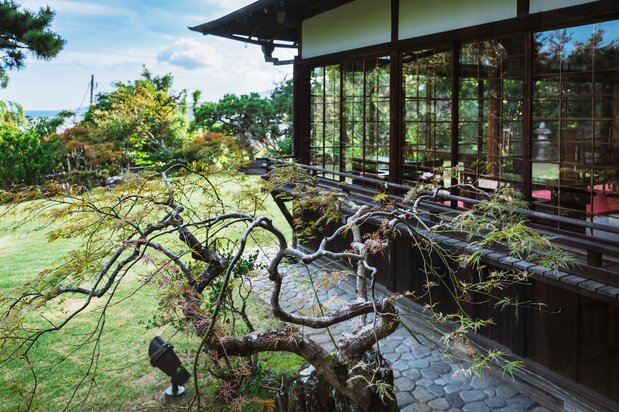 The building was destroyed in the Great Kantō Earthquake of 1923, but was recreated using what remained of the original structure. (© Kawaguchi Yōko)
When I part the white noren curtain and enter, staff are waiting to welcome me. A 15-minute guided tour of both floors is held hourly, led by staff whose knowledge of local history and culture makes the tour a memorable experience.
And this mansion certainly has many mysteries. Bold, innovative elements amid traditional architecture. A tea room with a wooden floor instead of tatami mats. A view of the sea that should be excellent, blocked by a pine tree in the garden. A west-facing main room on the second floor, defying traditions that consider this inauspicious. On the guided tour, the thinking behind all these features becomes clear.
A Tearoom for Black Tea, Not Matcha
Nagashige studied at Cambridge University in England, where he also received an education in English culture. The mansion is replete with touches that reflect his aesthetic.
For example, the kitchen and its adjoining tearoom. The tearoom, remarkably, has Western-style wooden floors. The ceiling is of woven cedar bark, like a traditional Japanese tearoom, but it looks like Western-style herringbone, and a chandelier hangs from it. Nagashige discovered the culture around black tea during his time as a student overseas, and made his tearoom a space for entertaining guests with English tea.
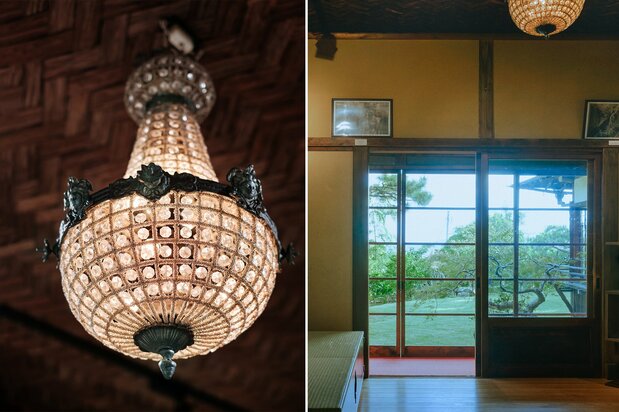 Left: A chandelier hangs from the woven cedar bark ceiling; right: Looking out on the garden from the wooden-floored tearoom. (© Kawaguchi Yōko)
Of course, this was more than just personal preference.
“Kuroda Nagashige served as vice-chairman of the House of Peers for 30 years,” explains a staff member. “He had a responsibility to maintain a neutral position, not leaning toward any particular faction or influence. At that time, Odawara had a salon culture that connected luminaries of the political and business world through the tea ceremony. It’s theorized that he made a tearoom where this political dimension was deemphasized because he was wary of succumbing to these dynamics.” This flexible, neutral bearing is said to reflect the teachings of Kuroda Kanbei, forebear of the Kuroda family.
Pines and White Roses: An Artistic Collaboration Across Centuries
Every room in the mansion has different designs on its ceiling and floor, and Nagashige’s ideas shine in the smallest details of the ranma (decorative transoms) and fittings. The room used as a restaurant is notable for its cedar door. Made of a single panel of cedar, it has been used by the Kuroda family since the latter days of the Edo period (1603–1868).
The first designs painted on the door were reportedly the pine and peacock. Nagashige added a white rose, symbolizing England. The saturation and thickness of the paint vary, but the different designs feel perfectly natural together. Could it be because of the effortless elegance that fills the entire mansion?
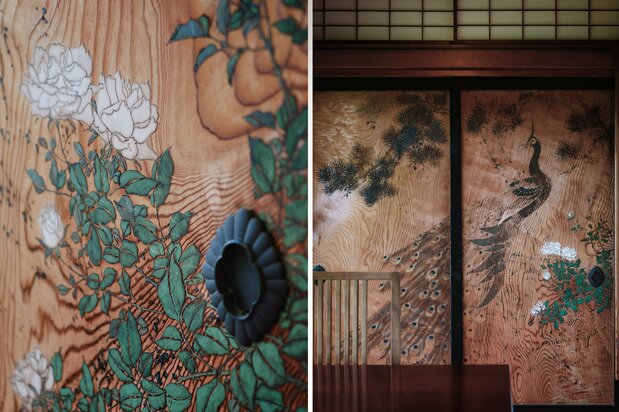 These cedar doors were used by the Kuroda family as far back as the Edo period. (© Kawaguchi Yōko)
Meanwhile, the paintings on the fusuma (sliding doors) in the room Nagashige used as a dining room were executed by a contemporary artist during a renovation.
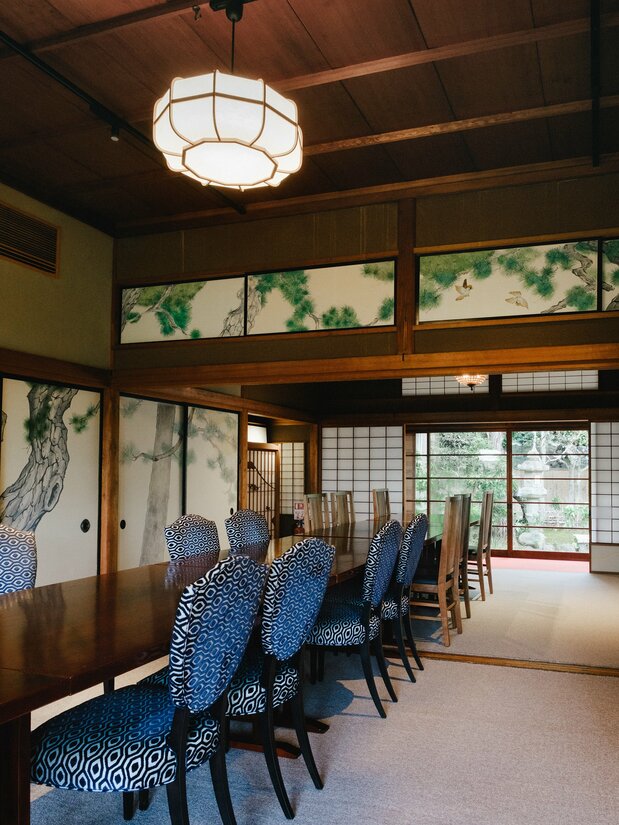 The fusuma-e painted by a contemporary artist blends seamlessly with the green of the garden. (© Kawaguchi Yōko)
The Pine that Sheltered Weary Spirits
In the room at the top of the stairs, the tokonoma alcove faces west. This is traditionally considered inauspicious, but here Nagashige was guided by a more important tradition.
When the head of the house sat with their back to the tokonoma, what they saw was the famous “one-night castle” on Mount Ishigaki. Toyotomi Hideyoshi had this legendary fortification built during the Siege of Odawara. During the siege, Kuroda Kanbei entered Odawara Castle and negotiated a bloodless surrender from the Hōjō clan. This accomplishment was the foundation on which the Kuroda family flourished.
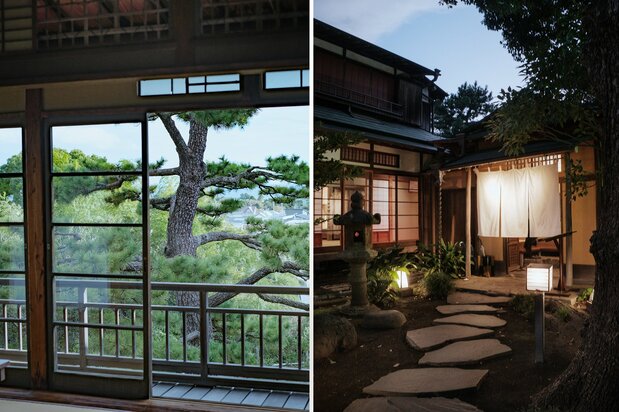 Left: Looking seaward from the second story; right: Seikantei in the evening. (© Kawaguchi Yōko)
Meanwhile, the view of the ocean should be superb—but a pine tree in the garden blocks it, allowing only glimpses of the horizon. When the mansion was built, the area between it and the sea was occupied by the holiday residences of other political and business figures, including Itō Hirobumi and Yamagata Aritomo. Nagashige wanted to spend his holidays, at least, far from any hint of politics, so he intentionally used the pine tree to conceal it.
From the Meiji era (1868–1912) into the Taishō era (1912–26), Odawara was one of Japan’s most exclusive areas for luxury holiday residences. It was surrounded by mountains and seas, was rich in natural beauty, had a warm climate, was just the right distance from Tokyo, and its status was further raised by Emperor Meiji building a residence there. The titans of politics and industry who had lived through the wrenching changes during and after the fall of the shogunate and the two wars that followed, sought a place to recover from mental and physical exhaustion. Kuroda Nagashige was one such person.
Original Confections in the Storehouse Café
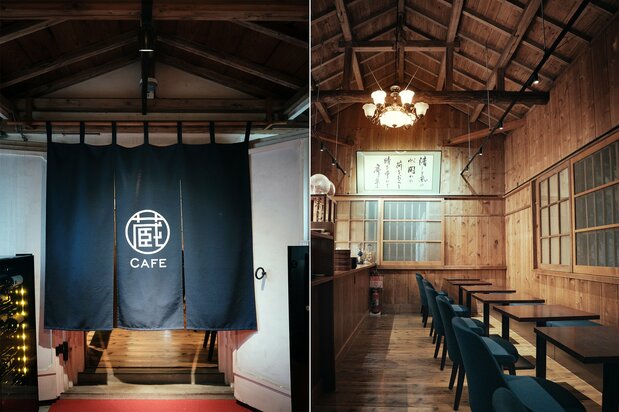 The calm, quiet interior of the storehouse café. An excellent place to drop in casually while on a walk. (© Kawaguchi Yōko)
The storehouse that cleaves close to the mansion was built by Marquis Asano Nagatake, who became the second to own the property in 1941. Known for serving as director of the Tokyo National Museum, Asano evacuated to Seikantei with his family during World War II, making the storehouse a necessity for furniture storage.
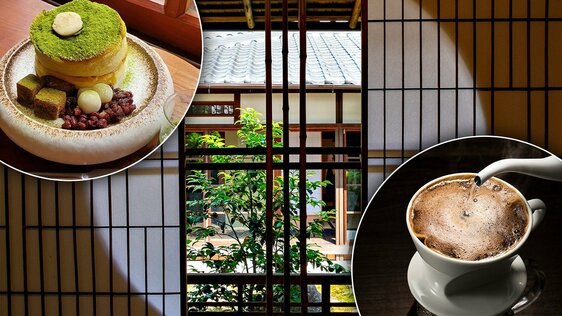
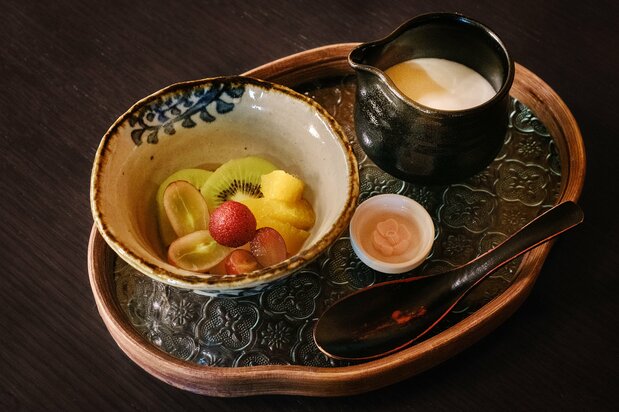 Susuri Anko is an original confection inspired by susuri dango, said to be the forerunner of oshiruko. (© Kawaguchi Yōko)
That storehouse is now a café, and one of the specialties served there is the Susuri Anko with Seasonal Fruit. White an (sweet bean paste) is mixed with fresh cream and other ingredients to create a smooth, paste-like texture, then poured over the seasonal fruit and shiratama dumplings to enjoy.
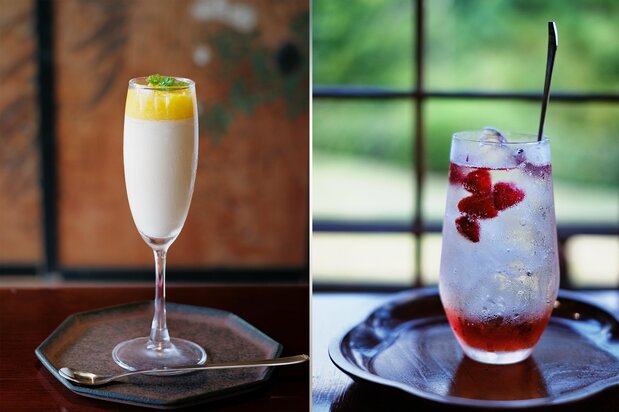 Left: Seikantei Pudding; right: Squash of the Day. (© Kawaguchi Yōko)
Seikantei Pudding is made using Marquis Kuroda’s beloved English tea. The fresh fragrance of the orange sauce brings out the refined aroma of the tea.
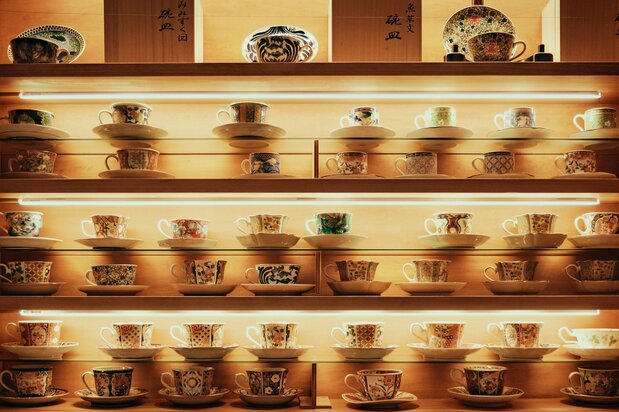 The tableware used in the café is from Murakami Genki Tōbō, a renowned Arita ware kiln in Kyūshū, to which the Kuroda family had a historical connection. (© Kawaguchi Yōko)
A small mystery can be found in this storehouse, too. The hurried pace of construction when the building proved necessary for the evacuated family is evident in details like the noticeable knots on the interior wall’s cedar panel, which seem mismatched with the generally elevated tone. And yet the storehouse door, and only the door, has a thick, earthen-walled construction. This, say the staff, is so that “even if a fire started in the storehouse, it wouldn’t spread to the main Kuroda family home next door.” What this storehouse was made to protect was the opposite of the usual.
After the war, Seikantei was used for a half-century as a guest house and recreational facility by Daiichi Life Insurance. In 2008, the city of Odawara acquired the building and opened it to the public until 2022. Then, in 2024, to secure funds for maintaining this historic structure and preserve it in a sustainable fashion for future generations, it was opened to us again as a restaurant and café run as a public-private partnership. Every morning and evening the staff perform the time-consuming task of opening or closing the dozens of rain shutters to keep this historic building safely preserved.
There are afternoons when the distant sea’s presence is palpable through the boughs of the pine tree. There are moments when I imagine the faint clinking of spoons in teacups a century ago in a room where a marquis once served English tea. Beyond the white noren, both of these await.
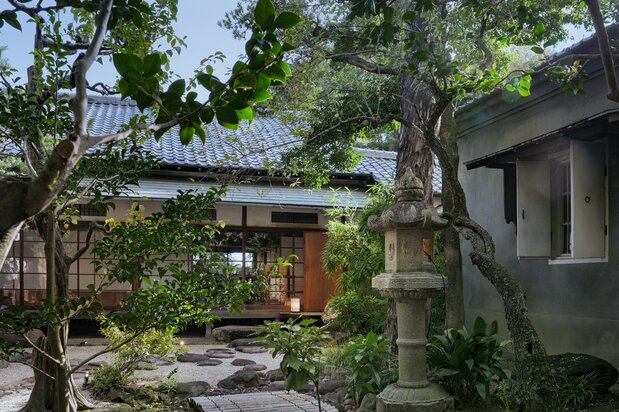 The main building and the storehouse café (right) as seen from the rear garden. (© Kawaguchi Yōko)
Odawara Villa Cuisine Seikantei
- Address: 1-5-73 Minamichō, Odawara, Kanagawa Prefecture
- Tel: +81-050-1809-2213
- Hours: Storehouse Café: 11:00 am–5:00 pm (no reservation required). Odawara Villa Cuisine: 11:00 am–3:00 pm and 5:00 pm–9:00 pm (reservations required for both lunch and dinner).
- Closed: Check the official website.
- Access: 15-minute walk from Odawara Station on the JR and Odakyū Lines.
- Official website: https://www.seikantei.jp/ (Japanese)
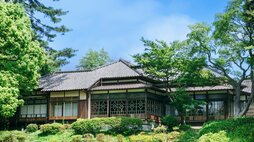
(Originally published in Japanese on October 29, 2026. Banner photo: The exterior of Seikantei. © Kawaguchi Yōko.)




 Read in other languages