


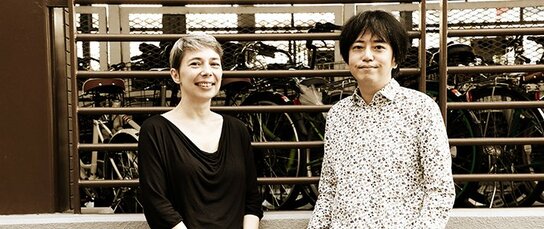
Nakamura Fuminori is one of contemporary Japanese literature’s most filmed and most translated authors. As the adaptation of his debut novel from 16 years ago, The Gun, reaches cinemas, we invited him to participate in a conversation with Myriam Dartois-Ako, the novel’s French translator.
Akutagawa Prize–winning novelist Nakamura Fuminori’s steady output since The Gun, his 2002 debut about a young man whose life spirals out of control after finding a handgun, has earned him a loyal audience both within Japan and overseas. In 2018, The Gun was made into a film, directed by Take Masaharu. By including the internal monologue of the student protagonist, the adaptation is a suitably literary take on Nakamura’s work—but how does Nakamura himself view the film? And how does his French translator see Nakamura’s creative world, which resonates even across differences of language and culture?
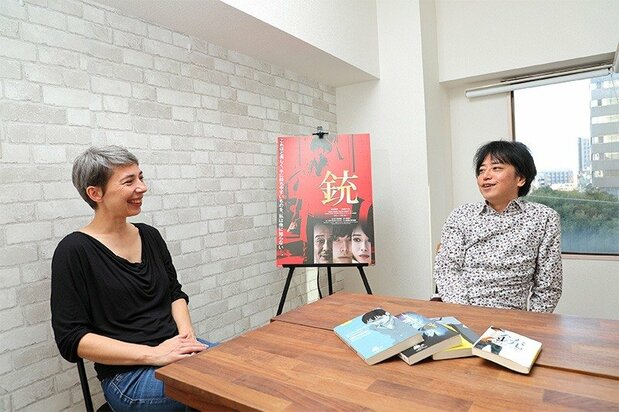

The Faceless Protagonist
NAKAMURA FUMINORI What did you think of the film?
MYRIAM DARTOIS-AKO It surprised me. Your writing had taken on a certain form within me, and seeing it in a different form was a little startling.
NAKAMURA Me too. I mean, I wrote the book, and I checked the script, but seeing it on-screen was still surprising. It felt new enough to me that I could forget that I wrote it and let myself be drawn into it. I actually did make one change. It’s the scene towards the end, when Yoshikawa Yūko passes Tōru on campus and says, “You have a problem.” That was the only thing added for the film. Everyone seemed to like the result.
DARTOIS-AKO Was it needed because of the different methods of expression in a film as opposed to a novel?
NAKAMURA The book didn’t need it, but I added it for the film because I was worried that if I didn’t add a hint of tension there things might become monotonous. I left the decision up to the director, but he agreed that the scene should be in there. Murakami Nijirō and Hirose Alice said that shooting it made them nervous because it felt like the core of the film.
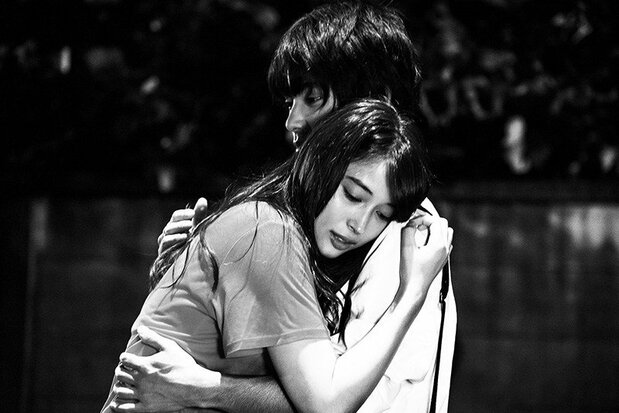 Yoshikawa Yūko (Hirose Alice, left) and protagonist Nishikawa Tōru (Murakami Nijirō) in The Gun. (© Yoshimoto Kōgyō.)
DARTOIS-AKO I’m sure you imagine the characters in your head as you write, but what was it like seeing them in the film?
NAKAMURA I thought they were absolutely perfect. I don’t have any visuals in mind when I write, so it’s always new to see my works on the screen. It wouldn’t be any fun if everything was as I expected, and The Gun surprised me in several ways. The protagonist is the sort of character where what he says on the surface is very different from what he’s thinking inside, so I thought the mismatch between his internal narration and the movements of his lips was an interesting idea. I was also surprised that a black and white film could include such powerful imagery.
DARTOIS-AKO What aspect of the original do you think inspired the decision to film in black and white?
NAKAMURA It could be the style at the sentence level. The whole novel is narrated by a withdrawn protagonist, after all. The black and white idea went from the cinematographer to the director, then the director to the producer, and finally the producer to me, and everyone along the line just said “Brilliant!” That’s always how it is when something new is born. By the way, what about when you’re translating? You do imagine the characters as Japanese while you translate, right?
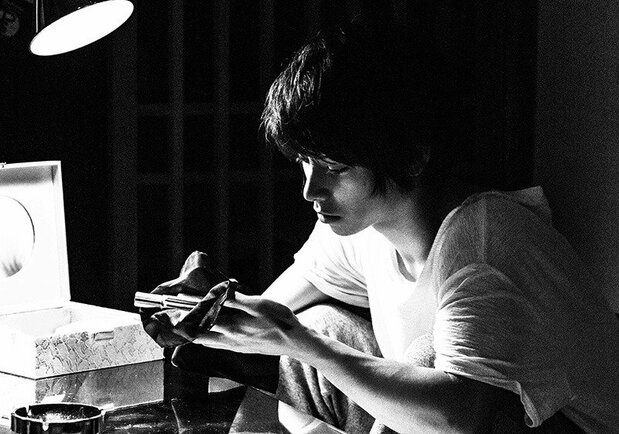 Still from The Gun. (© Yoshimoto Kōgyō)
DARTOIS-AKO No, actually! For The Gun, I was strictly attentive to the protagonist’s voice, but I had no particular image of his face.
NAKAMURA Me either. I want the reader to imagine it based on the depiction of his inner self.
DARTOIS-AKO When translating work by other writers, there are times when I have to keep the Japanese background in mind, but for most of your books that isn’t the case at all. You can read them without imagining a specific country. And that’s still the case even when Japanese names and places, proper nouns, turn up. The stories themselves could happen to anyone, anywhere, so it’s easy to identify with how the protagonists think and act. I think that, because the themes you deal with touch on the depths of human existence, they overcome any difference in cultural backgrounds or exoticism.
NAKAMURA Dostoyevsky’s stories are about Russia more than a hundred years ago, but they feel familiar. That’s the nature of literature.





 Read in other languages