


Writing that Evokes Visual Imagery
DARTOIS-AKO What I was most conscious of when translating The Gun, partly because I was translating it into French, was Albert Camus’ novel The Stranger.
NAKAMURA The Gun was my debut work, and the influence of The Stranger, especially on the style, was very strong. And it’s a unique kind of “translated” style, coming to Japanese from French. The opening lines, “Today, Mother died. Or maybe yesterday, I’m not sure” (Aujourd’hui, maman est morte. Ou peut-être hier, je ne sais pas.) The opening of The Gun, “Last night, I found a gun. Or you could say I stole it, I’m not really sure” (Kinō, watashi wa kenjū o hirotta. Arui wa nusunda no ka mo shirenai ga, watashi ni wa yoku wakaranai) have almost exactly the same rhythm. It’s very different after that, but how did you render this part in French?
DARTOIS-AKO Exactly the same.
NAKAMURA Really?!
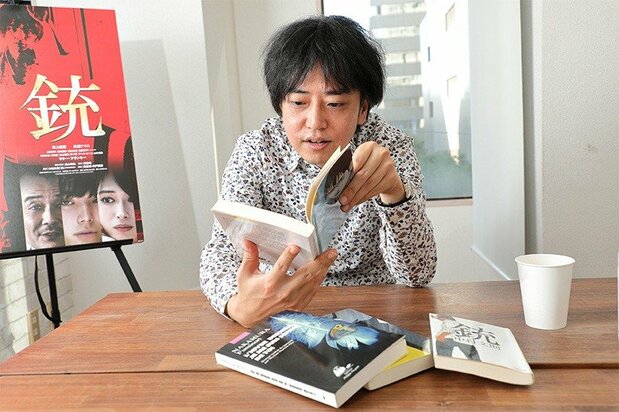
 Nakamura Fuminori reads the opening lines of Revolver, Myriam Dartois-Ako’s French translation of his novel The Gun.
DARTOIS-AKO The opening of the Japanese translation of The Stranger is faithful to the original, which makes it easy to put back into French. So the opening of the French translation of The Gun is the same as Camus too. This is immediately apparent to a French reader.
NAKAMURA I’m happy to hear that. Translated foreign literature was a strong influence on my debut as a writer. Dostoyevsky was also very influential, but for The Gun, Camus’ style is definitely in there. It’s interesting that the same is true of the French version now.
DARTOIS-AKO It went full circle! Of course, I was careful that the translation was not too dominated by Camus. It’s a very delicate balance. You could call a cinematic adaptation a kind of translation to film, too, couldn’t you? The question that always comes up is whether to read the book or see the film first, but as a translator I’m afraid of letting fixed images dominate my work, so I always start by reading the book.
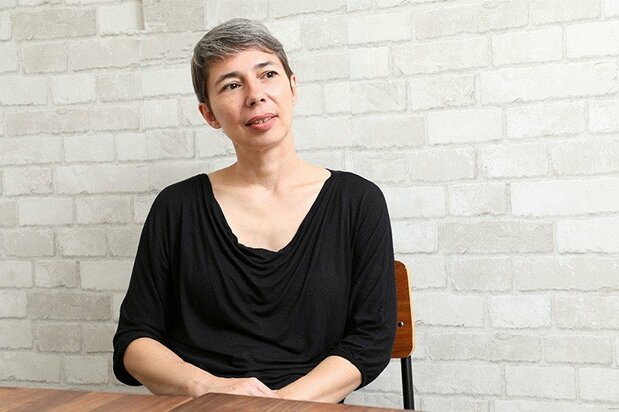
NAKAMURA That makes sense. At promotional events for the film I always say that it’s fine to start from either one, but as the author of course I do want people to read the book first. [Laughs]
DARTOIS-AKO As I recall, this isn’t the first time one of your books has been filmed, is it?
NAKAMURA It’s the fifth. There have been three this year alone. They make me do PR every time. [Laughs]
DARTOIS-AKO Why do you think so many films are made of your work?
NAKAMURA I just think there are a lot of daring adults in the film industry who like making films like that. [Laughs] I’m happy that Japan’s film industry has so many people who base their adaptations on a proper understanding of the world of the original.
DARTOIS-AKO There might be something about your work that makes it easy to film. Although you did say earlier that you don’t write with images in mind.
NAKAMURA People often tell me that images come to them as they read. If a character has a thought, it can add depth to also describe where they had it. Normally, background description in a novel slows things down, so in my case I try to be brief. Perhaps that makes people feel less like they’re reading and more like images are popping into their mind.
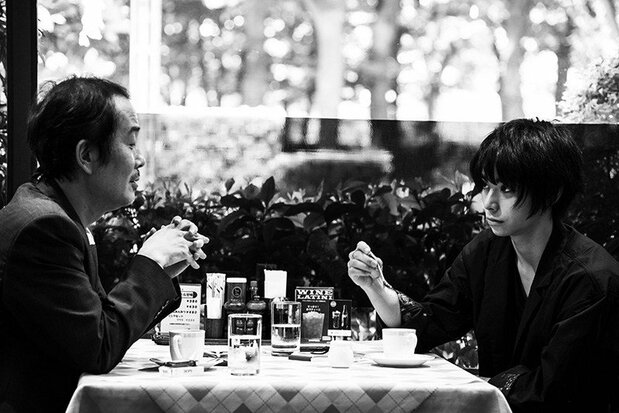 Lily Franky as a detective in The Gun. (© Yoshimoto Kōgyō)
DARTOIS-AKO I love the sharpness of your style. It’s a pleasure to translate. What I’m most careful about is keeping the translation pared down.
NAKAMURA I have a policy of not adding unnecessary sentences. I want to express as many things as I can in sentences that are as short as possible. I think of reading a book as exercise. You want to draw people in and keep them reading, and sluggish sentences get in the way. To write something on paper is very precious. You don’t want any waste in the sentences you put on that paper.



 Read in other languages