



Fresh Blood
The secret to Ama’s newfound success is the presence of young newcomers, as I mentioned at the outset. In addition to stirring themselves to action, residents took the bold step of ushering in fresh blood: during the 10 years since 2004, Ama saw 437 people (294 households) move in—a surprisingly high number when one considers that the island’s total population is just 2,300. Most of these I-turn residents have been in their twenties, thirties, or forties, and a high percentage have settled down. What prompted these young people to move to this remote island community?
Many of them were lured to Ama by a scheme under which “trainees” are provided with housing, a variety of local services, and a monthly stipend to develop attractive new products with the island’s resources. After their training period is over, they are free to either stay or move on. This respect for their freedom may be what sets Ama’s initiative apart from those of other municipalities, many of which have sought to entice newcomers with generous economic incentives while at the same time placing high expectations on their continued presence, which often creates a rift with old-time residents. Ama provides all the information and other support that newcomers need, but it also respects their free will and refrains from overly confining the activities of the new residents.
I-turn trainees who come up with promising ideas receive support for pilot implementation at publicly built, privately operated facilities. A number of the items that I described above were launched as an outgrowth of this trainee program. The fresh perspectives brought by the newcomers led to the “rediscovery” of highly attractive aspects of life in Ama that had been taken for granted by longtime residents, and the conscious, strategic effort made to market such treasures has probably been the biggest reason for Ama’s success to date.
Synthesis of New and Old
Ama cannot be said to have been truly revitalized, though, unless the newcomers become fully integrated into the community. Ama’s fourth comprehensive development plan was thus drafted with the aim of promoting exchange and achieving synthesis between the new and old residents. Many municipal development plans tend to be either just a dry list of numbers or a collection of rosy goals that is short on specifics. Ama’s plan, by contrast, is full of helpful illustrations and suggestions for concrete action.
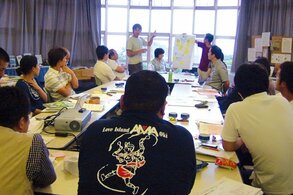
 Residents new and old, aged 15 to 70, actively took part in the drafting of Ama’s latest development plan, released together with the report “24 Proposals for Ama’s Future.” (Photo courtesy of Studio-L)
The theme of the plan was the pursuit of Ama’s happiness, and an attached report cites specific proposals for activities that can be undertaken by individual residents as well as by groups of 10 residents, 100 residents, and 1,000 residents. Examples include converting an unused nursery into a community hobby center and meeting space; thinning abandoned bamboo forests and using the felled trees to make charcoal; and building a “university” to preserve Ama’s traditional culture and hand down the skills and knowledge of local experts. These are accompanied by specific sources for further details and contact information for the relevant sections of the municipal government.
Four separate teams comprising residents and municipal officers were created to draft the plan over a period of a year. Community designer Yamazaki Ryō was invited to these meetings to offer advice. This intensive dialogue among the new and old residents no doubt made a significant contribution toward the building of an integrated community in Ama. The driving force for Ama’s growth may be such commitment to democratic self-determination, as exemplified in the residents’ own decision not to seek a merger with neighboring municipalities.
Spurred to action by a crisis that threatened its survival, the town of Ama has made remarkable efforts to determine its own future through dialogue among residents, the embracing of newcomers into the community, and the launching of new initiatives through a synthesis of the new and old. The model of regional revitalization in Ama offers many valuable hints for other communities throughout Japan confronting similar challenges.
(Originally published in Japanese on December 11, 2014. Photos courtesy of the Ama Town Office, unless otherwise noted.)










 Read in other languages