


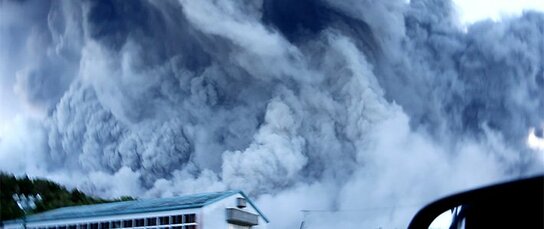
Earthquakes and Volcanoes
INTERVIEWER Do you think there’s some relationship between the Great East Japan Earthquake and the volcanic activity we’ve seen over the past couple of years?
NAKADAI know a lot of people out there believe there’s a direct connection, and perhaps there is. But the relationship between earthquakes and volcanic eruptions is by no means clear. There’s the well-known case of the 1707 eruption of Mount Fuji, which began just 49 days after the Hōei earthquake. But even there, we can’t prove a cause-and-effect relationship.
An earthquake could “shake up” the magma beneath a volcano, but so far, no one has documented an instance of an eruption triggered by that sort of shaking. Four years ago, after the Great East Japan Earthquake, a group of 20 active volcanoes centered on the Tōhoku region began registering seismic activity. But not one of those volcanoes has erupted. On March 15, an earthquake occurred directly beneath Mount Fuji, but there was no eruption. So my impression is that no amount of shaking is going to cause a volcano to erupt if it isn’t ready to erupt to begin with.
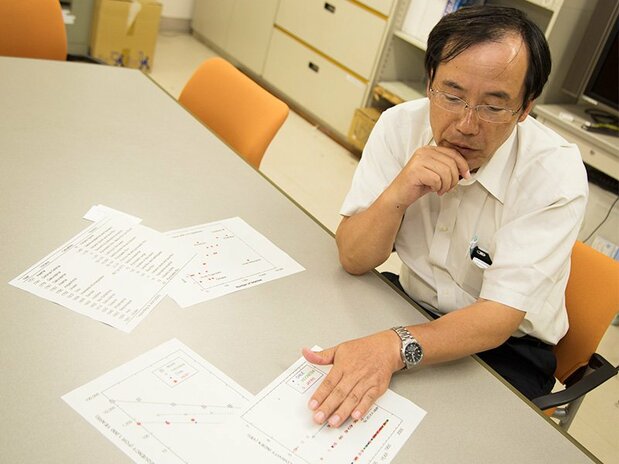

Another way in which an earthquake could theoretically trigger a volcanic eruption would be if a fault slip caused a readjustment of stresses that altered the pressure on a pocket of magma. Presumably, that could allow volatile material in the magma to separate and form bubbles, which could build up pressure and lead to an eruption. But any eruptions that might occur under this scenario should happen fairly quickly. Japan hardly experienced any eruptions for three years after the Tōhoku quake, and the volcanoes that have erupted since 2014, such as Mount Ontake, Nishinoshima, and Mount Aso, are pretty far from the epicenter of the Tōhoku earthquake. A fault slip of 50 meters or so off the northeast coast isn’t going to have a significant impact on crustal stresses as far away as Kyūshū.
I think earthquakes are seldom the cause of volcanic eruptions. The Hōei earthquake may have helped trigger the eruption of Mount Fuji, but only because Mount Fuji was ready to erupt anyway.
Impact of Major Volcanic Events in Japan (1700s to present)
| Year | Volcano | Deaths | Cause of deaths/damage |
|---|---|---|---|
| 1721 | Mount Asama | 15 | Ejected ash & rock |
| 1741 | Oshima-Ōshima | 1,467 | Debris avalanche, tsunami |
| 1779 | Sakurajima (An’ei eruption) | 150+ | Ejected ash & rock, lava flows |
| 1781 | Sakurajima | 15 | Tsunami |
| 1783 | Mount Asama (Tenmei eruption) | 1,151 | Pyroclastic flows, landslides, flooding of Agatsuma and Tone rivers |
| 1785 | Aogashima | 130–40 | More than one-third of island’s 327 inhabitants believed killed; remainder evacuated to Hachijōjima. |
| 1792 | Mount Unzen (“Shimabara taihen, Higo meiwaku”) | 15,000 | Earthquake, debris avalanche, tsunami |
| 1822 | Mount Usu | 103 | Pyroclastic flows |
| 1856 | Mount Hokkaido-Komagatake | 19–27 | Ejected ash & rock, pyroclastic flows |
| 1888 | Mount Bandai | 461(or 477) | Several villages buried by debris avalanche |
| 1900 | Mount Adatara | 72 | Eruption killing all workers at sulfur mine in summit crater |
| 1902 | Torishima (Izu Islands) | 125 | All of island’s inhabitants killed |
| 1914 | Sakurajima (Taishō eruption) | 58–59 | Eruption and earthquake |
| 1926 | Mount Tokachi | 144 | Lahar (volcanic mudflow) |
| 1940 | Miyakejima | 11 | Volcanic bombs, lava flows, etc. |
| 1952 | Bayonnaise Rocks | 31 | Submarine eruption at Myōjin Reef, killing everyone aboard a Japanese research vessel |
| 1958 | Mount Aso | 12 | Ejected ash & rock |
| 1991 | Mount Unzen | 43 | Pyroclastic flows |
| 2014 | Mount Ontake | 63 | Ejected ash & rock, pyroclastic flows, etc. |
Source: Japan Meteorological Agency, etc.
There are some volcanoes, like Miyakejima and Mount Usu, that simply have to erupt once every few decades. The magma accumulates, and when a certain amount builds up, the pressure pushes it out, causing an eruption. Some volcanoes erupt with that kind of regularity, and in those cases, once the magma has been released, no amount of shaking by an earthquake is going to trigger another eruption.
Mount Fuji hasn’t erupted for more than 300 years, so it’s difficult to know what sort of schedule it might be on. But there have been a number of great earthquakes affecting the region, and the only one that seems to have triggered an eruption was the Hōei earthquake. The Great Jōgan eruption of Mount Fuji [846–66], which produced the huge Aokigahara lava flow, seems to have been connected in some way with the 869 Sanriku earthquake, but the eruption occurred five years before the temblor.
The increase in the frequency of eruptions in the Kyūshū region might go back to the eruption of Mount Kirishima, which started a month and a half before the quake. Rather than posit a direct causal connection between the eruptions and the quake, I think it would make more sense to hypothesize that the tectonic plates under Japan are under particular stress, causing instability in the earth’s crust and making us prone to both earthquakes and eruptions.




 Read in other languages