



Racing Fans in the True Sense
INTERVIEWER You’ve raced two seasons since obtaining your all-year license. What is it like now that you live year-round in Japan?
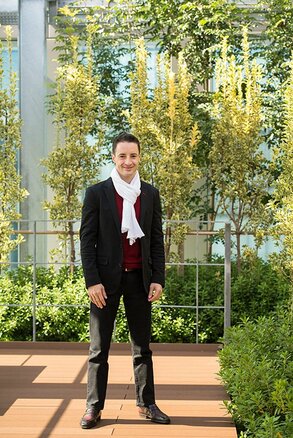

LEMAIRE I live in Kyoto, which is not far from the Rittō training center in Shiga Prefecture. There is also a French school in Kyoto, which is perfect because I have two kids. It’s such a beautiful city and very livable too. The style of Kyoto really suits me. It is more traditional than Tokyo and also has many old buildings and streetscapes. When I first started living in the city I mainly visited all of the famous tourist spots, but now I like to walk along the narrow backstreets and explore the small temples and parks that are less well known.
INTERVIEWER Have your two children [an 11-year-old son and 9-year-old daughter] adjusted to life in Japan?
LEMAIRE At first they complained and told me they wanted to go back to France, but I explained to them that this was our new home. Now they have made friends and gotten used to the cuisine. And unlike France, where I was racing every day, here I am able to spend time with them on weekdays. I can check their homework and see them off to school. So I feel much more relaxed and free here than I did in France. And even when someone recognizes me in the street, there are no worries. Japanese people always approach me with such kindness and respect. My family and I feel that Japan has really accepted us, and we are doing our best to reciprocate that feeling by respecting those around us and trying to assimilate. With this approach, things have been going very well, and we have nothing to complain about.
INTERVIEWER How long do you think you’ll stay in Japan?
LEMAIRE I’d like to stay here as long as I am physically able to work as a jockey and continue to win. More than a few jockeys these days continue racing until they are around 50. As for my plans after that, I’m not really sure. Perhaps I will be able to act as a sort of bridge between the horse racing worlds of Japan and France.

INTERVIEWER What do you think are the charms of Japanese horse racing from a global perspective?
LEMAIRE First of all, there are a lot more fans who go to the racetrack to watch the races. In France, it is more common to watch a race at home or in a nearby café, and there is a deep-rooted negative image of the racetrack as simply a place to gamble. By contrast, the JRA has strived to improve the image of horse racing in Japan to keep attracting new fans. The future of racing in Europe is worrisome since the fan base is so centered on older men. The fans in Japan, who include many younger women, are true supporters of the sport. They view racing as a genuine sport and they cheer on and show respect to the horses, jockeys, and trainers. The way Japanese people enjoy racing is just marvelous. I don’t think there is any other country where people enjoy racing so passionately and cheer us on so much. And for us as jockeys, we find great satisfaction in trying to meet the fans’ high expectations.
(Originally published in Japanese on December 23, 2016, based on an interview conducted in French. Photographs by Kodera Kei.)(*1) ^ “Classic” horseraces are tradition-rich Grade 1 races limited to outstanding three-year-olds. Japan’s five classic races are: Satsuki- shō, Ōka- shō, Yūshun Himba (Japanese Oaks), Tokyo Yūshun (Japan Derby), and Kikka- shō








 Read in other languages