


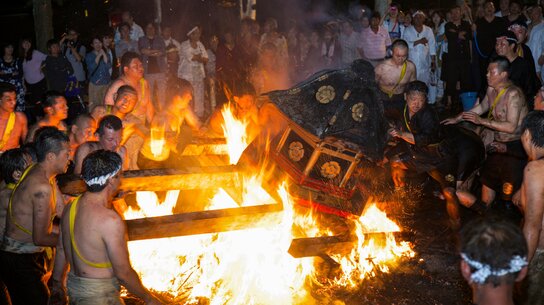
For this entry in our series on Japanese festivals in sets of three, we spotlight three fierce celebrations where mikoshi are dragged until they break—or hurled until they fall—all to honor and appease the deity.
The Rougher the Better
In a typical Japanese matsuri, a deity is carried from its shrine and placed in a mikoshi, often an elaborately decorated portable shrine. Borne by parishioners, the mikoshi makes the rounds of the neighborhood and receives the prayers of the people under the deity’s protection. But in some festivals, the mikoshi are treated with rough reverence. Here we introduce three prominent examples.
Ushitsu Abare Matsuri
(First Friday and Saturday of July, Noto-chō, Ishikawa Prefecture)
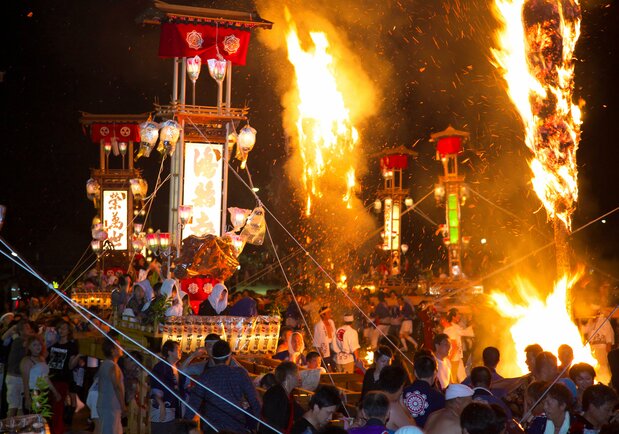
 Kiriko surround a 7-meter-tall torch. (© Haga Library)
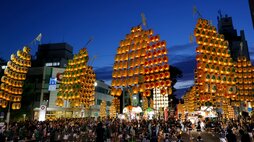
Every summer and autumn, over 200 communities across Noto Peninsula in Ishikawa Prefecture hold matsuri featuring towering kiriko, floats carrying elongated paper lanterns.
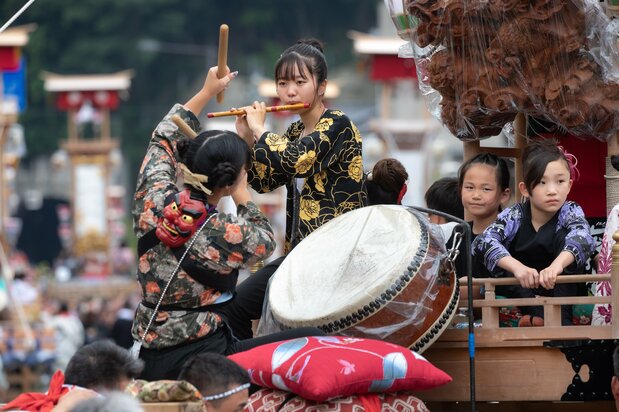 Women and children riding on a kiriko float provide musical accompaniment. (© Haga Library)
The first of these kiriko festivals is the Ushitsu Abare Matsuri, held in early July in the northern part of the peninsula.
The festival traces its origins to the seventeenth century, when an epidemic spread through the region. In response, a protective deity from Kyoto’s Gionsha (now Yasaka Shrine) was enshrined to ward off misfortune, and a festival was held to pray for relief. When the epidemic subsided, the villagers paraded kiriko through the community to express their gratitude.
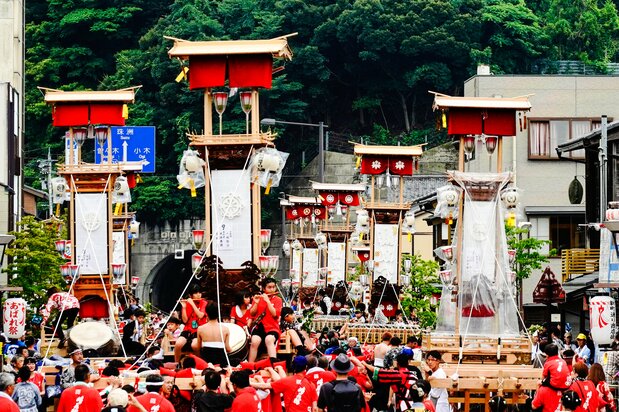 The kiriko can reach 7 meters in height. Before 1921, when power lines were installed, they were even taller. (© Haga Library)
The first day of the festival features a parade of 30 to 40 kiriko through the streets. On the second day, the floats precede the two mikoshi that are the main attraction of the event. The mikoshi carry the spirit of Susano-o, the most unruly and impetuous deity in the Shintō pantheon, and pass through the neighborhoods to drive away evil spirits.
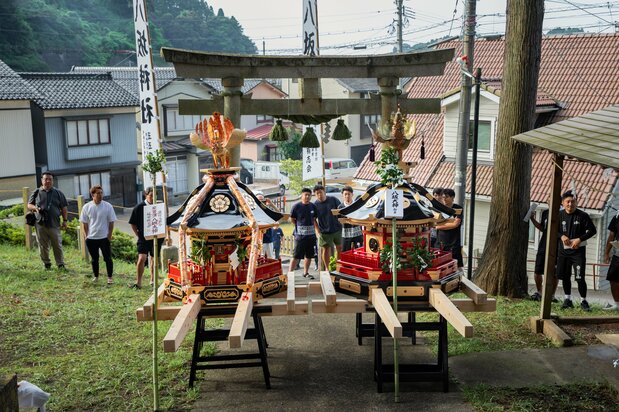 The deity Susano-o occupies these two mikoshi. (© Haga Library)
As the mikoshi are returned to the shrine, the bearers shout in unison and throw them to the ground, into a river, and even into the sea. It is believed that this rough treatment pleases the wild deity and increases his sacred power. All the while, the kiriko move around the battered mikoshi, adding to the festival’s energy.
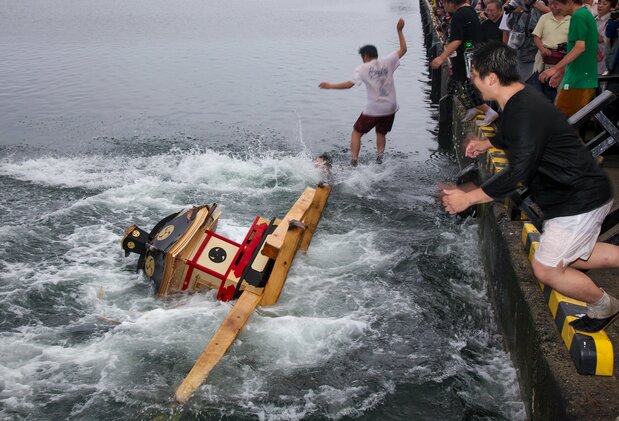 Rough handling pleases the deity. (© Haga Library)
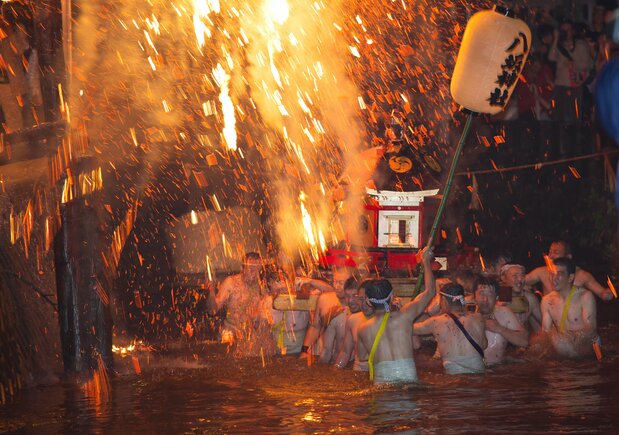 Into the water, into the flames! (© Haga Library)
The festival reaches its climax when sparks from the torch rain down on the bearers, and their excitement builds to a frenzy. They throw the mikoshi into the flames again and again, slam them to the ground, and climb atop them.
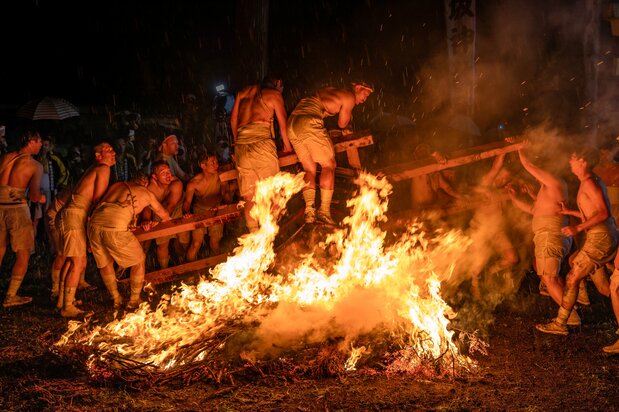 Oblivious to the heat, bearers expose the mikoshi to the bonfire. (© Haga Library)
By the time the mikoshi return to the shrine late at night, they are scorched and their roofs often broken. But no matter how battered the mikoshi are, they are painstakingly repaired every year, part by part. This perseverance is a symbol of the community’s resilience as it continues its path to recovery from the devastating January 1, 2024, Noto earthquake.
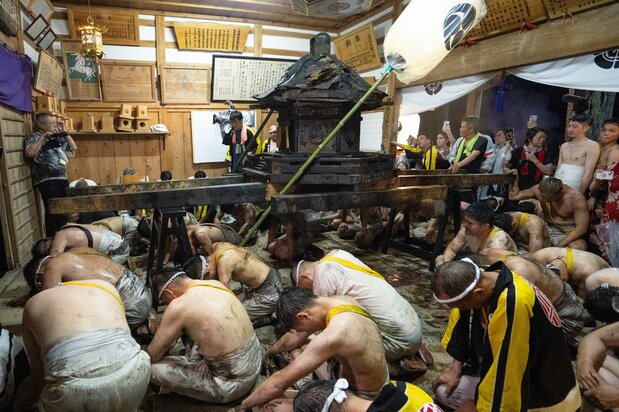 The mikoshi return to the shrine late at night. (© Haga Library)
Ohoshi Matsuri
(October 30, Mashiki, Nishihara, and Kikuyō, Kumamoto Prefecture)
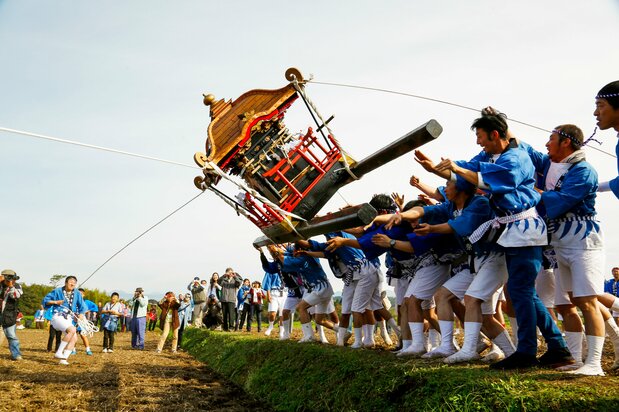 The mikoshi is thrown to the ground. (© Haga Library)
Twelve neighborhoods in Mashiki, Kikuyō, and Nishihara in the western foothills of Mount Aso take turns hosting the Ohoshi Matsuri, centered on Tsumori Shrine in the town of Mashiki. Each year, one community is designated to build a temporary repository for Ohoshi, the shrine’s object of worship. Transported in a mikoshi, the deity is carried to the next community. The route and destination of this unusual festival vary each year, with each community taking its turn once every 12 years.
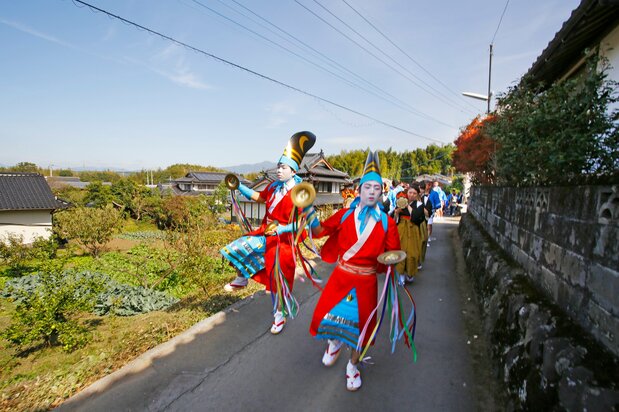 Everyone in the village turns out to give the deity a sendoff. (© Haga Library)
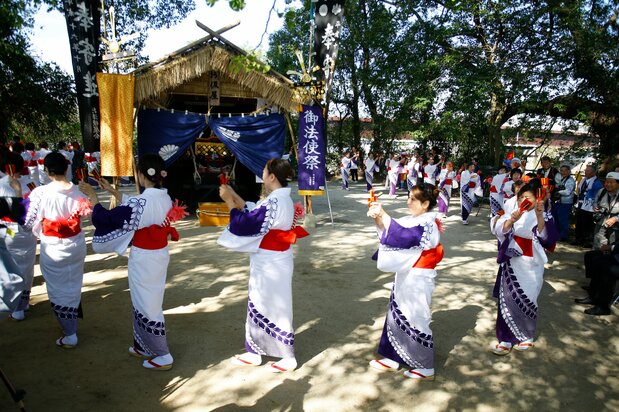 Dancing to welcome the deity to its new home for the year. (© Haga Library)
But what happens along the way is hardly typical. As the mikoshi makes its journey, bearers deliberately fling the mikoshi onto the road or into nearby fields.
The gūji, or shrine priest, then steps forward to inspect the damaged mikoshi, shouting “Mada, mada” (Not yet, not yet). The mikoshi is then thrown into the air two or three more times, crashing loudly to the ground each time. Finally, when the gūji declares “Kore made” (That’s enough!), the mikoshi is handed over to the next community.
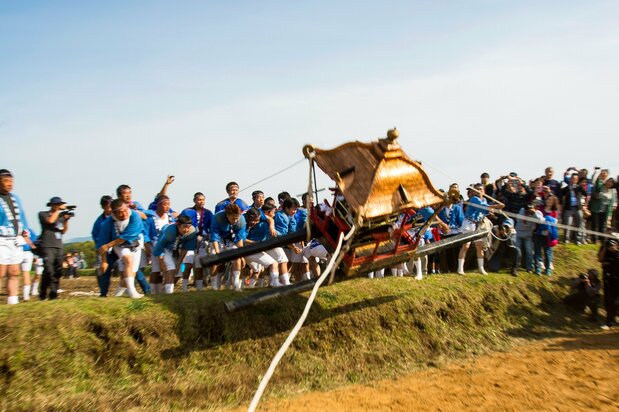 The mikoshi is thrown down multiple times during the procession. (© Haga Library)
The origins of the festival are unclear, but oral tradition holds that descended from the heavens near Tsumori Shrine and visited each of the 12 communities in turn, every second year. Today, the rough handling the mikoshi is said to express the villagers’ sorrow at the deity’s departure and the happiness the deity feels at their devotion. The cost of repairing the mikoshi, which can reach \1 million, is borne by the receiving community.
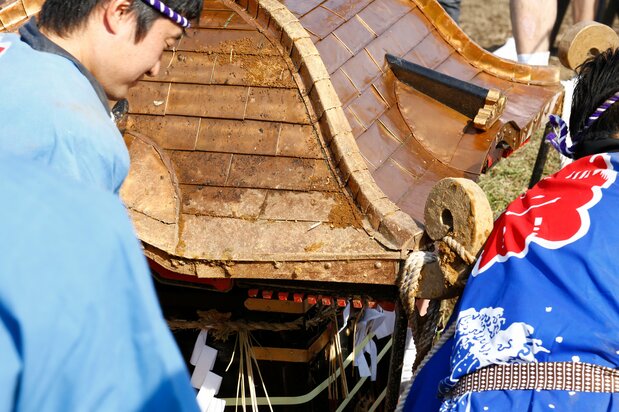 The more banged-up the mikoshi is, the greater pleasure it gives to the deity and the villagers. (© Haga Library)
Iba no Sakakudashi Matsuri
(May 4, Iba, Shiga Prefecture)
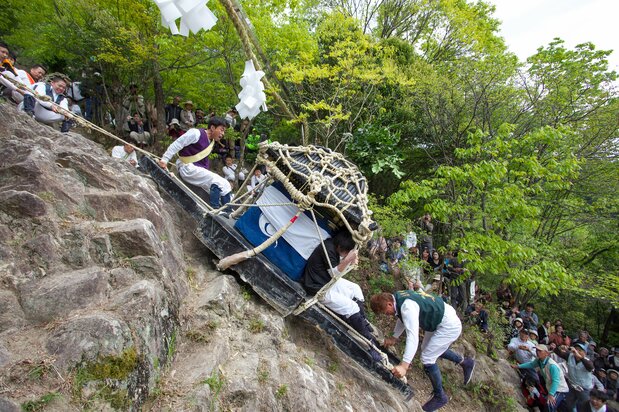 Ropes control the mikoshi’s descent down the steep slope. (© Haga Library)
The 432-meter-tall Mount Kinugasa rises above Iba, a neighborhood in the city of Higashi Ōmi on the eastern shore of Lake Biwa. Midway down the mountain stands Sanpōsan Shrine, known for the Sakakudashi, a dramatic 850-year-old ritual where a mikoshi is slid down a steep, rocky slope.
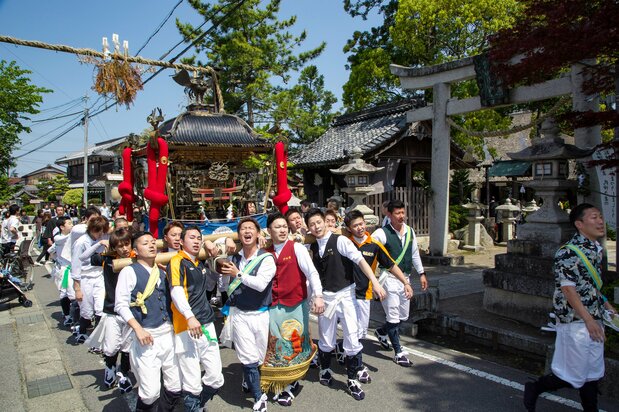 The mikoshi weighs over 500 kilograms. (© Haga Library)
From the torii gate at the foot of the slope, the shrine’s approach appears like a cliff that can only be climbed on all fours. The path to the main shrine stretches 503 meters with a vertical difference of 175 meters. The mikoshi is hauled up the day before the festival and waits at the top to begin its perilous descent.
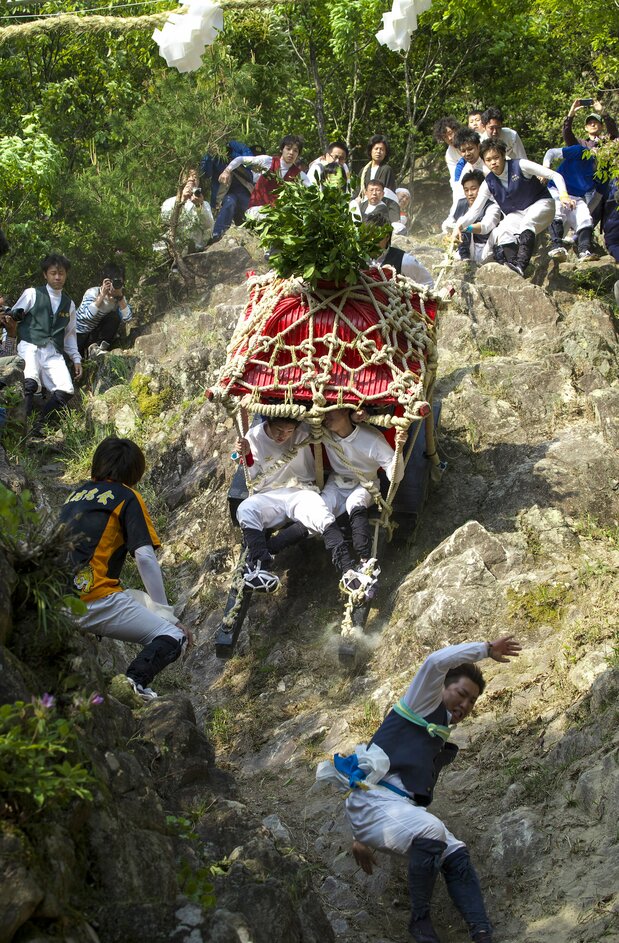 This 60-degree incline is the most challenging spot. (© Haga Library)
On festival day, a teenage boy rides in front of the mikoshi as it is slid down the slope. There is a 6-meter stretch with an especially steep incline, and the crew must tightly hold on to the rope to prevent the mikoshi from overturning. When the mikoshi reaches the torii at the foot of the hill, the waiting crowd erupts into cheers for the courage of the crew young participants.
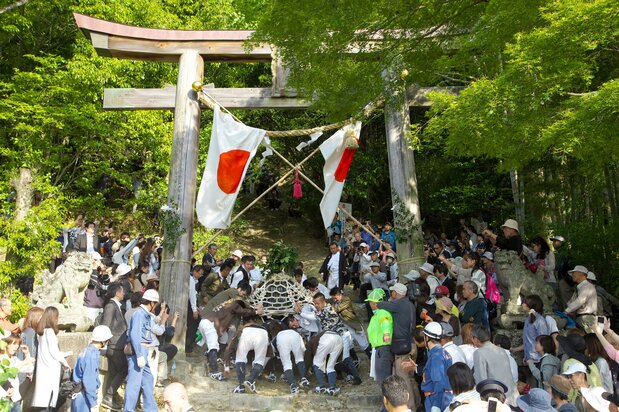 The cheering crowd greets the safe arrival of the mikoshi. (© Haga Library)
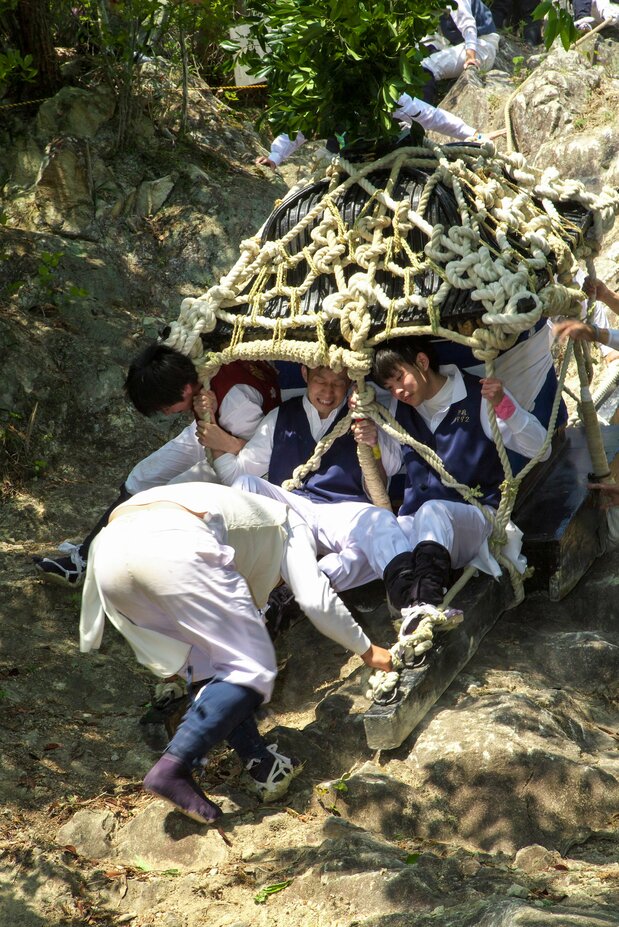 The festival is also a coming-of-age event. (© Haga Library)
(Originally published in Japanese. Dates given are those on which the festivals are usually held. Banner photo: The mikoshi is burned in flames in Ishikawa’s Ushitsu Abare Matsuri. © Haga Library.)



 Read in other languages