


What Caused Public Finances to Deteriorate?
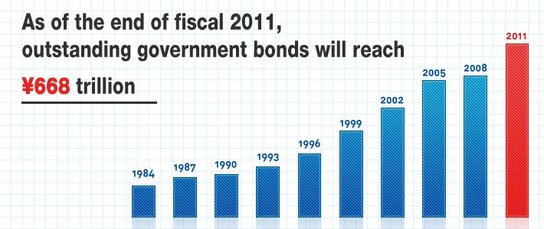
The fiscal 2010 edition of the government’s Annual Report on the Japanese Economy and Public Finance identifies three causes of the mounting fiscal deficits: (1) Revenue contracted because the nominal growth rate slowed down under unfavorable economic conditions; (2) Interest payments on public debts increased; (3) The government followed a course of lowering taxes and stepping up public investment for policy reasons. (*3)
During the 1990s, the fiscal deficit expanded because of policy factors and economic stagnation. Government spending was boosted to head off a recession when the bubble economy collapsed at the start of the decade. The deficit also grew larger in and after 1999, when business fell into a slump. The government switched course to scaling back public investment after the turn of the century, but social security outlays climbed at a steadily accelerating pace. Meanwhile, the sluggish growth of corporate taxes, which respond sensitively to the business climate, has been a major factor in the shortfalls on the revenue side. In fiscal 2008 even revenue from the consumption tax and other indirect levies, which are supposed to be fairly impervious to swings in the business cycle, fell sharply.
Comparative international data collected by the Organization for Economic Cooperation and Development reveal that Japan’s general government gross financial liabilities, which include long-term government bonds and debts in social security funds, grew larger than GDP in 1997 and went on expanding thereafter, reaching more than twice the size of GDP in 2011. At that level, they are more than double the government financial liabilities in the United States (98.5% of GDP) and Britain (88.6%), and they are considerably larger even than Italy’s (132.7%) (figure 4). (*4)
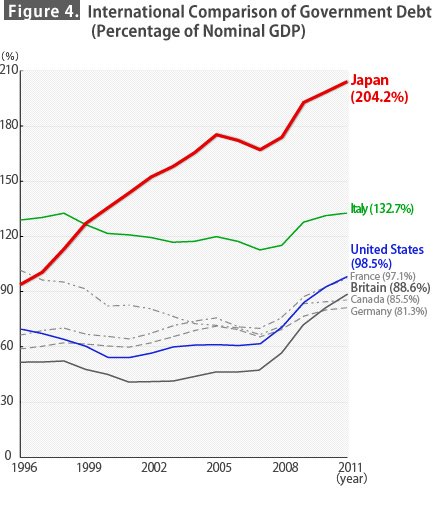

Source: Ministry of Finance data and OECD Economic Outlook 88 database.
In the United States the administration of President Barack Obama has embarked on a major effort to reduce the red ink in the budget, while Britain under Prime Minister David Cameron is making deep cuts in government spending and imposing a heavier tax load on the public. Japan’s “national burden ratio” (total taxes and social security contributions as a percentage of national income) stood at 40.6% in fiscal 2008, with taxes at 24.3% and social security contributions at 16.3%. This is on the low side among the members of the OECD, well below the figures for Sweden (59.0%) and Germany (52.0%) (figure 5). (*5)
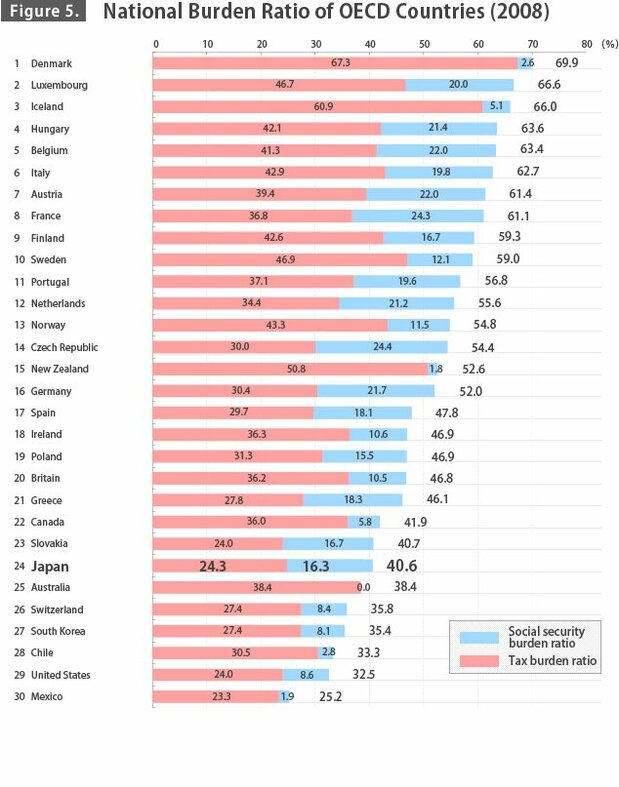
Source: Ministry of Finance data.
Some economists argue that the proper way to compare countries is to look not at gross liabilities but at net liabilities, or in other words, liabilities minus assets. I have my doubts, because some of the assets are items like pension reserves whose future use has already been determined. Even on a net basis, however, Japan’s government financial liabilities stood at 120.4% of GDP in fiscal 2011, higher than the liabilities of any other developed country.












 Read in other languages