


In November last year, the Chinese government reacted with furious rhetoric and punishing actions to Prime Minister Takaichi Sanae’s suggestion—made in response to questioning in a Diet committee meeting—that a crisis in the Taiwan Strait might qualify as a “survival-threatening situation” for Japan. Moreover, since then China has escalated its verbal and economic retaliation while taking every opportunity to enlist Russia and others as confederates in its campaign.
In November last year, the Chinese government reacted with furious rhetoric and punishing actions to Prime Minister Takaichi Sanae’s suggestion—made in response to questioning in a Diet committee meeting—that a crisis in the Taiwan Strait might qualify as a “survival-threatening situation” for Japan. Moreover, since then China has escalated its verbal and economic retaliation while taking every opportunity to enlist Russia and others as confederates in its campaign.
China’s anti-Japanese offensive and its recruitment of Russia and other collaborators actually began well before Takaichi made the above-mentioned remarks. But those comments gave China a pretext for ramping up and broadening its strategy. In the following, I analyze China and Russia’s joint effort to weaponize history in the context of the latest shift in Sino-Russian relations.
Russia’s Place in China’s New Order
Nowadays, China and Russia are often described as allies, but Chinese foreign policy stresses independence and nonalignment. Officially, Beijing regards Russia not as an ally but as China’s highest-ranking partner.
Since President Xi Jinping came to power, China has made clear its intent to build a new international order to replace the existing Western-led system. As Beijing describes it, the order it envisions is characterized by a new model of international relations. The basic idea is to cultivate partnerships grounded in mutually beneficial economic ties, leading to the emergence of a community of nations bound by a “shared destiny.”
As Beijing builds such partnerships, it labels them in a manner that defines their position within a hierarchy of diplomatic ties. The relationship with Russia is called a “comprehensive strategic partnership of coordination for a new era,” which essentially places it at the apex of the hierarchy. This tells us that Russia occupies an extremely important place in the international order envisioned by China.
Russia also occupies an important place in China’s strategy for realizing two ambitious national goals: to “move to the center of the world stage” and to “realize the nation’s dream,” both by 2049. Achieving these goals means prevailing over the so-called Western powers, led by the United States, and from this viewpoint, Russia is China’s most promising partner. A strong Russia is especially desirable from the standpoint of countering the military clout of the North Atlantic Treaty Organization.
China’s Anti-Western Ideology
Currently, America’s strategic worldview pivots on the idea of China, Russia, North Korea, and Iran as the adversaries of the developed world. China tends to emphasize the conflict between the industrially developed “Western” bloc (which includes Japan) and the rest of the world. Thus, the quality of being non-Western is fundamental to China’s vision of a new model of international relations. China and Russia are regarded as the two non-developed countries best equipped to lead the resistance against the developed Western bloc.
China’s attitude toward Russia was summed up by Foreign Minister Wang Yi at a news conference held on March 7, 2025, during the third session of the fourteenth National People’s Congress. "No matter how the international environment changes,” he declared, “the historical logic of China-Russia friendship remains unchanged, and the intrinsic driving force does not diminish." He called Sino-Russian relations a prime example of the new model of great-power relations sought by China, being founded on the principles of "non-alignment, non-confrontation, and non-targeting of third parties." (President Xi had used the phrase "new model of great-power relations" a decade earlier, when he was courting the Obama administration, to convey the idea of bilateral ties grounded in mutual respect for one another’s core interests and avoidance of conflict. While the catch-phrase is no longer applied to the United States, it appears to have been revived in the context of Sino-Russian ties.)
Against the background of the eightieth anniversary of the end of World War II, Wang stressed China and Russia’s shared history of courage and sacrifice on the battlefields of Asia and Europe, respectively. Then he said that the two countries would use this milestone as an opportunity to “promote the correct view of World War II history, defend the achievements of our victory in World War II, maintain the international system with the United Nations at its core, and promote the development of the international order in a more just and reasonable direction.” In other words, China and Russia, having affirmed the significance of their joint struggle in World War II, vowed to work together to shape the current international order. Thus, the joint Sino-Russian campaign to shape the historical narrative is closely linked to China’s plans for a new international order.
Sino-Russian Collaboration in 2024 and 2025
Over the past few years, China and Russia have both found themselves in serious need of a friend. The COVID-19 pandemic and Beijing’s response to the outbreak exposed China’s leaders to a torrent of international criticism, and Russia’s invasion of Ukraine in 2022 drew worldwide condemnation. Attitudes toward Beijing hardened, especially among the Western powers, as it became apparent that Chinese assistance was enabling Russia to sustain its combat capability despite economic sanctions. Faced with this hostile climate, China and Russia have bolstered bilateral ties and stepped up their criticism of the Western bloc.
In 2024, China and Russia celebrated 75 years of diplomatic ties. In May that year, during President Vladimir Putin’s state visit to China, he and Xi signed a Joint Statement on Deepening the China-Russia Comprehensive Strategic Partnership of Coordination for the New Era. This unusually long declaration revealed the determination of Russia (embroiled in the ongoing war in Ukraine) and China (still recovering from the aftereffects of the pandemic) to affirm and support one another’s policies.
The May 2024 statement included a long paragraph linking the two countries’ role in World War II to the postwar global order:
“The parties will continue to firmly defend the outcomes of the Second World War and the postwar world order enshrined in the Charter of the United Nations and oppose the denial, distortion, and falsification of the history of the Second World War. They point out the need to ensure correct historical education, to protect the world’s anti-fascist memorials and to keep them safe from desecration or destruction, and they strongly condemn the glorification of Nazism and militarism and attempts to revive them. In 2025, they plan to celebrate the eightieth anniversary of the victory in the Chinese People’s War of Resistance against Japanese Aggression and the Soviet Union’s Great Patriotic War and to jointly promoting a correct historical perspective on the Second World War.”
Already at this stage Russia is highlighting its victory over Nazism and China its defeat of militarism. As yet, however, there is no explicit language linking the militarism of the past to Japan’s present-day leadership or policies.
That changed in May 2025, when Xi Jinping visited Moscow during Russia’s celebration of the eightieth anniversary of its victory in World War II. A joint statement issued on May 8 refers specifically and repeatedly to the defeat of “Japanese militarism and Nazi Germany.” It also affirms China and Russia’s commitment to fighting the rise of neo-Nazism and the revival of militarism. In addition, the two sides agree that “the Japanese government should draw lessons from the brutal crimes it committed in history, be prudent in words and deeds on historical issues such as Yasukuni Shrine, and completely cut ties with the militarism that once brought disaster to the people of the world and Japan itself.” They also vow to “further explore and study the evidence and historical materials of the crimes committed by Nazi Germany and Japanese militarism during World War II.”
As the foregoing makes clear, months before Takaichi’s remarks last November, China and Russia had officially agreed to collaborate on historical messaging in conjunction with the eightieth anniversary of the end of World War II, with Japan as a prime target.
Sharpening Its Knives
In the second half of 2025, China sharpened the language of its “history offensive” with a focus on Japan. Among other things, it vigorously rejected the legality of the San Francisco Peace Treaty and its disposition of Okinawa as well as Taiwan. Moreover, such claims were advanced to justify China’s surging naval activity around the First Island Chain (although its naval expansion was already extending past the First Island Chain into the Second Island Chain and parts of the Western and South Pacific).
Beginning around the start of 2026, in the wake of Takaichi’s controversial remarks, China’s rhetorical assault on Japan metamorphosed into an all-out propaganda war. The Renmin Ribao (People’s Daily) began carrying articles accusing Japan of “neo-militarism.” Soon the word crept into Chinese Foreign Ministry’s briefings, gradually taking its place in the vocabulary of official discourse.
The May 2026 China-Russia Joint Statement on Further Strengthening Comprehensive Strategic Coordination and Deepening Good-Neighborly and Friendly Cooperation, released during Putin’s most recent visit to China, devotes a lengthy section to criticism of Japan. It claims that Japan’s “remilitarization” is accelerating and calls it a threat to the peace and stability of the region. It goes on to state that 2026 marks the eightieth anniversary of the Tokyo Trial (International Military Tribunal for the Far East), which brought to light the scale and horror of the crimes committed by Japanese militarists against civilians. It then urges the Japanese government to learn from the mistakes of the past, reflecting on its own history of aggression, and to resist the forces of neo-militarism and remilitarization, cognizant of the disaster that militarism wreaked on the peoples of the world and on Japan itself.
As I have explained, China and Russia have joined forces to influence historical discourse in a manner that buttresses their own strategic policies. Russia’s narrative deals primarily with Germany, while China’s focuses on Japan, but the two governments have supported one another in their weaponization of history. This trend was in evidence before Takaichi’s remarks, but it has intensified and accelerated since then.
Taking the History Wars to the UN and the US
Evidence of such coordination is not limited to the joint statements released by the leaders of China and Russia at their bilateral summits. For one thing, Beijing has been working surreptitiously to expand the reach of its anti-Japanese rhetoric by incorporating phrases like “opposition to militarism” into the joint statements it issues with other governments. In addition, China, supported by Russia, has intensified its criticism of Japan at international forums attended by representatives from all over the world. A prime example was the September 2026 meeting of the UN General Assembly. On September 28, China’s permanent representative to the United Nations made use of the general debate to issue a sharp rebuke of Japan, citing its past militarism and accusing it of “remilitarization.” In his own speech before the General Assembly, Russian Foreign Minister Sergey Lavrov aligned his rhetoric to Beijing’s, emphasizing past Japanese militarism and asserting that Tokyo was now “on the path of remilitarization.”
This is the context in which we should view remarks made by Xi Jinping during his high-profile visit to Washington this past September, in which he repeatedly stressed the idea that the United States and China had fought side by side “against fascist aggression” and “Japanese militarism.” The problem with these statements is not a matter of inaccuracy. It is a fact that America and China (then the Republic of China under Nationalist, or Kuomintang, rule) were allies during World War II. But repeated references to historical events by officials of the Xi regime generally have a purpose beyond the transmission of factual information. Their aim is to foster discourse and shape public opinion in a manner congenial to China’s global strategy, including its goal of reshaping the international order. Xi’s recent attempt to build a sense of historical solidarity with the United States could well be linked to this larger strategy.
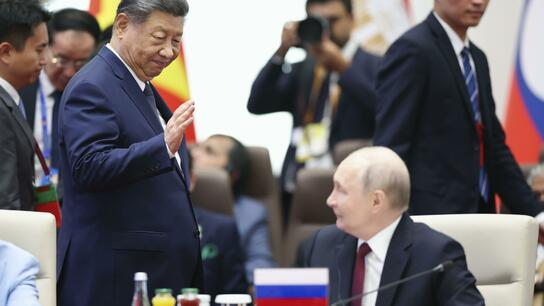
(Originally published in Japanese. Banner photo: Chinese President Xi Jinping, left, and Russian President Vladimir Putin at the Shanghai Cooperation Organization summit in Bishkek, Kyrgyzstan, September 1, 2026. © Tass/Kyōdō.)




 Read in other languages