


Hatsukaichi, Hiroshima Pref., Oct. 28 (Jiji Press)--Excavation is underway at an archaeological site in a western Japan city, with both researchers and local residents anxious to unravel the mystery of when and how humans arrived in the Japanese archipelago.
The Kanmuri ruins in the Yoshiwa district in Hatsukaichi, Hiroshima Prefecture, generated excitement in 2024 when a stone tool that is likely to be the oldest such artifact in Japan was discovered at the site.
Sadakatsu Kunitake, 51, chief researcher at the Nara National Research Institute for Cultural Properties, which is spearheading the excavation, said that the Kanmuri ruins are "the finest archaeological site in Japan that connects (the country) to the world."
"We hope to delve into the history of humans in the Japanese archipelago," he said.
Homo sapiens are believed to have first appeared in Africa 200,000 to 300,000 years ago, and then moved across Eurasia and gradually spread throughout the world.
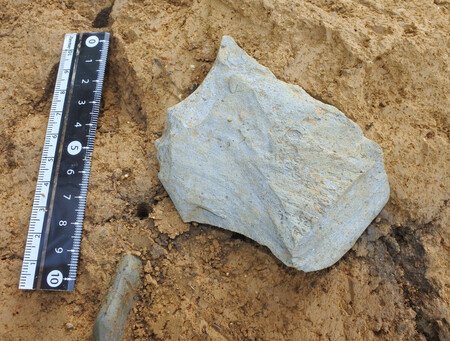
 A stone tool point believed to be from 42,300 years ago excavated from the Kanmuri ruins in the city of Hatsukaichi, Hiroshima Prefecture, western Japan, pictured in September 2024 (Courtesy of Sadakatsu Kunitake, chief researcher at the Nara National Research Institute for Cultural Properties)
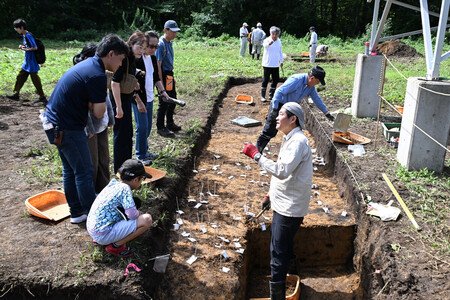 People listen to researcher Sadakatsu Kunitake (front right) at the Kanmuri ruins in the city of Hatsukaichi, Hiroshima Prefecture, western Japan, on Sept. 5.
 "Dorayaki" pancakes featuring a character inspired by stone tools excavated from the Kanmuri ruins in the city of Hatsukaichi, Hiroshima Prefecture, western Japan, photographed Sept. 5
[Copyright The Jiji Press, Ltd.]








 Read in other languages