


Tokyo, Oct. 29 (Jiji Press)--A group of Japanese researchers have uncovered the characteristics of archaea, single-celled micro-organisms, that are most closely related to eukaryotes, organisms including plants and animals, from a methane production well in Chiba Prefecture, near Tokyo.
The group, including senior researchers Hiroyuki Imachi and Masaru Nobu of the Japan Agency for Marine-Earth Science and Technology, published their findings in the online edition of the British journal Nature dated Wednesday.
The group isolated and cultivated two archaea strains, which have spherical bodies and numerous long, slender protrusions that allow them to move.
The archaea are believed to obtain nutrients by absorbing and breaking down proteins found in the remains and secretions of other micro-organisms. The team also found that the strains use their protrusions to capture methanogens, another type of archaea, and exchange substances with them in a symbiotic relationship.
Eukaryotic cells have complex structures, including a nucleus containing DNA and mitochondria, which produce molecules that provide energy. Mitochondria are widely believed to have evolved from independent organisms taken inside archaea long ago, eventually contributing to the emergence of eukaryotes. The latest findings are expected to shed light on this evolutionary process.
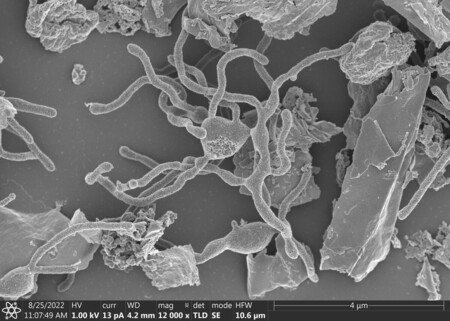
 An image of an archaeon (center) in a strain closely related to eukaryotes, with multiple protrusions extending from the body, taken by a scanning electron microscope (Courtesy of JAMSTEC)
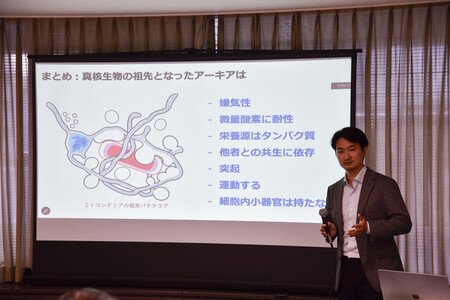 JAMSTEC researcher Hiroyuki Imachi explains the characteristics of archaea strains closely related to eukaryotes in Tokyo on Wednesday.
[Copyright The Jiji Press, Ltd.]






 Read in other languages