Experiencing the Art of “Gyotaku” Fish Prints
Guideto Japan
Culture Art- English
- 日本語
- 简体字
- 繁體字
- Français
- Español
- العربية
- Русский
Born from Samurai Discipline
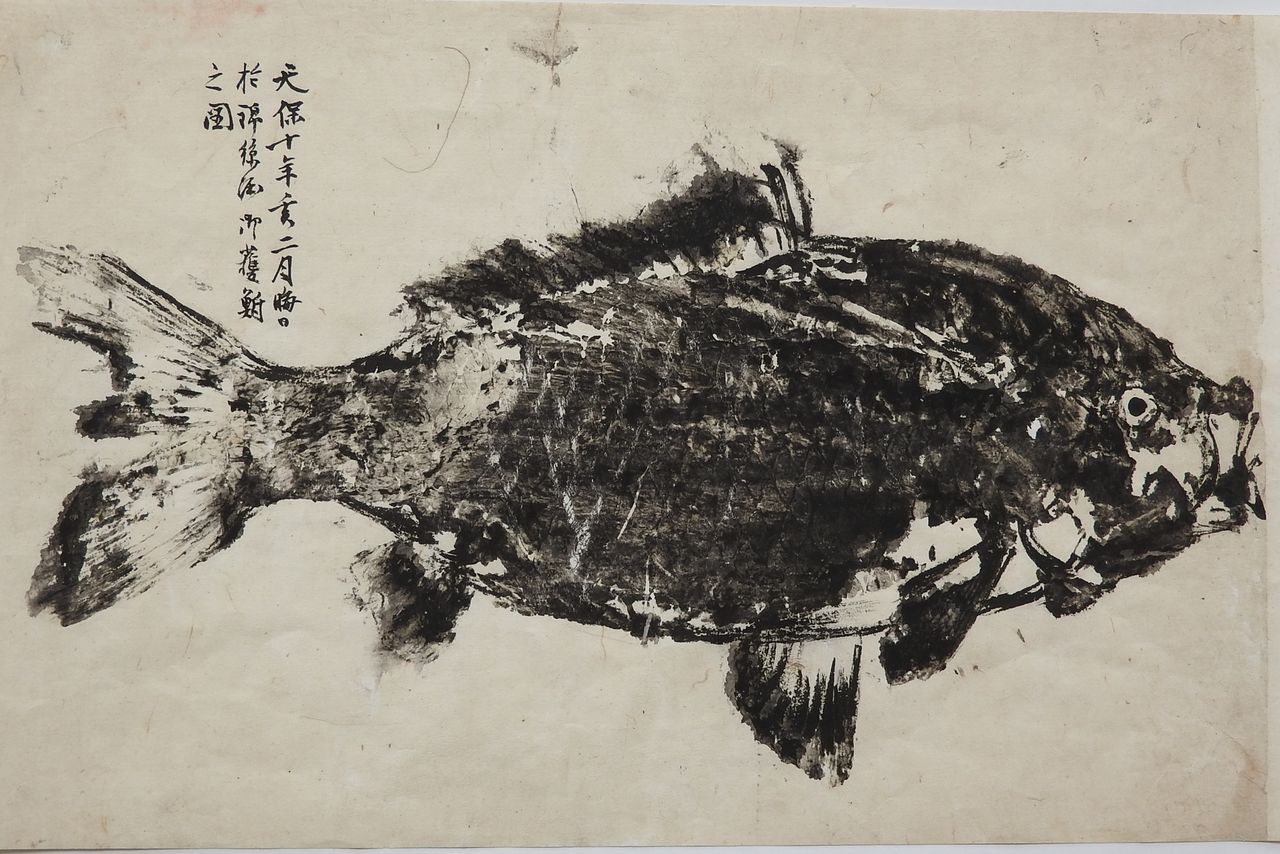
This gyotaku is entitled Kinshibori no funa (Crucian Carp from the Kinshibori Canal). It has been dated to 1839, making it the oldest know gyotaku in Japan. (Courtesy Tsuruoka City Museum of Local History)
The Shōnai region, particularly around the city of Tsuruoka, Yamagata Prefecture, is considered the birthplace of gyotaku.
During the Edo Period (1603–1868), the Shōnai domain encouraged its samurai to fish from the rocky shore as a way of training body and mind. The distance from the castle town of Tsuruoka to fishing spots on the Shōnai coast ranged from 12 to 20 kilometers. Samurai would take up their long poles and set out on mountain paths before dawn. They would stand at the side of the rough Sea of Japan and wait motionless for a fish to bite, hoping for a chance to test their strength against a big one. This approach to fishing required not only physical stamina but mental fortitude and quick judgment. It was something akin to martial arts training.
The samurai called this demanding pursuit shōbu, or “a contest,” and they used gyotaku to leave records of their victories, like we would take photographs or file records today. The oldest existing gyotaku in Japan is called Kinshibori no funa. It is a print of a funa, or crucian carp, caught in the Kinshibori canal in Edo, now Tokyo, by the ninth lord of the Shōnai Domain, Sakai Tadaaki. The print is now kept in the Tsuruoka City Museum of Local History.
From Mere Records to Colorful Artworks
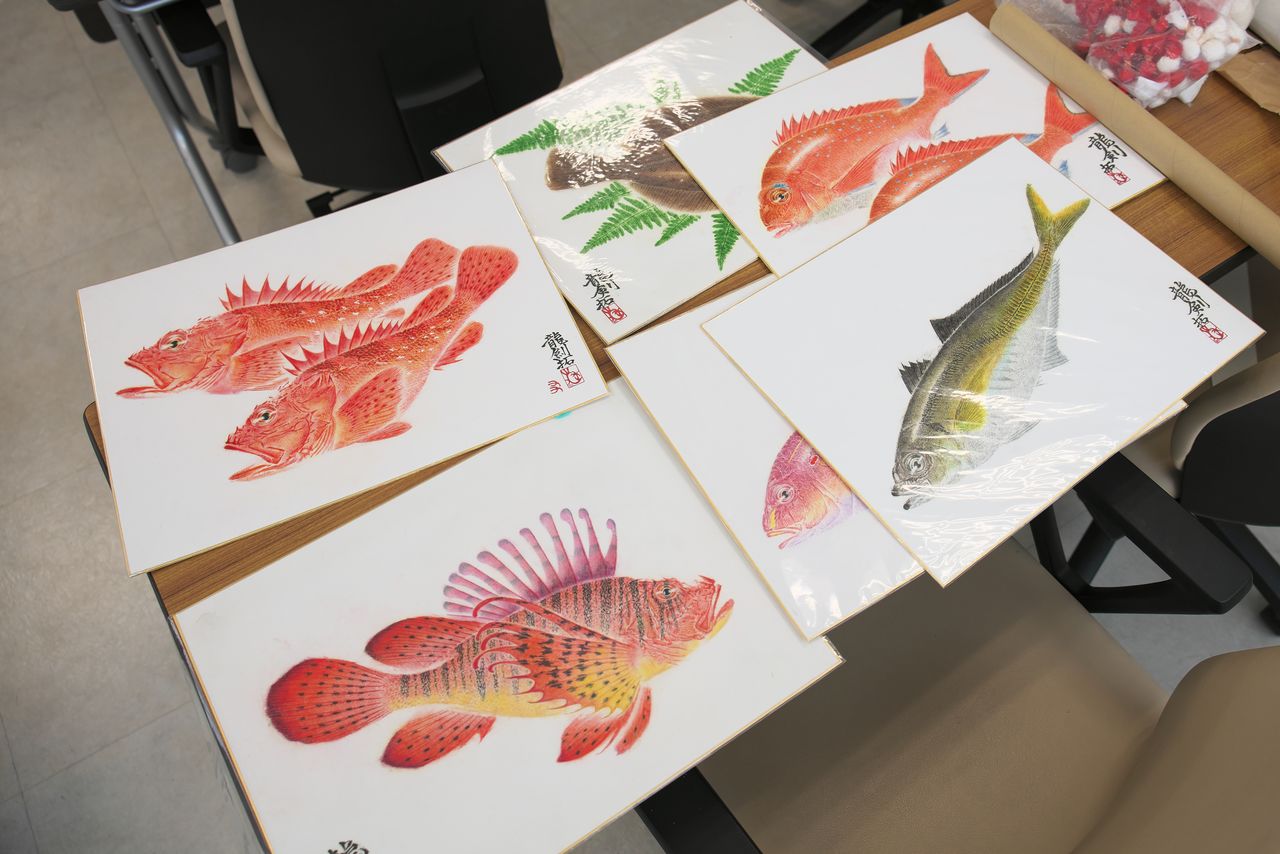
Artistic gyotaku by members of the Tatsu no Ko Kai. (© Nomura Kazuyuki)
The old-fashioned black-ink gyotaku offers a clear record of a fish’s contours and size. But after the spread of photography in the postwar period, the gyotaku world began to see a movement toward expressing the fish’s living color and beauty. These prints use paints to produce a colorful rendition known in Japanese as shikisai bijutsu gyotaku, or “colorful art fish prints.”
Art gyotaku prints are not limited to a single fish at a time. Artists can arrange multiple fish in a single print and add leaves or water plants, and use gradations of color to represent light and depth. They are works of graphic art in which fish become one element of many, as opposed to a simple record or proof of a catch.
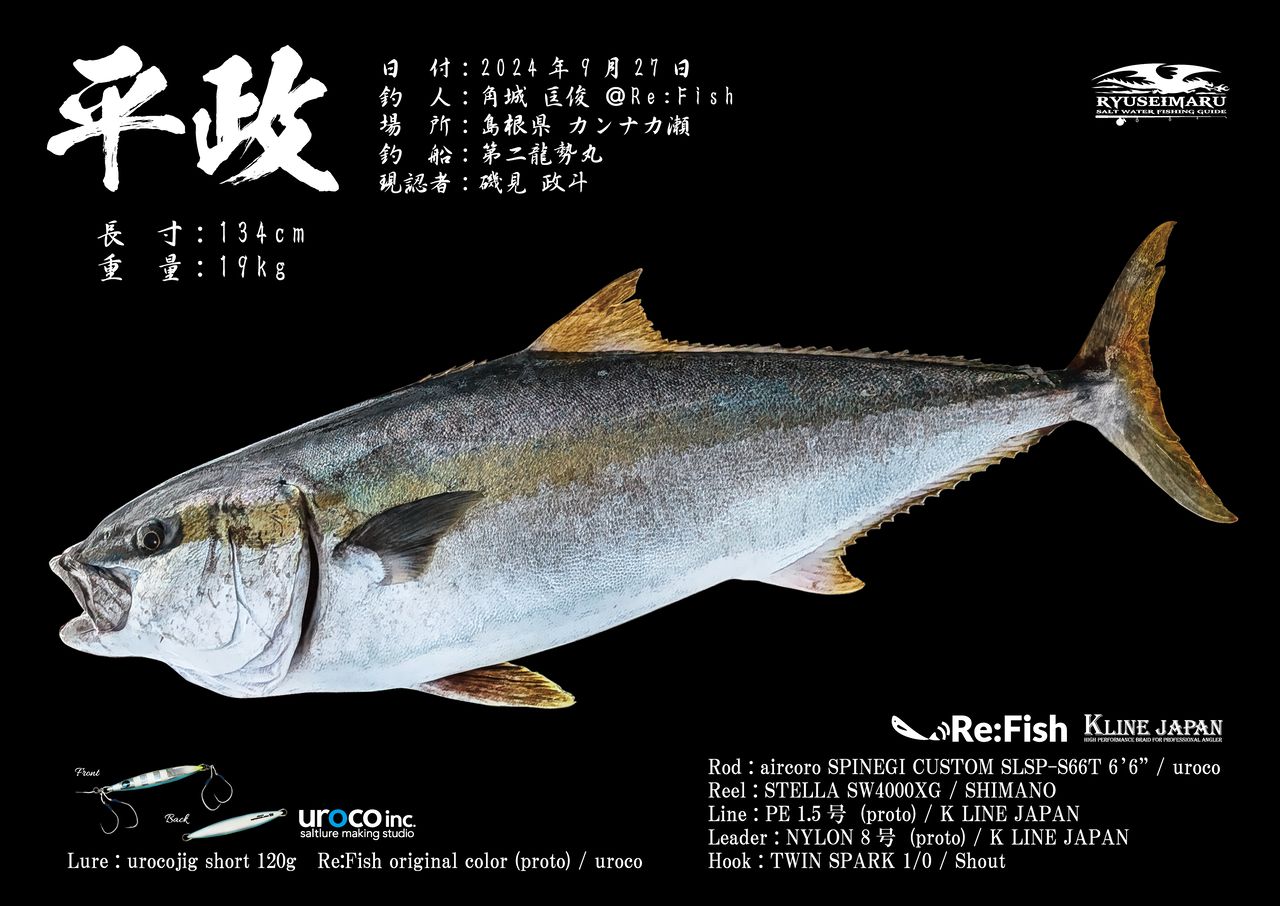
A digital gyotaku that records an image of the fish along with its length, the day it was caught, the tackle used, and other data. (Courtesy Re:Fish)
But of course, different people want different things from gyotaku. There are plenty of anglers who still think of the prints as a way to attractively record the size of their catch. That is where the modern method of digital gyotaku come into play.
It can process digital photographs containing fish into an enlarged image of the fish with its type, length, weight, date of catch, location, and the name of the angler. It works even when the fish was released instead of kept, or when only an old photo remains. It isn’t a direct print from the actual fish, but it uses digital techniques to create a similar tangible reminder of that one you still think about.
Tapping the Colors
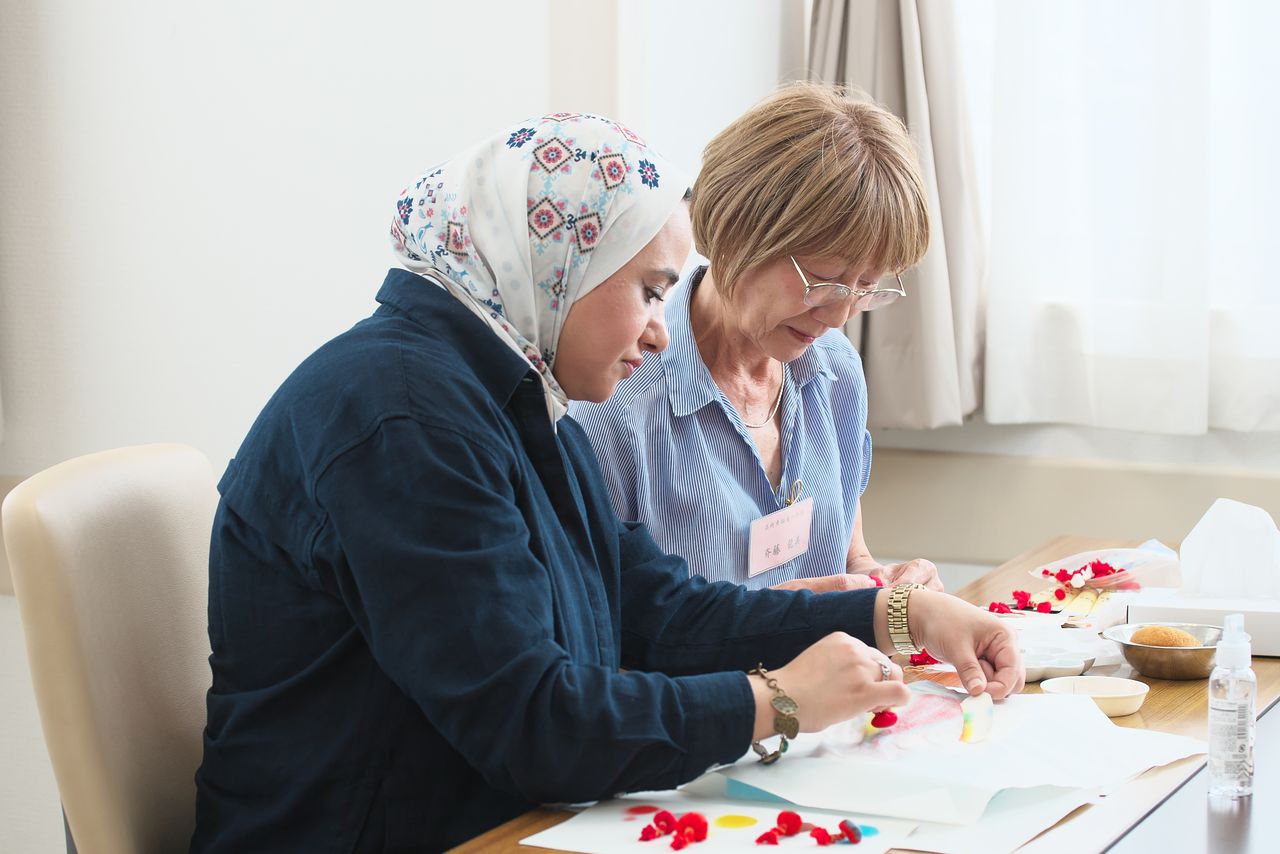
Nippon.com staff member Marwa Adly learning the techniques of art gyotaku from Saitō Tatsumi of the Tatsu no Ko Kai. (© Nomura Kazuyuki)
The Tatsu no Ko Kai is an association dedicated to spreading artistic gyotaku around their base in Tokyo and Yokohama. Recently, Nippon.com staff member Marwa Adly, from Egypt, joined a regular meeting and tried her hand at making a colored print of a red sea bream.
There are two major ways of producing gyotaku: chokusetsuhō, or the direct method, and kansetsuhō, the indirect method.
In the former, ink or paint is applied directly to the fish and paper is laid over it to make a print. It uses the same techniques as woodblock printing, and the finished print is reversed left to right from life.
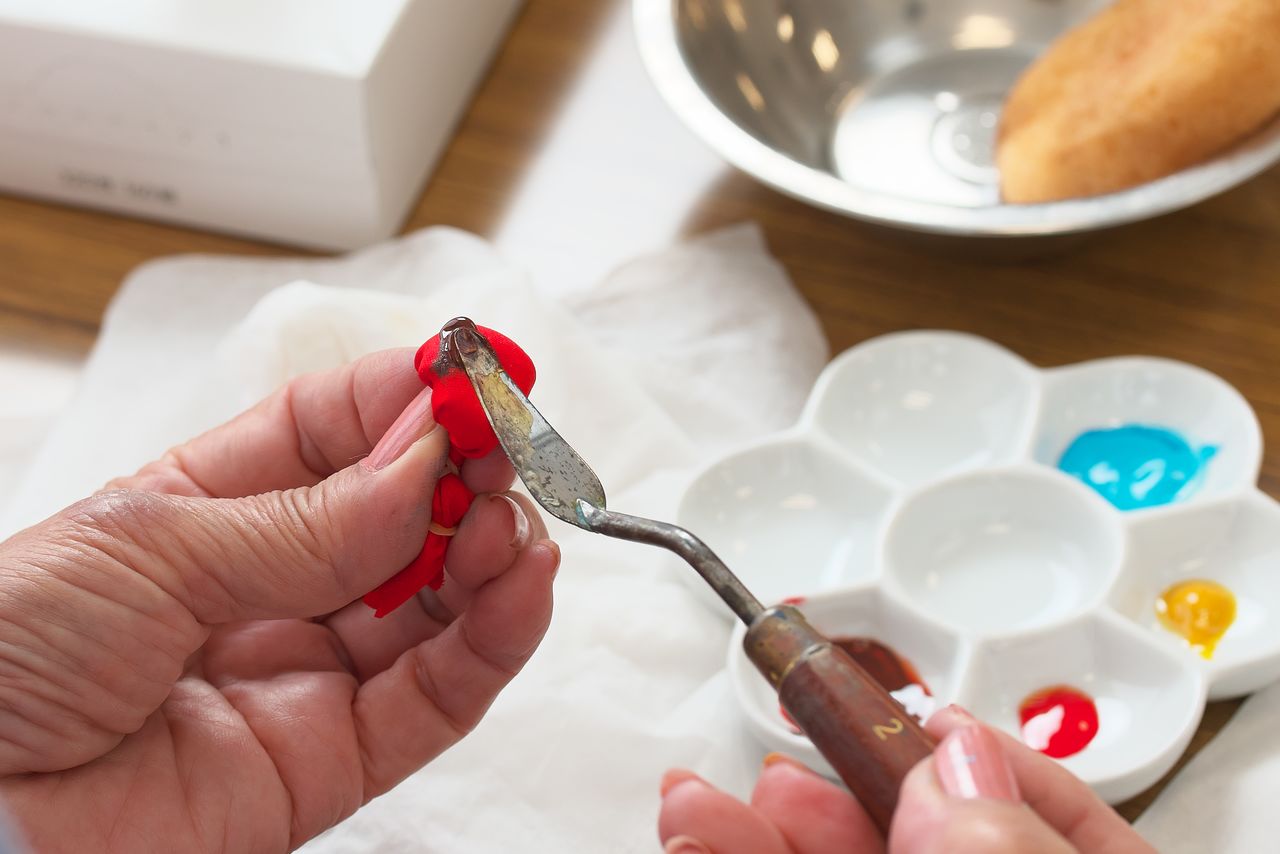
A wad of silk-wrapped cotton, or tanpo, is loaded with paint and then tapped on the paper to transfer the color. (© Nomura Kazuyuki)
But in the kansetsuhō method, the one Marwa tried, a thin layer of washi paper is laid over the fish, and a wad of cotton wrapped in silk—called a tanpo—is loaded with paint and tapped over the paper to lay down the color. It’s a similar idea to making rubbings by covering a coin with paper and running pencil lead over it.
The meeting tables were loaded with the tools of the trade: paper, spray bottles, various sizes of tanpo, and paints. At Tatsu no Ko, seven specially selected paints are mixed to match each fish.
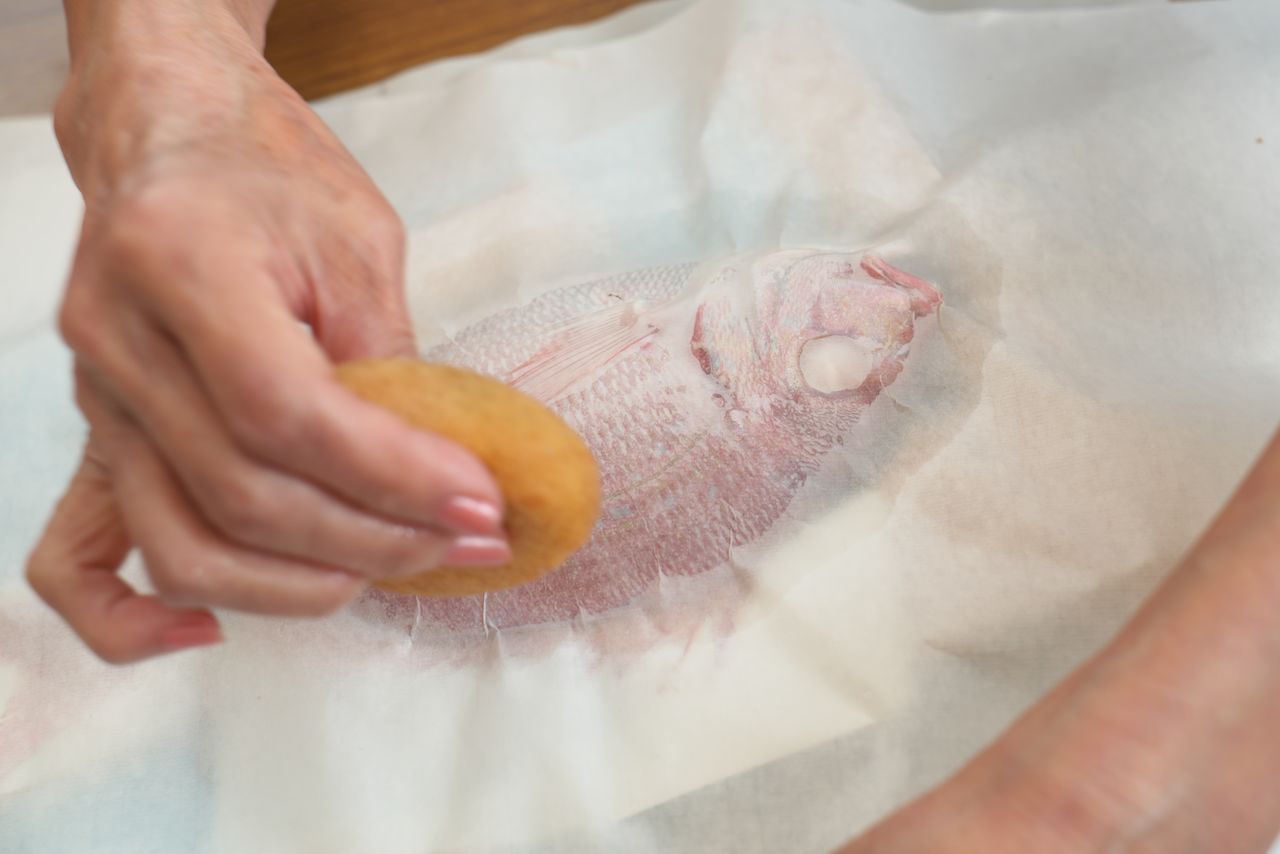
The washi is pressed closely to the fish and excess moisture wiped away. (© Nomura Kazuyuki)
First, a bream is prepared and secured to the table, and washi is laid over it. The paper is dampened with a spray bottle. It is carefully pressed to mold it to the fish’s contours, and wrinkles are smoothed out. Excess water is then carefully wiped away, and finally it is time to begin adding color.
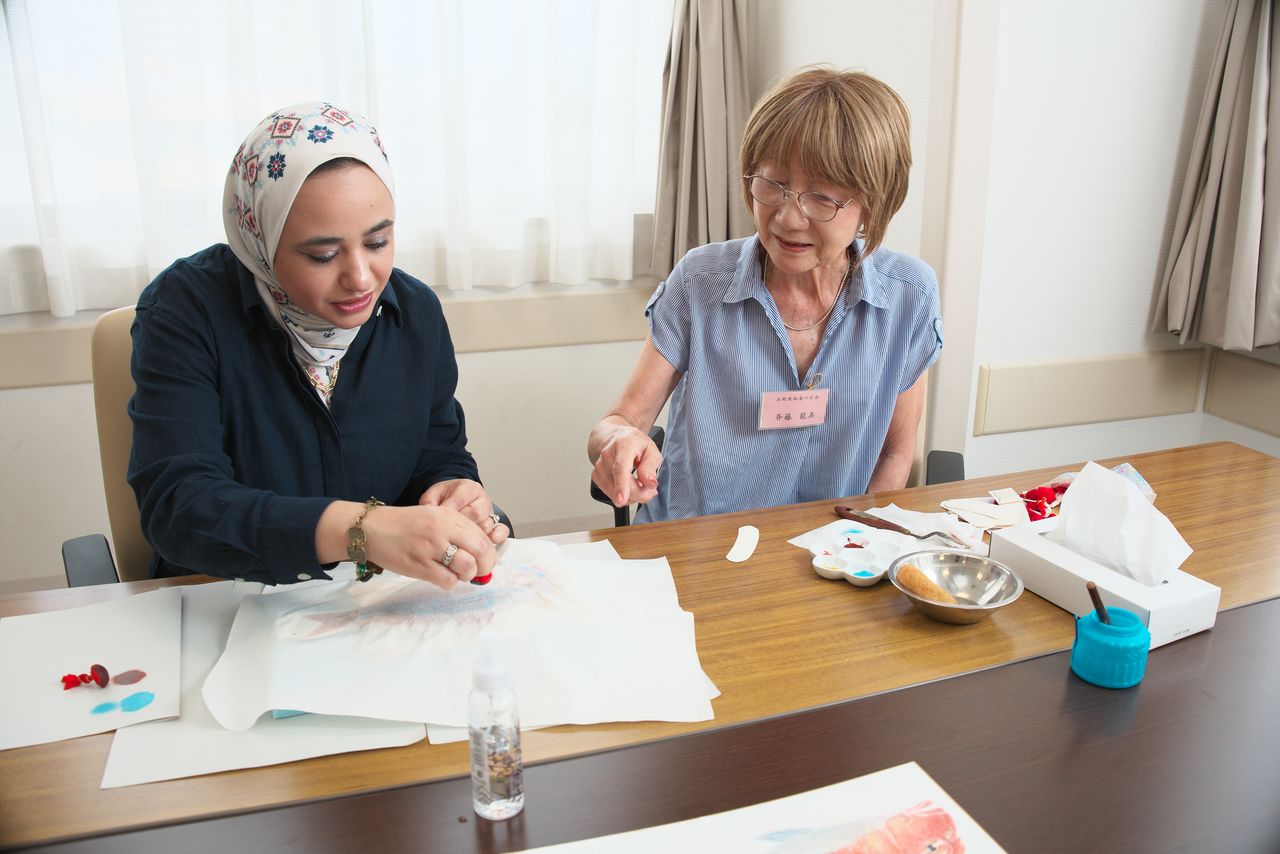
Layering blue, yellow, gray, red, and reddish-brown paints brings out the fish’s shape. (© Nomura Kazuyuki)
While listening to advice from the teacher for this experience, Saitō Tatsumi—do not press down, but gently tap—Marwa begins adding blue to the fish’s back. The blue only serves as a base, so it is still difficult to picture the final image. As the picture progresses, she layers on yellow, gray, red and red-brown. Increased tapping results in darker areas, and as Marwa approaches the fish’s belly she reduces the tapping for a lighter color. She brings out the ridge of the gill cover and leaves some white spots on the back to look like reflected light. Adding many thin layers rather than simply painting it all in one slowly builds up a sense of the fish’s rounding and slickness.
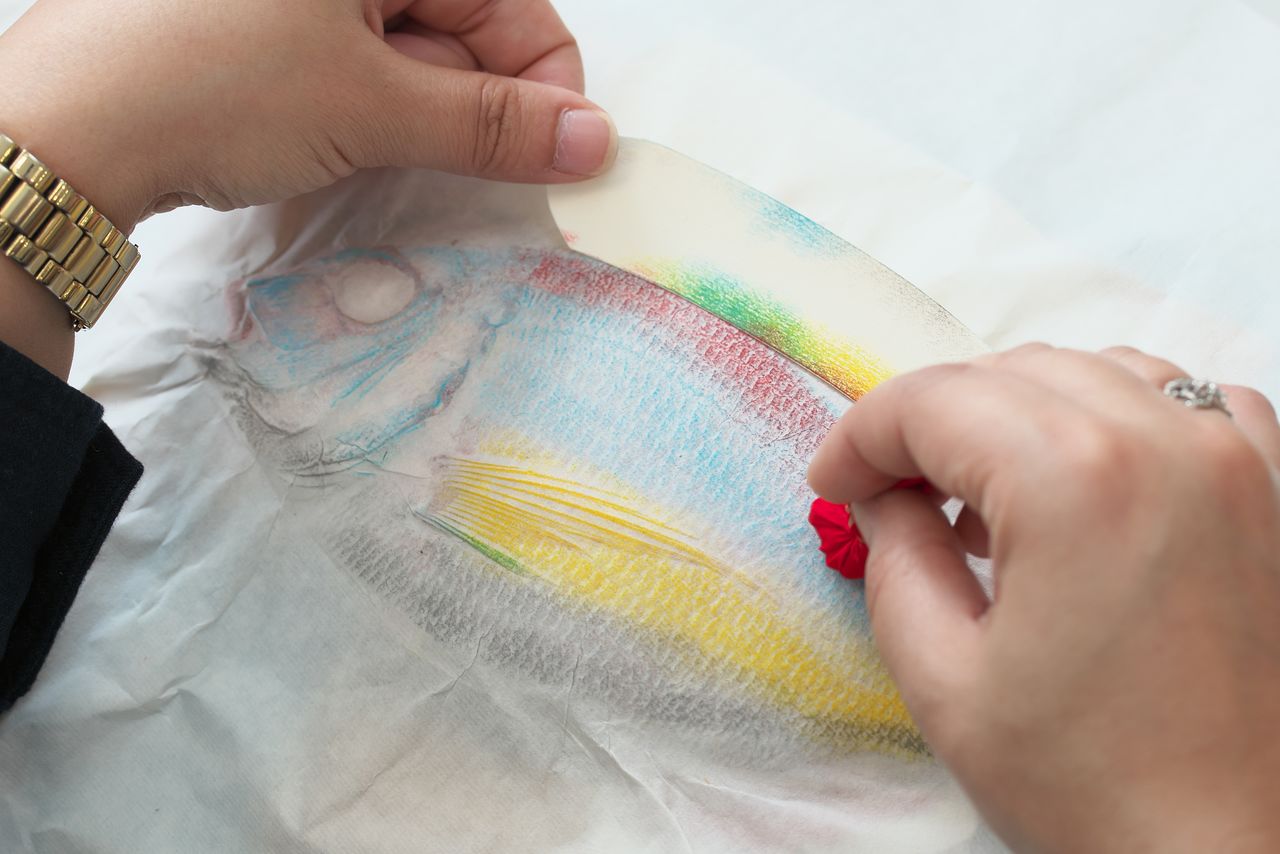
Progress requires a careful observation of the details. (© Nomura Kazuyuki)
Saitō says, “While you’re tapping, you start to notice little things like the position of the nostrils,” and Marwa nods vigorously. “It’s my first time looking so closely at a fish,” she says. Indeed, progressing through the whole print does require close observation of everything from the rise around the gills to the layering of the scales and all the individual spines of the fins. Even if you often see fish on the dinner table, it’s rare to look so closely.
Once the main body is done, it’s time to take care of the face and each fin. The fins require shifting the paper and tapping out the shape of each individual spine, then adding a faint belt of color to the thin membrane between them.
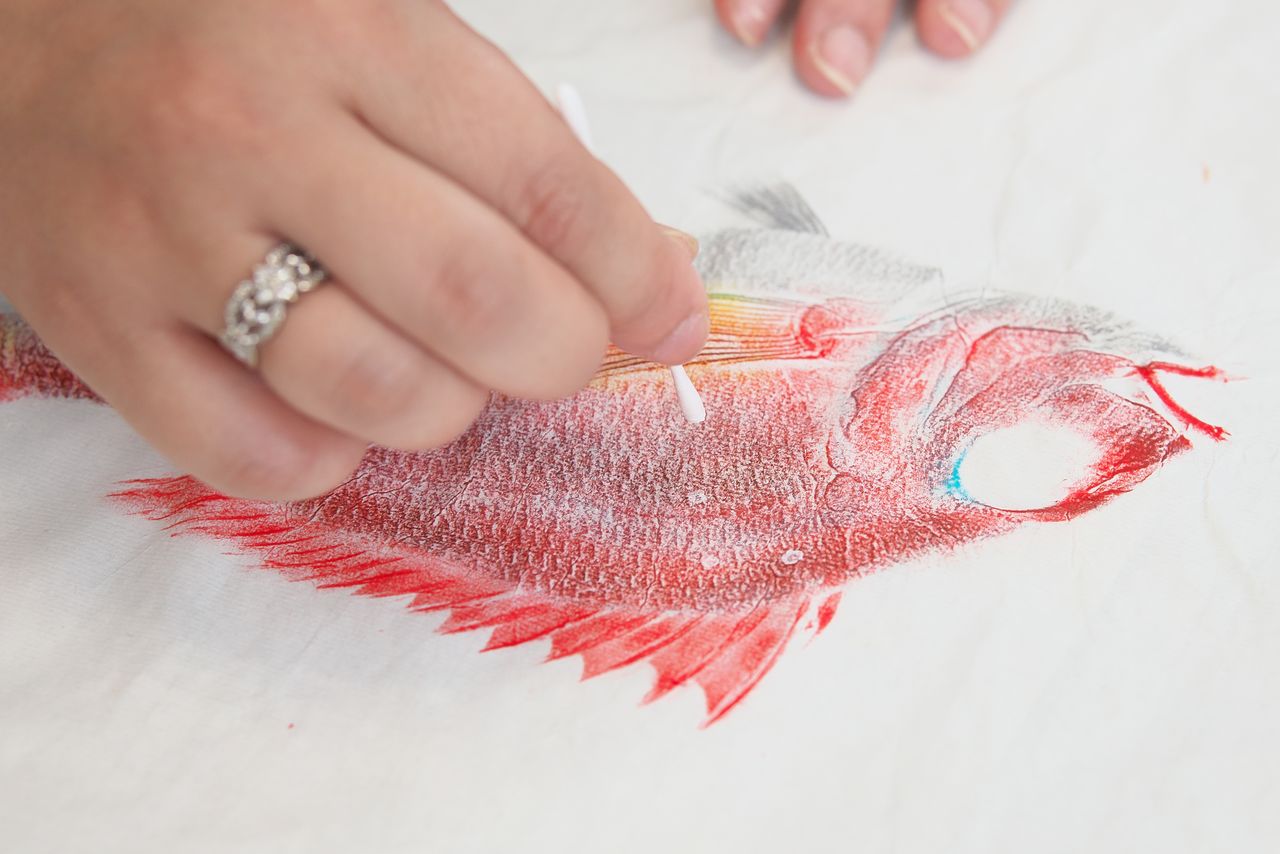
Dots of gofun, a white pigment made from ground seashell, are used to create a lifelike sparkle. (© Nomura Kazuyuki)
The blue glints that are so characteristic of a living bream are made by using a cotton swab to dot the back with gofun, a white shell-based pigment, with a faint touch of blue paint over the top.
The last touch is painting in the eyes with a brush. Saitō handles that step with an experienced hand, commenting that mistakes at this point will make it end up looking like a koinobori carp streamer. With a few deft strokes, she leaves a touch of white at the top to look like a reflection.
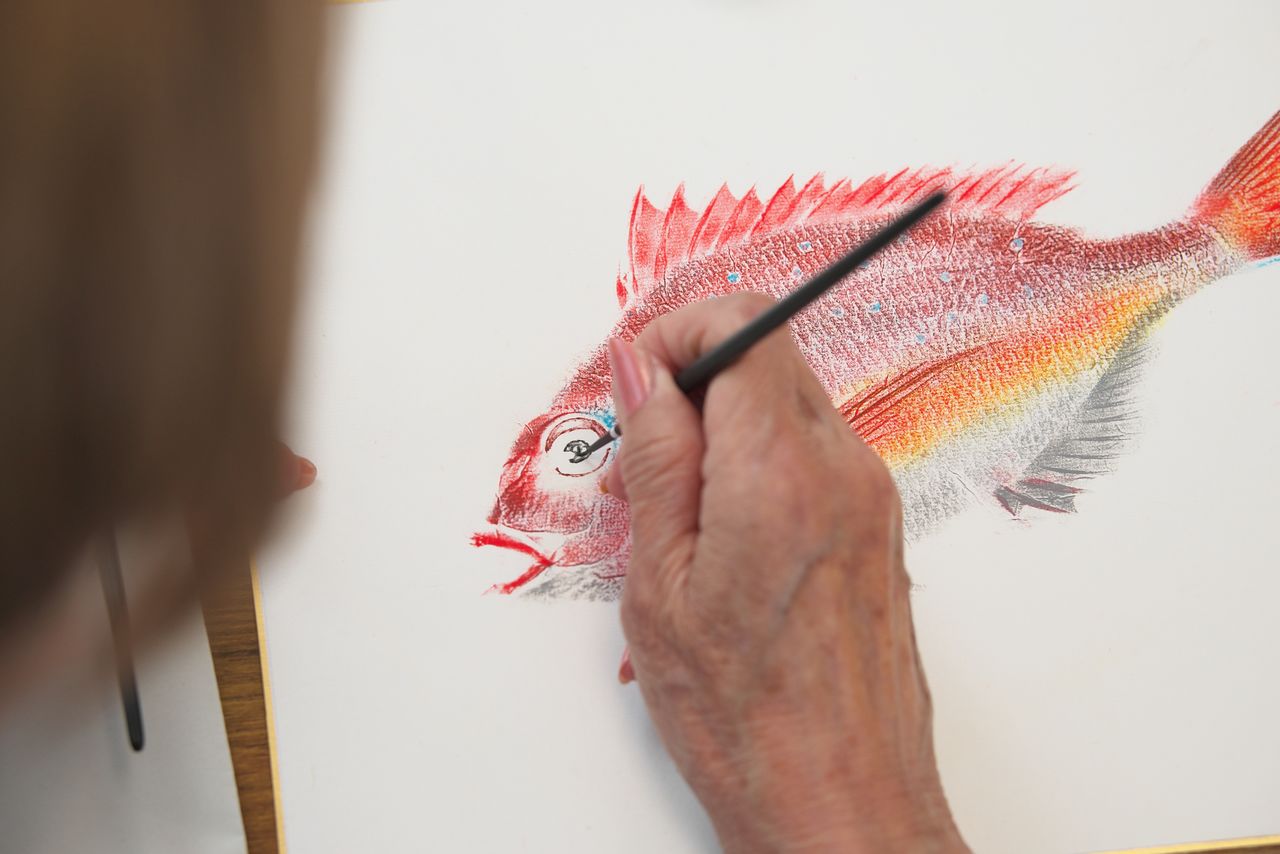
The eyes are drawn with a brush at the very end. (© Nomura Kazuyuki)
Natural Beauty Revealed by Your Own Hands
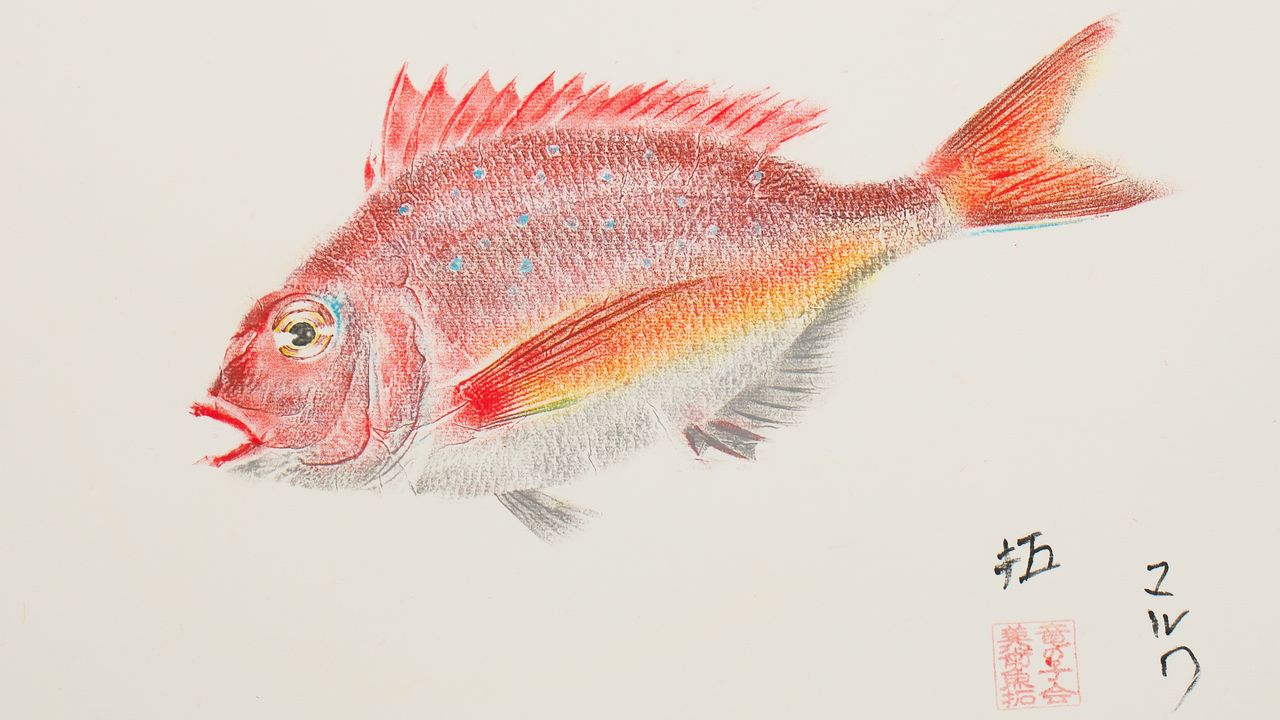
After signing and stamping the paper and adding the kanji for taku, or “impression,” Marwa’s painting is complete. From a base form of blue and gray, layers of red and yellow have helped to create the very image of a living bream on the page.
“I had no idea what color it would be at first. I didn’t think it would end up so beautiful. It was the first time I ever noticed the little details, and I could feel the beauty of nature. I think it’s a wonderful part of the culture,” Marwa says.
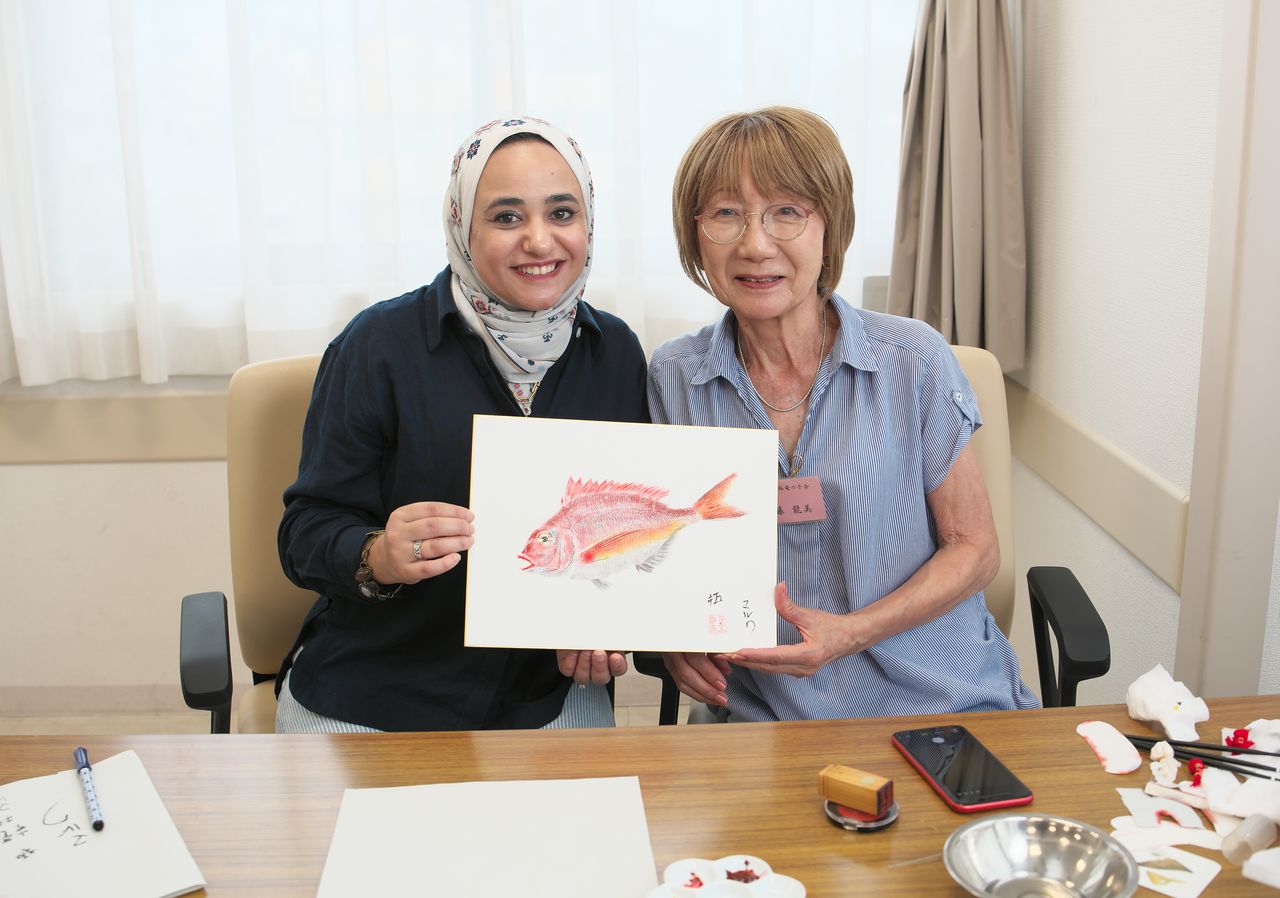
Teacher and pupil pose with the completed piece (© Nomura Kazuyuki)
Perhaps what she senses comes from intentionally taking the time to press the paper and carefully layer different colored prints, rather than opting for the instantaneous ease of a photo. Marwa’s comment about seeing so much for the first time is perhaps a perfect reflection of how the value, and the fun, of artistic gyotaku is found in the involved work itself.
(Originally published in Japanese. Banner photo: Marwa Adly’s artistic gyotaku. © Nomura Kazuyuki.)