Studio Ghibli Anime: The Inspiration Behind the Imagination
Miyazaki Hayao’s Animism: The Historical Theories That Shaped “Princess Mononoke”
Culture Entertainment Society- English
- 日本語
- 简体字
- 繁體字
- Français
- Español
- العربية
- Русский
More than Four Decades of History
In June 2025, Studio Ghibli celebrated 40 years since its founding, just before Japan marked 80 years since the end of World War II. Miyazaki Hayao (born in 1941) and Takahata Isao (1935–2018), the directors who drove Ghibli’s success, were both born during Japan’s wartime period, living the greater part of their lives in the twentieth century. Over the past 20 years, the studio has released films by a new generation of directors, including Miyazaki’s son Gorō and Yonebayashi Hiromasa, alongside later works by Miyazaki Hayao and Takahata.
From the 1990s, Ghibli’s anime quickly won international recognition, and in the 2020s, its appearance on international streaming services broadened its popularity among different regions and generations. By contrast, there seems to have been a rapid drop in interest among people in Japan under 30, who are unable to view the films via streaming due to rights issues.
Below, I consider how the 1997 Princess Mononoke and other anime by Miyazaki Hayao have reflected postwar Japanese thinking and society.
Miyazaki and Tezuka Osamu
First, I will introduce some lesser-known connections between Japan’s postwar cultural and intellectual history and Miyazaki’s philosophy and imagination.
Manga and anime showed remarkable development in the popular culture landscape after World War II, and were highly influential in a variety of ways both in Japan and overseas. Tezuka Osamu (1928–89) and Miyazaki stand as twin giants in that process, unmatched in terms of their fame, impact, and the masterpieces that they produced.
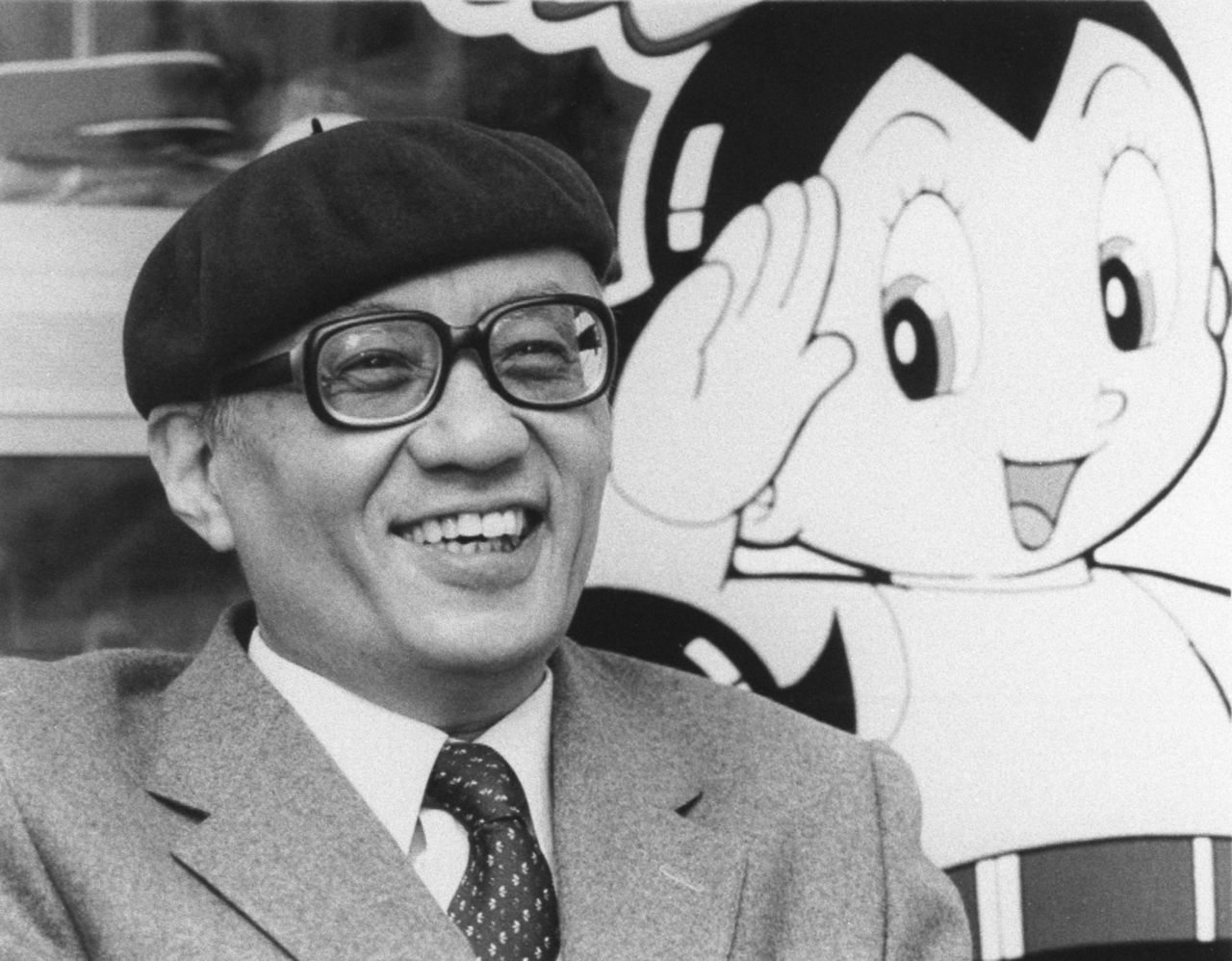
Tezuka Osamu talks in front of an image of Astro Boy in Tokyo in February 1985. (© Kyōdō; officially licensed by Tezuka Productions.)
In their affection for children, humanistic style, and ecological preoccupations, these two artists appear to have much in common, and are often placed in the same category. As a child, Miyazaki enthusiastically read and was influenced by Tezuka’s manga. There were real-life connections between them too, such as that Miyazaki made his debut as an animator on the film Doggie March (1963), for which Tezuka provided the story. The two were also due to work together on an adaptation of the graphic novel Rowlf, which inspired Miyazaki’s manga Nausicaä of the Valley of the Wind, launched in 1982, and the 1984 anime feature with the same title.
However, it is well known among anime fans that Miyazaki later blasted the low-budget “limited animation” system Tezuka established for television production. In this sense, there is a surprising distance between the two men as creators.
Killing the Forest God
They are linked, however, through a surprising connection in the notable postwar philosopher Umehara Takeshi (1925–2019). This intellectual leader upended established theories through his bold new readings of Japan’s ancient history, culture, and thinking, eventually proposing a unique theory of civilization that became known as “Umehara Japanology.”
In September 1988, Umehara wrote the play Gilgamesh, which was based on the Epic of Gilgamesh, often considered to be the world’s oldest surviving story. After this, Umehara said that he received a passionate letter out of the blue from Tezuka, who he had never met, urging him, “Please let me adapt this work into an anime.” However, Tezuka died suddenly of illness the following February, with his wish unfulfilled.
In 1998, the year after the release of Princess Mononoke, Umehara appeared on stage together with medieval historian Amino Yoshihiko (1928–2004) at a symposium centered on Miyazaki. Umehara and Miyazaki shared the anecdote that Umehara had asked Miyazaki to continue Tezuka’s legacy by adapting his Gilgamesh to anime, but Miyazaki had politely refused. However, Miyazaki later realized that he was influenced by the play while creating Princess Mononoke.
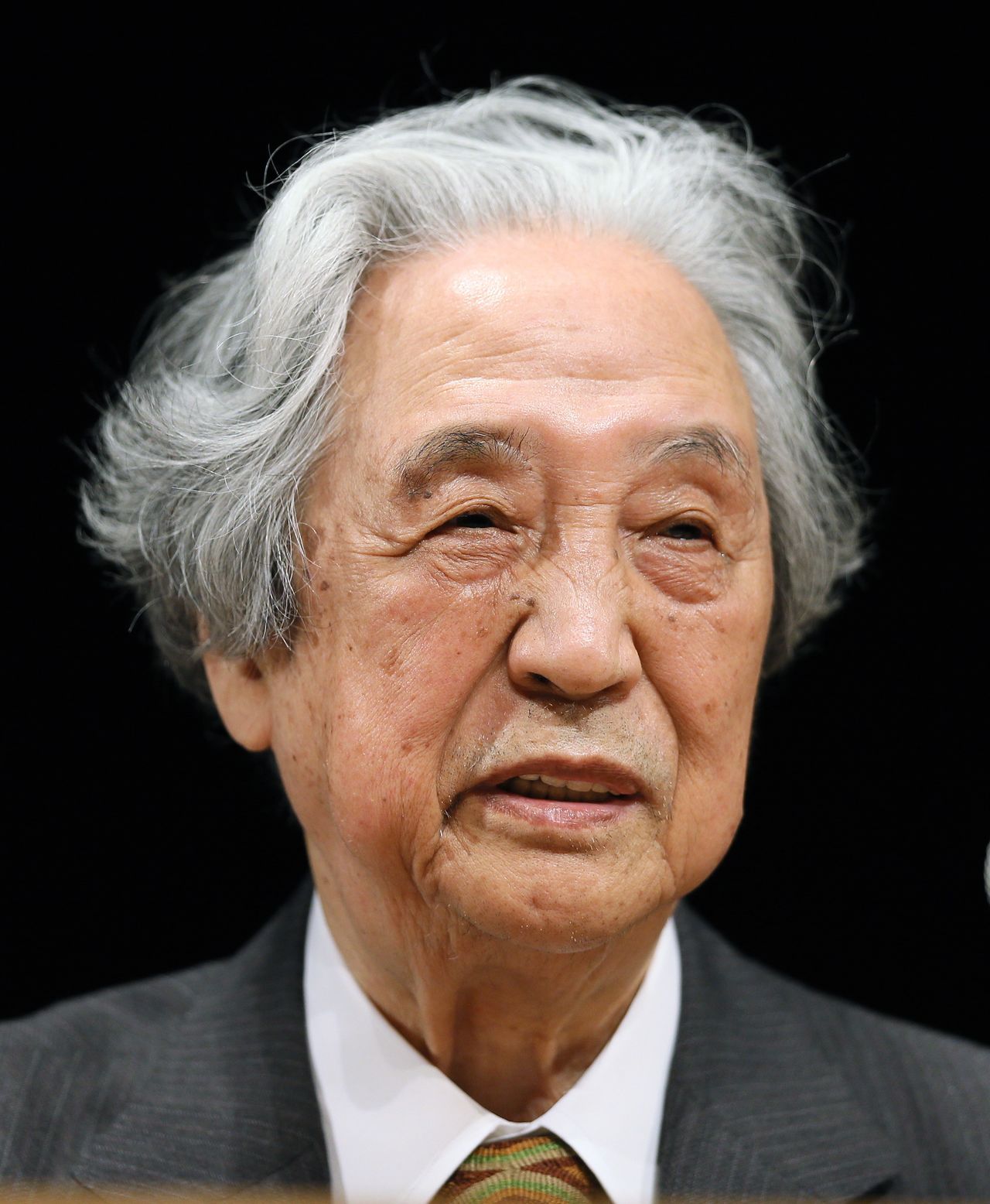
The philosopher Umehara Takeshi. (© Jiji)
In the middle of Umehara’s Gilgamesh, the protagonist Gilgamesh, King of Sumer, slays Humbaba, the deity of the sacred forest of Dilmun. This motif of a human slaying a forest god recalls the moment in Princess Mononoke when Lady Eboshi kills the Forest Spirit, the ancient deity of the primordial woods. There is another connection in the character Enkidu, who accompanies Gilgamesh, and is a human-beast hybrid made by Aruru, the goddess of creation. He is evocative of San, the girl raised by wolves in the realm of the Forest Spirit.
Meanwhile, as Tezuka’s desire to produce an anime version demonstrates, Gilgamesh is filled with elements that evoke his own works. For example, dialogue exchanges in the play between a serow and spirits of the dead recall the “Walpurgis night” scene in Goethe’s Faust, Part One. Tezuka was a lifelong fan of Goethe’s Faust, remaking it three times as manga, and toward the end of his life, at the same time he was considering adapting Gilgamesh, he was conceptualizing a feature-length anime version of Faust. In the final act of Gilgamesh, the titular character embarks on a journey to obtain the elixir of eternal life from Utnapishtim (equivalent to Noah in the Old Testament). This is the same kind of quest seen in Tezuka’s lifelong masterpiece Phoenix (1954–88).
Views of Nature and Princess Mononoke
Born in 1928, Tezuka belonged to the “little citizens’ generation,” raised as members of the wartime state, while Miyazaki was born during the war and was part of the “scorched earth generation” who grew up among devastation and reconstruction. With more than a decade between them in age, it is only natural to find differences in their generational values and ideologies.
While both Tezuka and Miyazaki treated nature as an important creative motif, their approaches to it were entirely different.
Tezuka had a lifelong love of nature and living creatures, to the point that he created his pen name by adding the character for “insect” to his real name. However, his view of nature was based on the suburban culture of Takarazuka, Hyōgo, where he spent his childhood. Here, nature was artificially processed to become a place of observation or relaxation, like the garden city concept proposed by the British social reformer Ebenezer Howard. Tezuka’s view was connected to his background as a licensed medical doctor and his modern scientific rationalism and progressivism, epitomized by his signature work Astro Boy (1952–68). Trust in modern rationalism and Enlightenment values was a dominant ideology until the mid-twentieth century, before the scientific view of historical progress was seriously called into question. This stance was also prominent in the work of Takahata Isao, who was six years older than Miyazaki.
Even when Tezuka talked about his love of anime, he gave as his reason that he could become a creator, bringing living beings into existence. This recalls how Doctor Faust creates Homunculus, an artificial human, in the Goethe play that Tezuka so admired.
By contrast, in films like Nausicaä, My Neighbor Totoro (1988), Princess Mononoke, and Ponyo (2008), Miyazaki depicts nature as something extremely grotesque and uncanny that humanity cannot objectify or control.
Most importantly, while Tezuka brought a modern, American imagination to postwar Japanese subculture based on prewar Disney and Hollywood cinema, Miyazaki sought to reintroduce a Japanese, postmodern imagination into his worldview and depictions of nature.
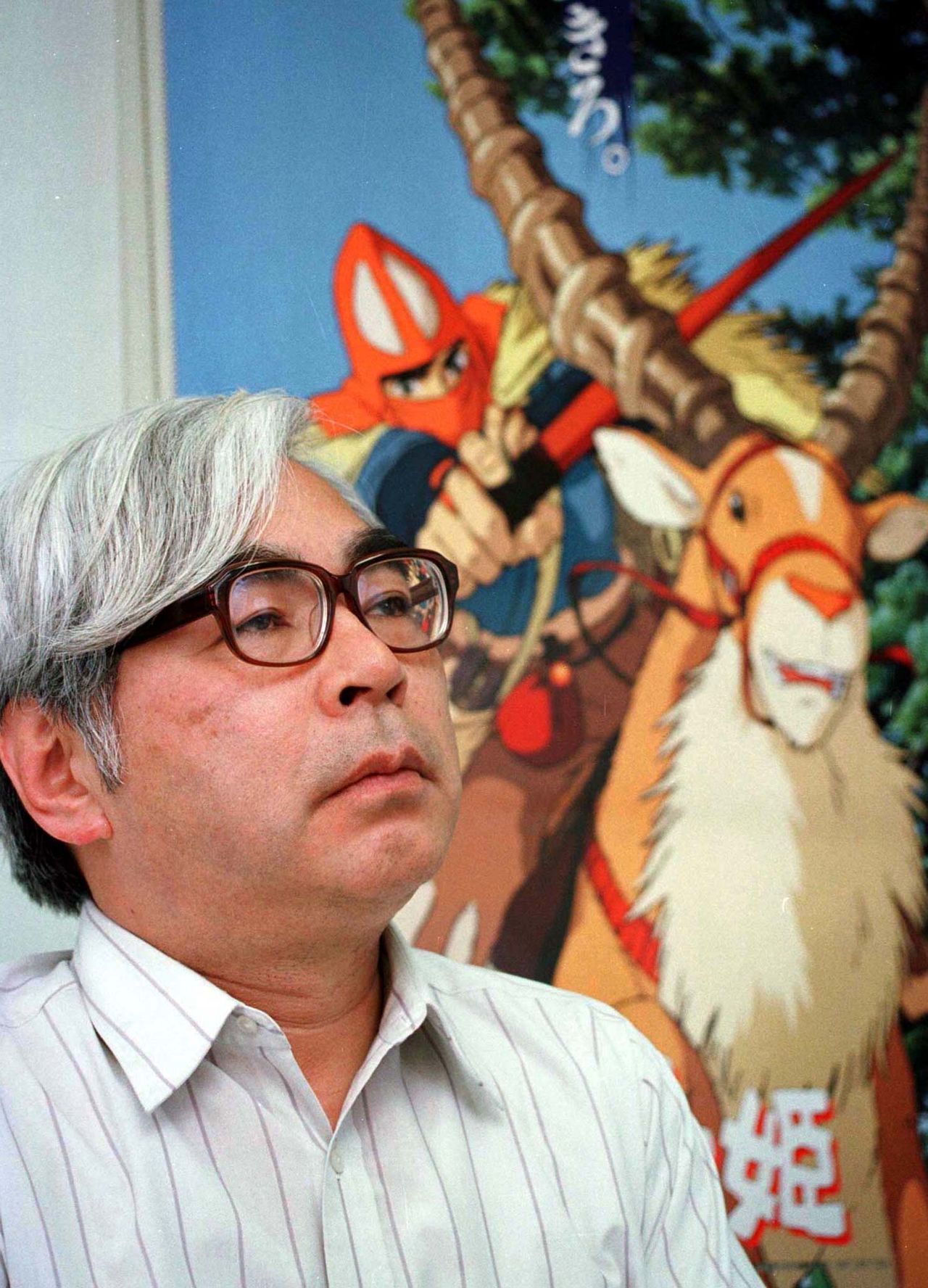
Miyazaki Hayao at the time of the release of Princess Mononoke in 1997. (© Reuters)
A prime example comes with the concepts Miyazaki incorporated into Princess Mononoke: the “laurel forest culture” theory and its associations with Jōmon culture, and the view of medieval history known as Amino historiography.
Laurel forest culture theory became influential in cultural anthropology and popular in mainstream journalism from the 1970s. It hypothesizes that foundational elements of everyday Japanese life and culture—such as slash-and-burn agriculture, consumption of sticky rice and fermented foods like nattō, and tattooing—have many parallels with elements found across East Asia’s belt of laurel forest (also known as evergreen broadleaf forest), suggesting shared cultural roots. This “East Asian crescent” stretches from Tibet, Bhutan, and China’s Yunnan Province through South China (the Yangtze River basin) and Taiwan, all the way to southwestern Japan.
Advocates of this theory were associated with the Institute for Research in Humanities at Kyoto University and were known as the New Kyoto School. Prominent members included the botanist Nakao Sasuke, the philosopher Ueyama Shunpei, and Umehara himself. They argued that laurel forest culture was linked not to the rice-farming Yayoi period (ca. 300 BC–300 AD), long considered the foundational model for Japanese culture, but to the earlier hunter-gatherer Jōmon period (ca. 10,000–300 BC), maintaining that Jōmon culture was where the true roots of contemporary Japan were to be found.
The hunter-gatherer or forest culture of the Jōmon period is highly animistic, characterized by interaction with a diverse array of mono, or nonhuman beings, ranging from animals and plants to rocks and streams, and even gods. At the above-mentioned symposium, the historian Amino Yoshihiko stated that he believed Miyazaki was conveying a sense of terror toward these mono, while Umehara noted that it was easier to express animism in manga than in written literature. This Jōmon-style animism is undoubtedly found in Princess Mononoke, and the worldview of Miyazaki’s works as a whole.
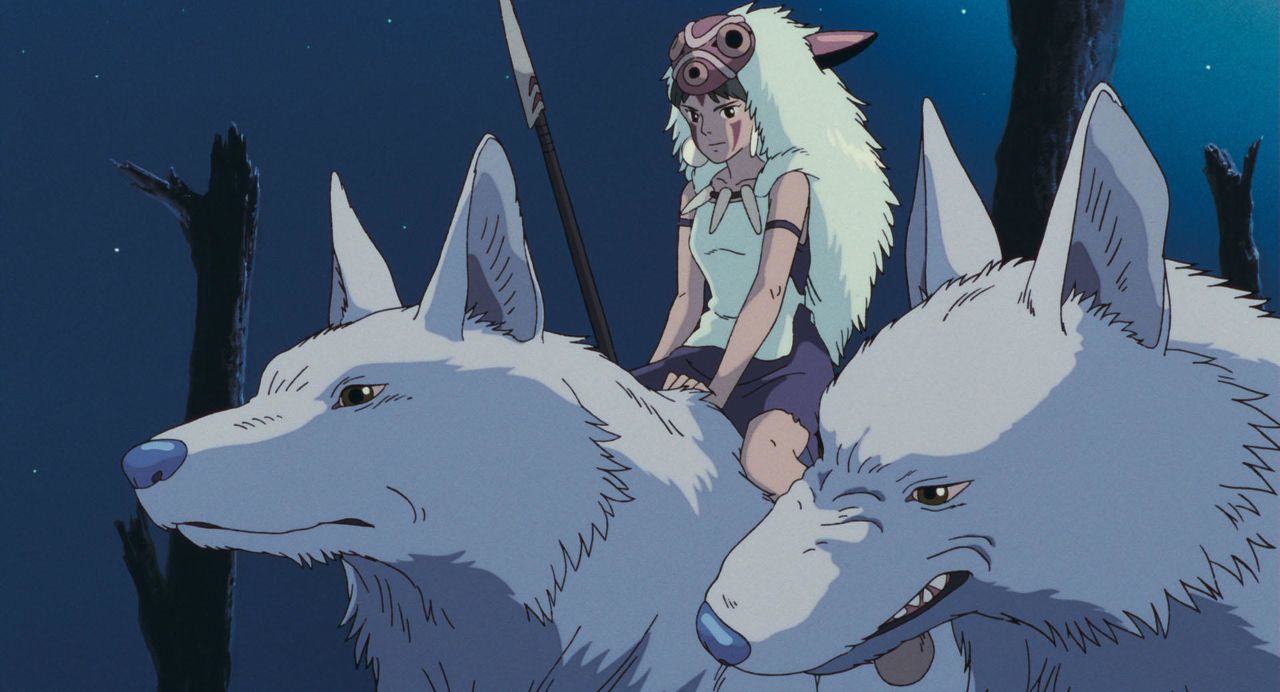
The character San in Princess Mononoke was raised by wolves. (© 1997 Hayao Miyazaki/Studio Ghibli, ND)
Meanwhile, Amino historiography refers to the new vision of medieval Japanese history espoused by Amino Yoshihiko in the 1980s. The sedentary population of rice farmers and samurai centered on the emperor and Yamato court had long been the focus of mainstream Japanese historical narratives and period dramas, but Amino brought to light details of a variety of itinerant populations, including ironworkers who made weapons, sarugaku (a predecessor to nō drama) entertainers, and courtesans.
These two theories, advanced during the postmodern era, challenged the idea of a “good old Japan” of paddy fields and satoyama landscapes, which had long been taken for granted in the twentieth century, as well as a certain kind of modern anthropocentrism, thereby creating a new image and worldview for Japan.
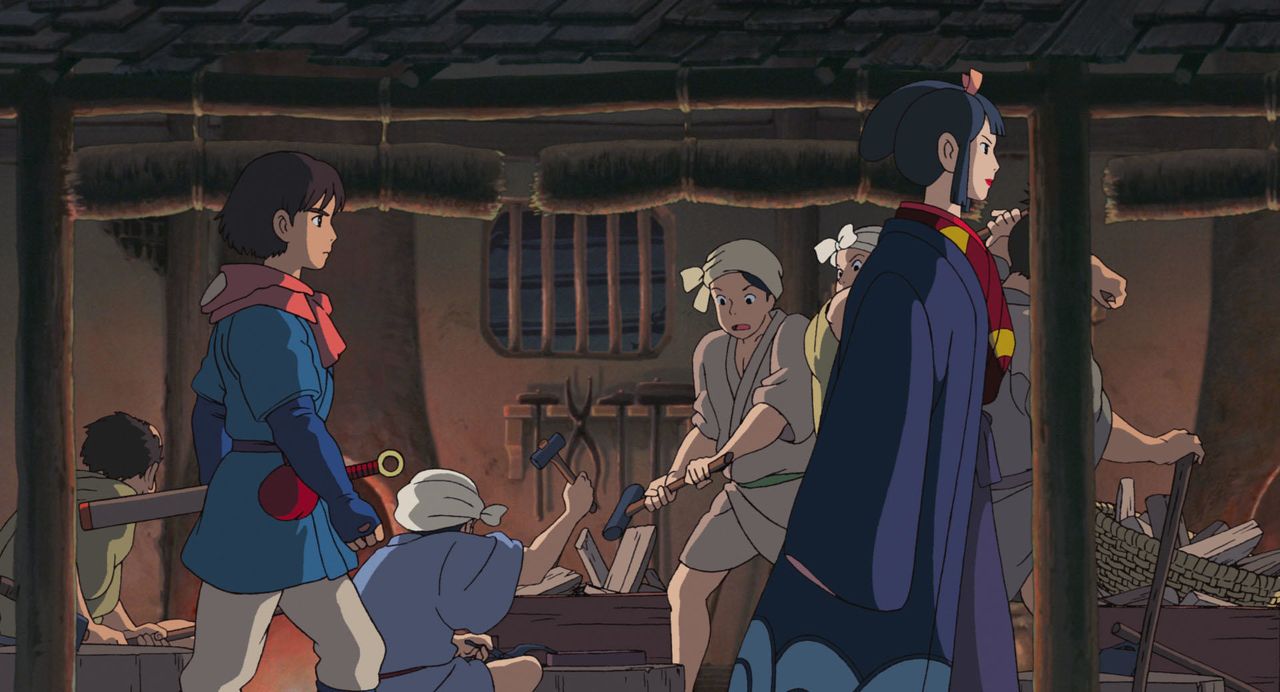
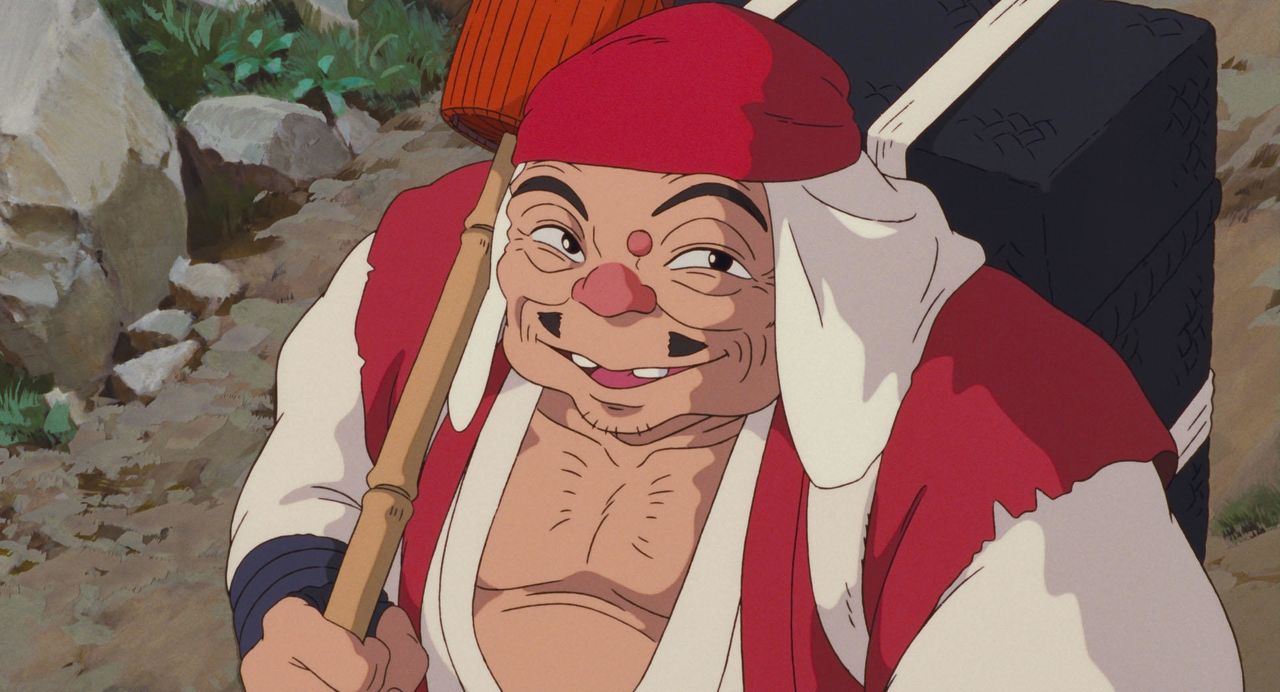
In the top picture, Ashitaka (left) follows Lady Eboshi through her iron foundry. The bottom picture shows Jigo, a mysterious monk who wants to get the Forest Spirit’s head. (© 1997 Hayao Miyazaki/Studio Ghibli, ND)
With Princess Mononoke, Miyazaki in a sense received the torch of creative imagination from Tezuka, via Umehara. In this film produced at the end of the twentieth century and set in the Muromachi period (1333–1568), Miyazaki designs the ancient primeval woods of the Forest Spirit as a distinctly Asian laurel forest belt, populating it with many nonhuman entities, such as the wolf goddess Moro, the boar god Okkoto and the kodama tree spirits. His bold choice of focusing on characters from the traditional peripheries shows his intent to create a new period film to transcend the Kurosawa Akira classic Seven Samurai (1954). These characters include the protagonist Ashitaka of the Emishi people; Lady Eboshi, a former shirabyōshi dancer and courtesan; and the monk Jigo (Jiko Bōshi in the Japanese original), a supplier to the imperial household.
Thus, Umehara and Amino’s theories played a central role in shaping Miyazaki’s Princess Mononoke, and here we can see the fascinating connections in the intellectual history of Japan’s popular culture in the twentieth century that trace a line from Tezuka to Miyazaki.
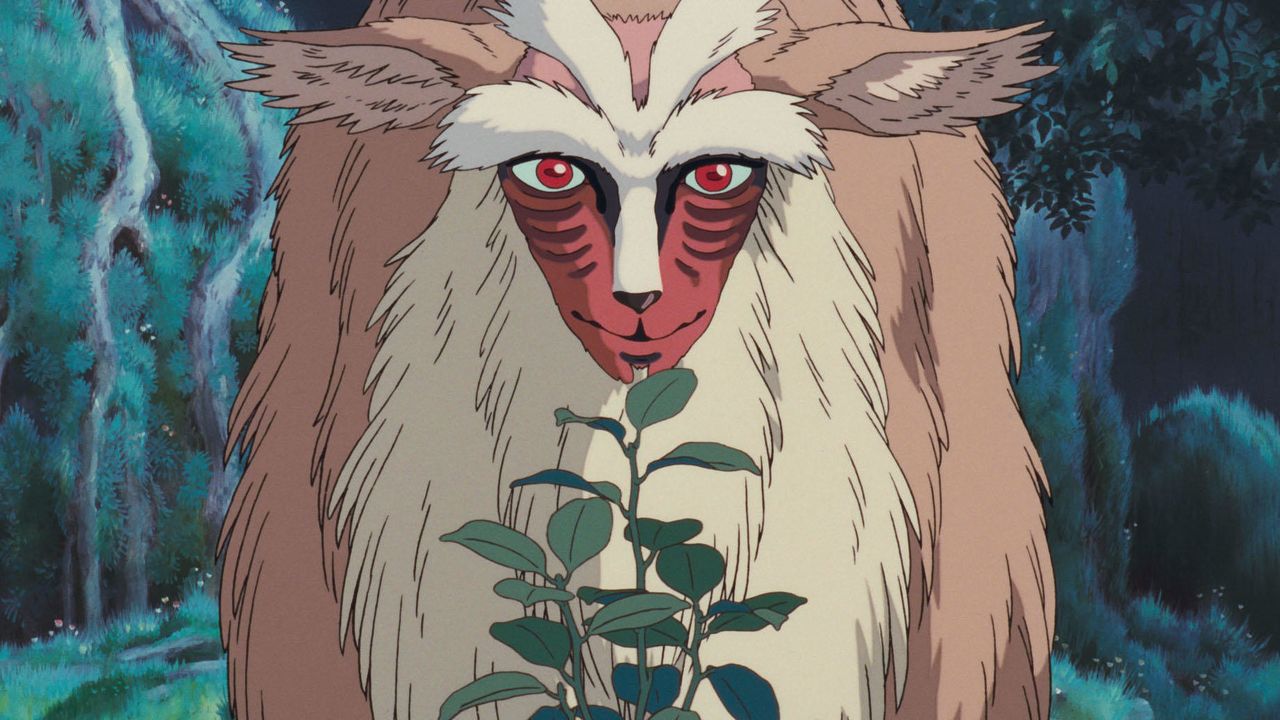
(Originally published in Japanese on September 29, 2026. Banner image: The Forest Spirit in Princess Mononoke. © 1997 Hayao Miyazaki/Studio Ghibli, ND.)
anime Studio Ghibli Miyazaki Hayao Princess Mononoke Manga and Anime in Japan