Surge in Solitary Deaths Reflects Changes in Japan’s Family Structure
Society- English
- 日本語
- 简体字
- 繁體字
- Français
- Español
- العربية
- Русский
Crowded Days at Tokyo’s Crematoriums
Japan is one of the world’s leading countries when it comes to longevity. Life expectancy in 2025 was 87.33 years for women and 81.35 years for men. Compared with 80 years ago, at the end of World War II, people are now living more than 20 years longer.
All members of the country’s baby boom generation (born from 1947 to 1949), which comprises an outsized share of the population, had by 2025 reached age 75 or older. This group will begin to shrink more rapidly as it moves into the age range of average life expectancy.
Japan is already recording around 1.6 million deaths of citizens per year. That is more than double the 788,000 deaths recorded in 1989 at the beginning of the Heisei era, just 35 years ago. With fewer than 700,000 Japanese children being born each year, the pace of decline of the native-born population is expected to accelerate. As of January 1, 2026, the population of Japanese citizens has dipped below 120 million for the first time in 42 years.
The growing number of deaths is already creating a bottleneck at crematoriums. In Tokyo, which has a population of about 14 million including foreigners, an average of 380 people die each day. The average wait time from application to cremation at Tokyo’s 26 crematoriums is around four days during the period from April to October. In the winter months of January and February, when the number of deaths is particularly high, the average wait time exceeds eight days. Because bodies need to be kept cool with dry ice until cremation, storage facilities known as “hotels for the deceased” are all said to be operating at full capacity.
Yet those who work in elderly care say the sheer number of deaths is not the most serious part of the problem. What is more troubling is the growing number of those who face death in isolation, without anyone to support them while alive.
Old and Alone
As we approach the end of our lives, we all depend on others for support in one way or another. In Japan, though, an increasing number of elderly people are living alone, compounding the issues associated with an aging population.
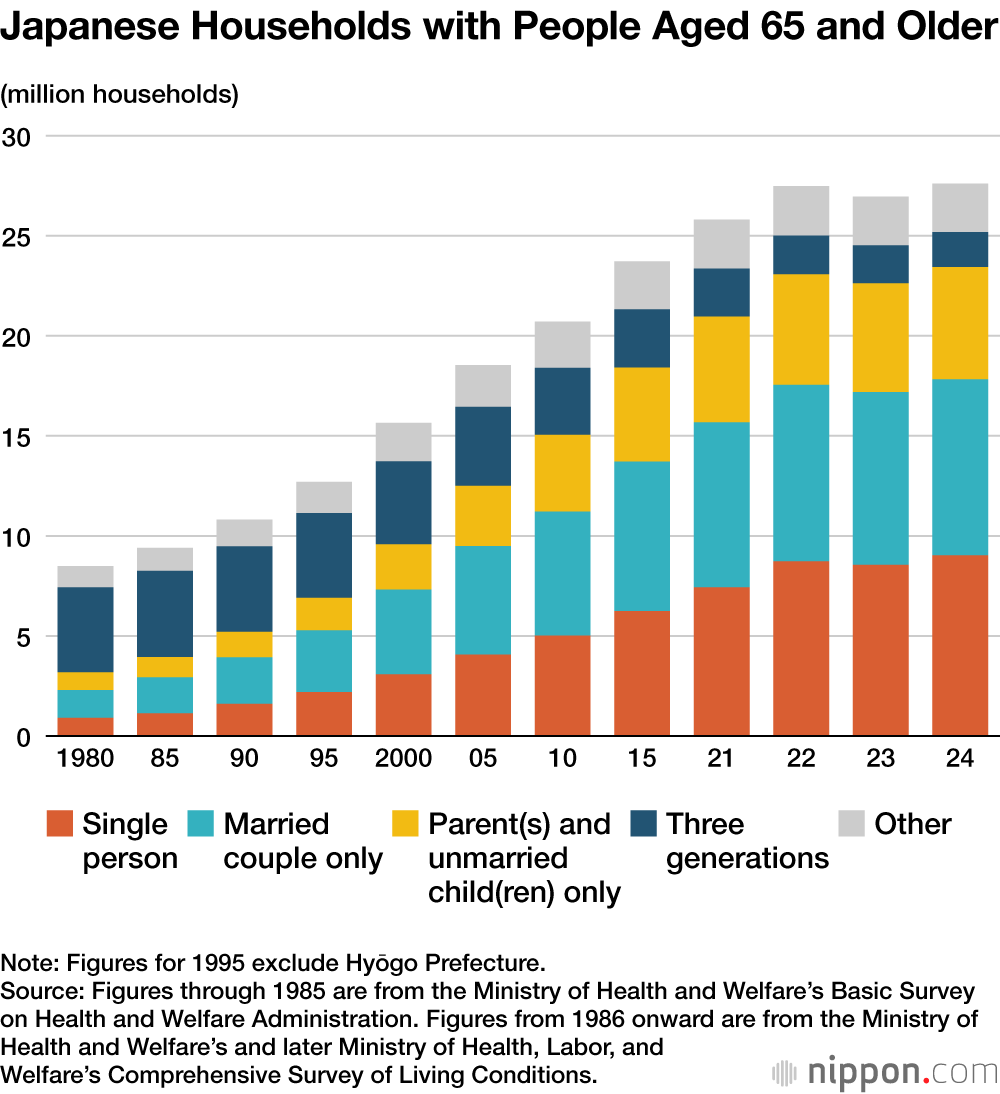
In 1990, 21.4% of all households including an elderly member aged 65 or older consisted of a married couple, while 14.9% were single-person households consisting of an elderly person living alone. The largest category was three-generation households, which accounted for 39.5% of the total.
The picture had changed drastically by 2024. The share of elderly households consisting of married couples had risen to 31.8%, while the share of single-person households had more than doubled to 32.7%, overtaking married-couple households. Meanwhile, three-generation households had dwindled to just 6.3%. Since an elderly married-couple household becomes a single-person household when one spouse dies, more than 60% of households with an elderly member can be considered potentially at risk of isolation.
The Cabinet Office defines isolated death (koritsushi) as a death that occurs at home in which the body is not discovered for at least eight days. According to estimates released by the Cabinet Office based on data from the National Police Agency, 22,222 people died in isolation in 2025, including 15,911 people aged 65 and older. Of these cases, 1,953 involved bodies that were not discovered for three months or longer, while in 208 cases more than a year passed before they were discovered.
The site of a koritsushi is wretched. I have personally accompanied a special cleaning company to sites where workers were restoring homes after these deaths. What I saw were floors with nowhere to step, littered with the remnants of instant noodles, clothing, and sometimes even plastic bottles containing urine.
What workers struggle with the most is the smell. Bodies begin decaying immediately after death, leaving behind a powerful odor that can linger for a long time. Something one of the workers said has stayed with me: “This smell is the voiceless cry of the person who passed away. I do my work with the intention of offering them repose.”
Unmarried Men Living Alone On the Rise
An increasingly important issue related to the rise in people living alone is the growing number of people with no contact with close relatives. Japan’s system for supporting the elderly is based on the premise that they have family members they can rely on. As such, those who are without close relatives that they can turn to toward the end of their lives can face a host of difficulties.
The problem becomes particularly serious when the person is being admitted to a hospital or care facility, which requires having a guarantor. People without family members to rely on may sometimes be refused admission. The government has issued notices instructing hospitals and facilities not to turn such people away. Still, from the perspective of hospitals and facilities, there is a risk that medical and care expenses incurred when the person dies will go unpaid. Determining who will take custody of the body after death is also a considerable burden.
Beyond this, there is the question of who will handle cremation and burial, sort through the deceased’s personal belongings, and process matters related to pensions and life insurance. These responsibilities were traditionally taken care of by family members, but Japan is seeing more and more people reach the end of their lives with no one left to handle them.
The growing number of people without close relatives is a crisis that care managers and hospital social workers have been well aware of for more than 10 years. As the problem cannot simply be ignored, those on the front lines have been handling matters even outside their working hours, taking on unpaid “shadow work.”
Care workers are especially concerned about elderly men. Men are more likely than women to remain unmarried, and the number of elderly men living alone is increasing noticeably. National Police Agency figures show that men account for about 80% of koritsushi cases.
According to projections by the National Institute of Population and Social Security Research, by 2050, 59.7% of elderly men living alone will never have been married. That is nearly twice the figure for women, at 30.2%. In other words, 6 out of 10 elderly men living alone will have no family on hand to support them. “That’s a terrifying statistic,” says one care manager in Yokohama.
An Alarming Graph on Unclaimed Remains
The national government and municipalities began to address the growing problem of people without close relatives after the city of Yokosuka, Kanagawa, produced an alarming graph.
Japanese law stipulates that when a person without close relatives dies, the municipality where the person died is responsible for cremating and burying the remains. Yokosuka had kept records of such cases since 1963. In 2015, Kitami Kazuyuki, a welfare specialist with the city, compiled the historical data on unclaimed remains into a graph. It revealed that while cases in which the deceased could not be identified had generally remained in the single digits, the number of cases in which the deceased had been identified but relatives refused to take custody of the remains even after being contacted by city officials had risen sharply from 2004 onward.
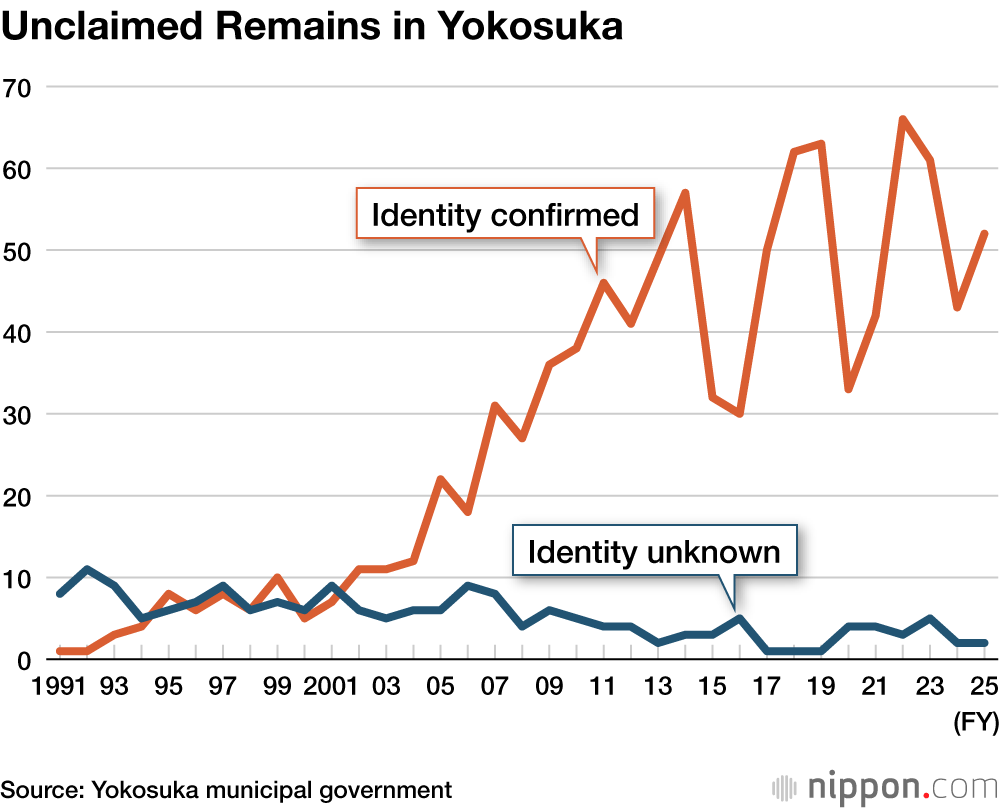
The graph gave a clear visual representation of what welfare workers across Japan had been experiencing firsthand: a growing number of elderly people without close relatives to rely on. In May 2023, a Liberal Democratic Party lawmaker used the graph to question the government in the Diet, warning that this was a serious problem. Prime Minister Kishida Fumio responded by taking up the issue and setting government and ruling-party efforts in motion. In June 2026, the Diet passed a revised Social Welfare Act strengthening support for elderly people without close relatives, and a system was established to provide support with daily life, hospital admission and discharge, and after-death administrative procedures.
The Japan Research Institute estimates that the number of unclaimed remains nationwide reached approximately 42,000 in 2023. This is a problem that extends far beyond Yokosuka. Moreover, it affects not only people who have no close relatives, but also those who cannot or do not want to rely on them. For this reason, I believe Japan may be entering an era when more local governments step up to offer support to elderly residents living alone as they prepare for their ends.
In the Kanagawa city of Yamato, retired municipal employees familiar with the system are being rehired as end-of-life planning concierges to advise residents. In November 2024, the city of Shizuoka launched its own certification program for businesses that provide end-of-life planning support. Meanwhile, the Edogawa City Council of Social Welfare in Tokyo is responding to demand from people who wish to be laid to rest in Edogawa by lining up space in local graveyards.
Yokosuka, which made an early start, is advancing two end-of-life planning programs. The first, its “Ending Plan Support Program,” is aimed at low-income residents. Participants arrange a contract with a funeral director in advance, with the city office monitoring the agreement after their death. The second, the “My End-of-Life Registration Program,” is available to all residents. The city keeps 11 pieces of information of the participant on file, including their emergency contact, primary physician, and location of their will or other documentation of how they wish to handle matters after they are gone.
“What’s most important is getting involved while they are still alive,” says Kitami. “That’s what really counts.”
Changing Views on Death, Funeral Practices
The shift in Japan’s family structure from extended families to nuclear families and the growing numbers of people who choose not to marry or have children are generally matters of individual choice, although some people do remain single despite wishing they could find a partner. Whatever their circumstances, though, our society cannot be said to be healthy when growing numbers of people reach the end of their lives without anyone to care for them, die alone, and leave this world without proper final rites.
The number of koritsushi is expected to peak from the mid 2050s to the 2060s, when the second baby-boom generation (the children of the immediate postwar boomers) will be in their eighties. Japan is already facing population decline and a massive fiscal deficit, and the government cannot indefinitely shoulder the problems arising from the challenge of many deaths coupled with isolation on its own—there are limits to what it can provide in terms of both human resources and funding. As such, we are likely to see situations that will reshape Japanese people’s views of life and death and their approach to funerals over the long term.
Indeed, funeral and burial practices have changed considerably since the 1990s. More people are moving away from traditional family graves. Scattering ashes at sea and tree burials are increasingly popular. “Family funerals,” which are inexpensive, brief, and attended by only a small number of people, have become predominant. Against this backdrop, Japan will continue to face the question of how to cope with a large number of deaths while death itself becomes increasingly private and compartmentalized.
(Originally published in Japanese. Banner photo: Buddhist monks are often called on to recite sutras as part of memorial rituals. © Pixta.)