
Adorable, Approachable Androids? New Japanese Takes on Robotic Companions
Technology Lifestyle- English
- 日本語
- 简体字
- 繁體字
- Français
- Español
- العربية
- Русский
Familiar Friends in 50 Days
At the Casio Hamura R&D Center in Tokyo, visitors are greeted by a fluffy gray robot, small enough to sit on one hand. If they succumb to the urge to pat it, the robot responds with wriggles and squeaks.
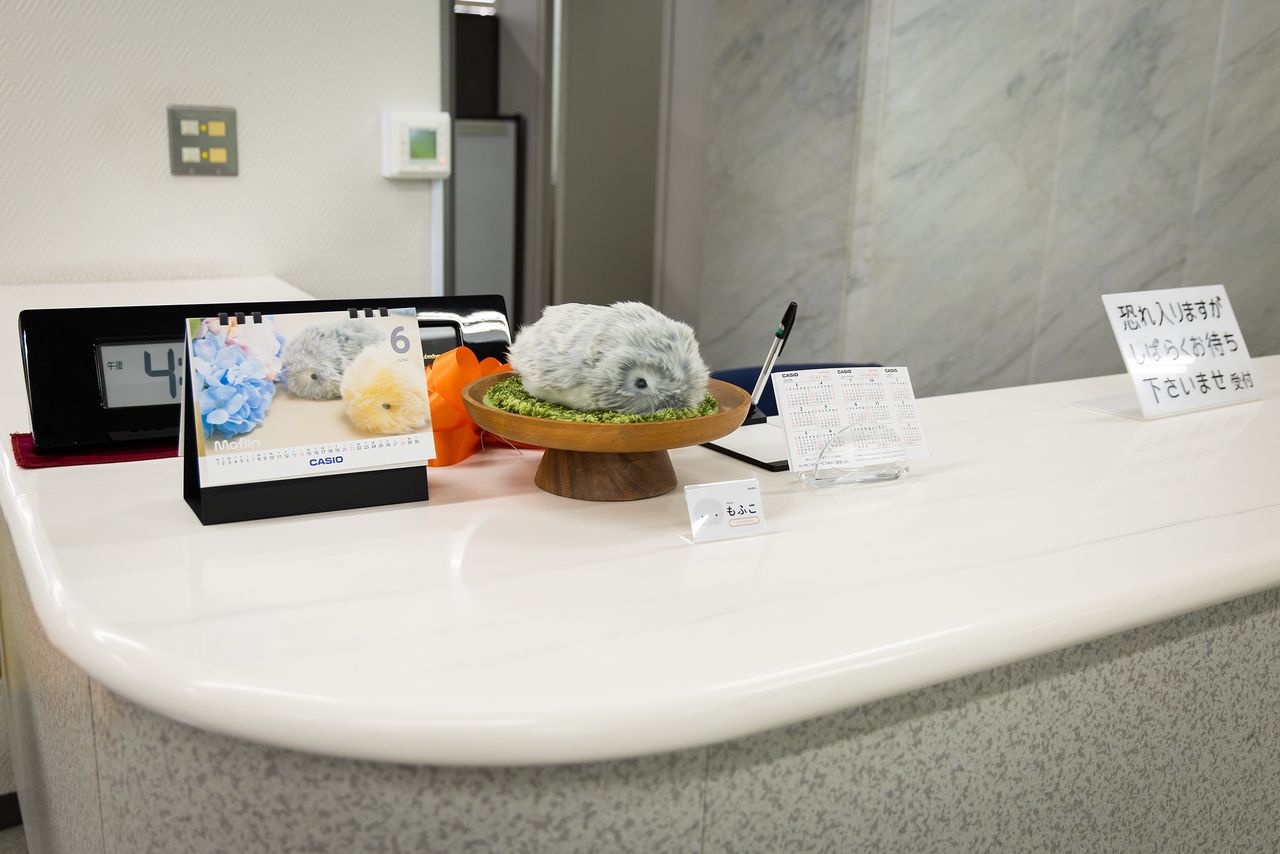
From atop the reception counter, Moflin welcomes visitors to the R&D Center. (© Nippon.com)
This is Moflin, a communicative robot developed at the center. The company describes it as a “smart companion with emotions like a living creature,” capable of recognizing its “owner” with AI and voice-recognition tools, developing familiarity as it “learns” its owner’s traits. Over a period of 50 days, it adopts corresponding mannerisms and noises , eventually settling on one of 4 millions of possible patterns to match the owner’s needs.
Casio is known for its “unbreakable” G-Shock wristwatch, whose testing took place at this R&D Center. Given Casio’s legacy of function and practicality, it came as a surprise to many when the company began developing a sensitive robot “pet” focused on feelings instead of real-world utility.
The idea for Moflin was conceived by Ichikawa Erina, responsible for planning in the New Business Division. In 2012, she was tasked with developing a product aimed at women—a novel concept for Casio. “I was in my late twenties and dealing with personal and professional struggles—I’d lost all confidence. This may have been my inspiration for devising a companion that might not be able to solve a person’s individual problems, but would stay by his or her side, granting steady confidence.” Against the backdrop of Japan’s deeply entrenched anime and mascot culture, creating a communicative pet robot soon became a quest to craft a suitably cute character.
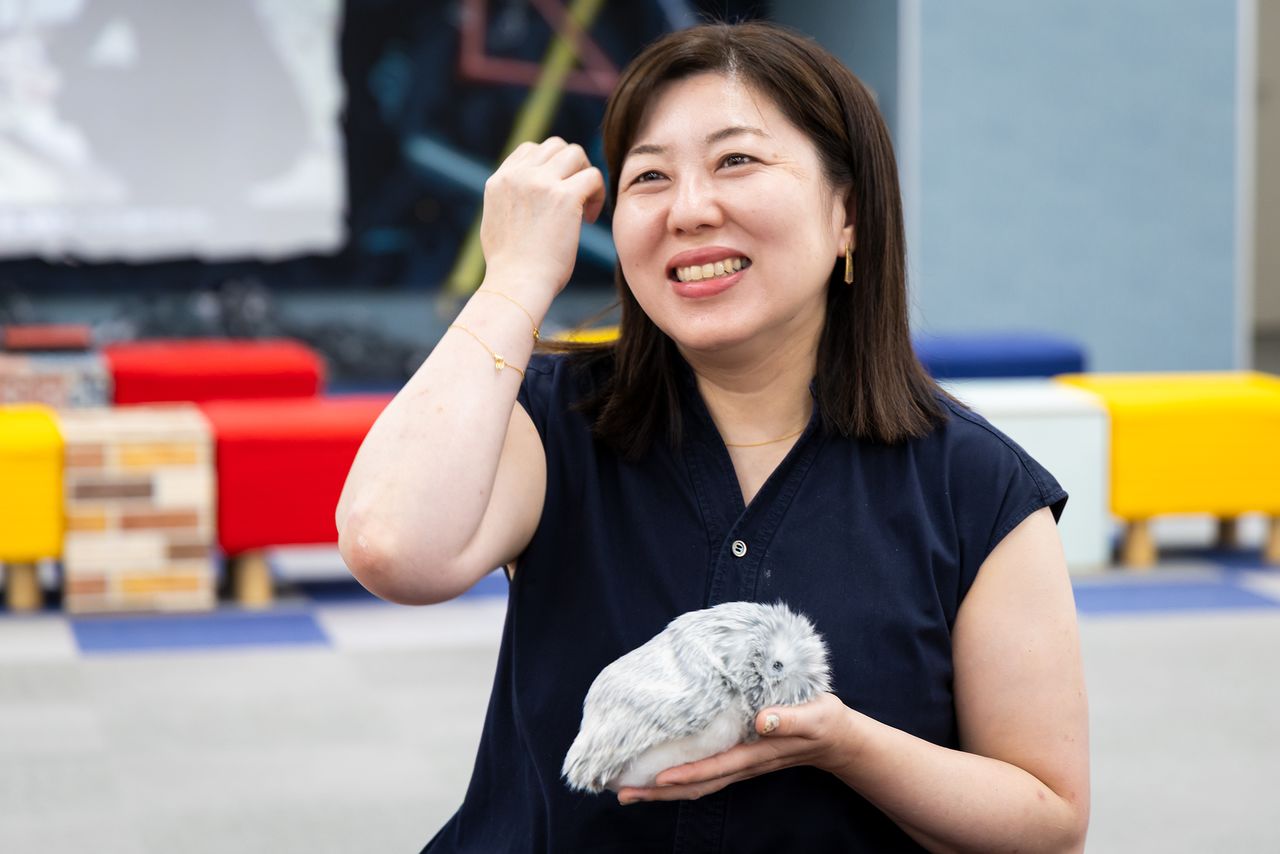
Ichikawa cradles a Moflin, roughly the size of a guinea pig, in one hand. (© Nippon.com)
Feelings over Function
During development, Ichikawa surveyed what was seen as the main target for the new product, women in their thirties and forties, to discover what they felt was “cute” or “right.” She prioritized realistic animal motion that is smooth yet erratic, and added breathing movements to make Moflin seem more lifelike.
The robot’s shape was also crucial. “It was difficult to convey the idea of ‘an adorable form’ to the developers. Women seemed to agree in general on a certain look, but many men couldn’t perceive the subtle differences.” It took the team about a year to settle upon the robot’s final appearance, with a prototype completed in 2017. The planning and development teams collaborated in market surveys, receiving favorable feedback. But Casio’s attachment to functionality proved a hurdle in getting the final go-ahead.
In 2020, they turned to crowdfunding in collaboration with a hardware start-up company. These efforts raised 30 times the target—an indication of the demand for such a product. Subsequently, in 2023, Casio approved commercialization, with gold- and silver-colored versions released in Japan in November 2024, retailing for ¥59,400 each. The company launched Moflin in the United States and Britain in October 2025, selling over 20,000 units by the end of December.
Since the COVID-19 pandemic, more people work from home and have less opportunity to interact with others. Moflin seems to fill an emotional gap for many.

The developers aimed to create a “buddy.” (© Casio)
Moflin does not speak, but expresses its “feelings” through nonverbal communication like noises and movement. Over time, and with a little imagination, owners learn to “understand” what Moflin is trying to say as they would with a pet.
Ichikawa explains: “If Moflin simply sought its owner’s attention, it would be tiresome, but it also has its own AI-powered personality, and can resolve its moods alone. We aimed to build a healthy mutual existence involving both Moflin and its owner.”
In September, the company released a sakura pink edition at the request of ardent fans. It retails at ¥64,900, with sales limited to Japan and China.
Meeting Eyes with a Baby on a Train
Casio is not alone in this new market. Yukai Engineering has developed cute robots that include Nékojita FuFu, a cat robot that cools down overly hot drinks, and Amagami Ham Ham, which bites playfully like a pet or a baby. The company followed up with another unique robot, Mirumi, launched in Japan in April 2026.
The 14-centimeter-high Mirumi can be attached to a bag like a fluffy, lucky charm. It responds to nearby noises, peering about as though searching for the source of the sound, or simply looks around at its surroundings. Retailing at ¥19,800, Mirumi is available in pink, ivory, and gray.
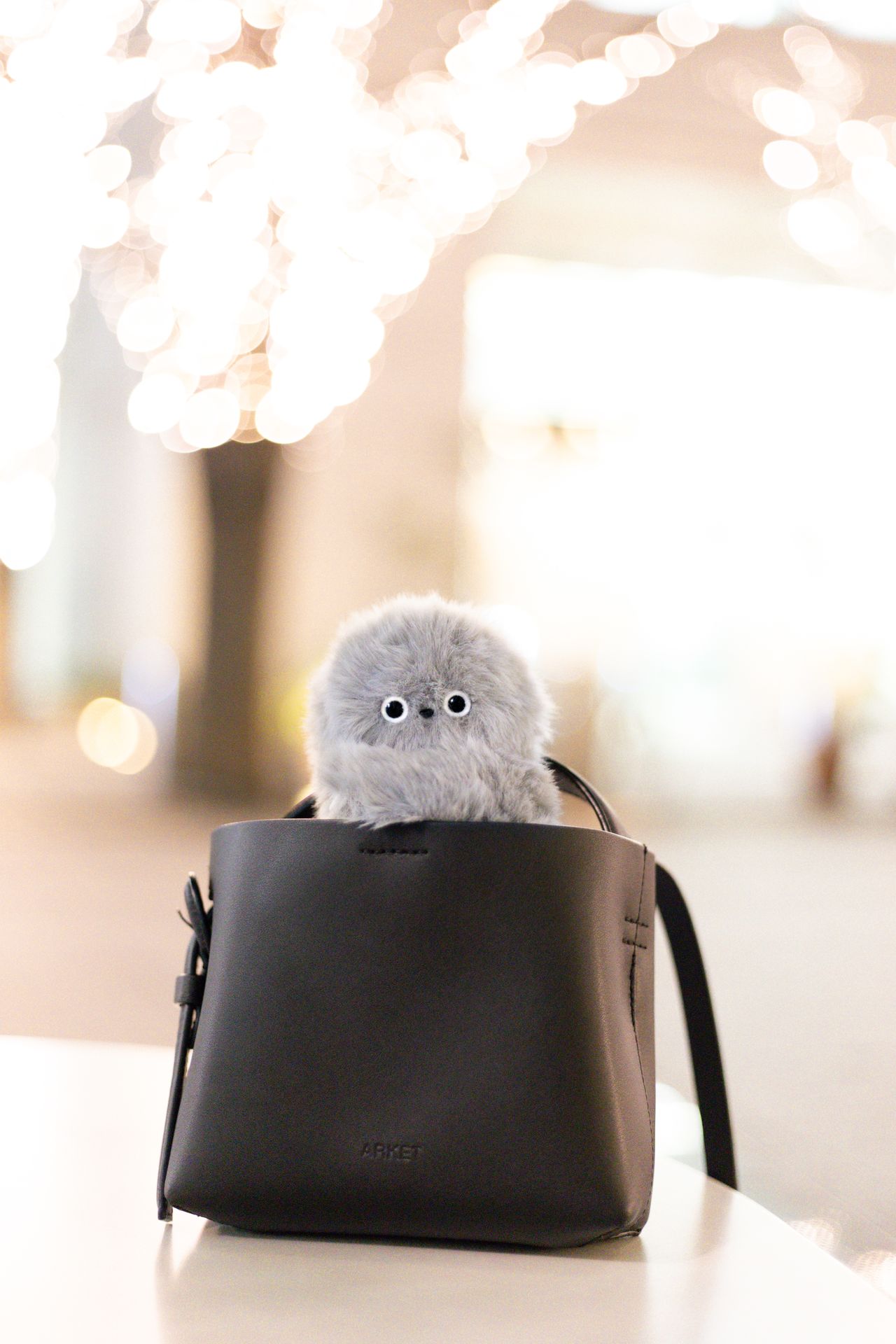
Mirumi. (© Yukai Engineering Inc.)
In January 2025, ahead of the Japanese launch, Mirumi debuted at the US Consumer Electronics Show, one of the world’s largest trade shows. In December that year, a crowdfunding campaign kicked off on the website Kickstarter, eventually pulling in around ¥80 million, with advance orders for 3,200 robots from 1,870 people in 32 countries. It was also featured at Milan Fashion Week in February 2026, gaining attention from many celebrities. In Japan, the first 3,000 Mirumi sold out within one week, and the product’s official Instagram account attracted 44,000 followers.
Yukai Engineering places its robotics focus on “fun living,” creating products that begin with fantasy. CEO Aoki Shunsuke is adamant: “We don’t simply think of ideas to resolve problems. Unless we design what we truly desire based on our personal experiences, we won’t create anything unique.”
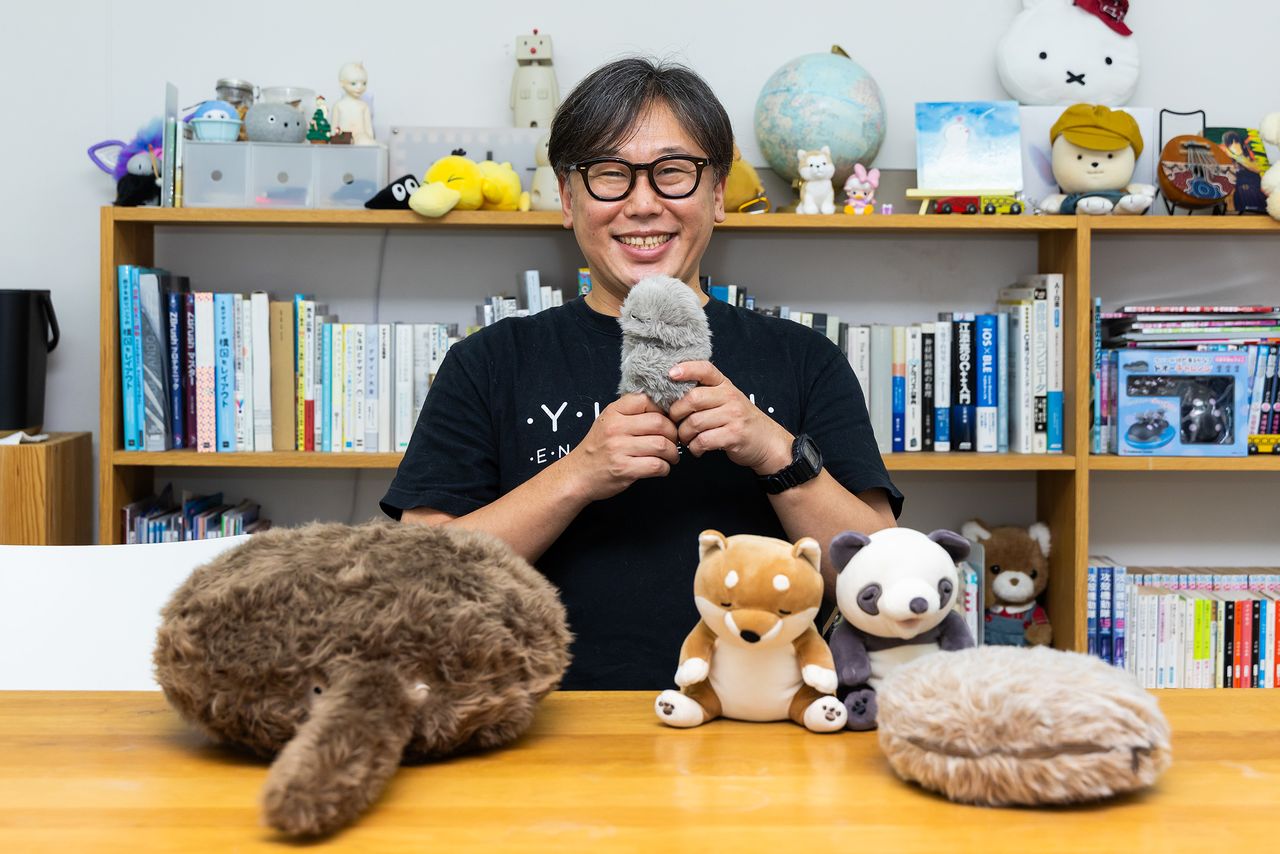
CEO Aoki poses with a Mirumi. On the left on the table is Qoobo, a cushion robot with a tail, and on the right is Petit Qoobo. They wag their tails when you stroke them. In the center are fox- and panda-shaped Amagami Ham Ham models. (© Nippon.com)
Mirumi is the product of a fantasy—imagine a mother on the train holding her baby as it peeks all around the car. Upon meeting the eyes of another passenger, the baby turns away shyly. Passengers who see the cute encounter unwittingly exchange smiles. Aoki says his hope was that a robot could elicit such a sensation.

Mirumi. (© Yukai Engineering Inc.)
Robots Connecting People
In commercializing the idea, the Yukai developers conceived dozens of movement routines, triggered by a microphone and other sensors, to devise a robot that moved impulsively, like a living creature. They strived for a texture that would be irresistible to pat. It was also important for the robot to meet eyes with its owner and others, so they constructed a sturdy frame to stabilize the eyes. The robot also needed to be durable, to stay in place when attached to a bag.
These activities come across as an attempt to redefine the concept of robots—to design devices that comfort their users and act as conduits to connect people.
“Our greatest aim in creating our robots is to invigorate people’s lives,” says Aoki. He believes they are having an impact. “The notion of comfort that Mirumi represents will spread throughout the world of robot development.”
Until now, Western stuffed-toy robots were marketed toward children, but the spread of Japanese pop culture has expanded their appeal to adults. In 2026, the company aims to sell 100,000 Mirumi worldwide.
Japan a Leader in Robotic Coexistence?
Okada Michio, professor emeritus at Toyohashi University of Technology, is developing “weak robots” that cannot complete tasks on their own. He invented a “Sociable Trash Box” robot that cannot pick up trash itself, but does so with the help of people around it. He also created “Talking Bones,” a forgetful robot that needs children’s help to tell folk tales.
Through such creations, Okada is promoting something he feels is more important than ever today: that which he terms “convivial robotics,” a catalyst for congenial relationships between humans and machines, enabling them to casually support one another.
“Strong robots that complete tasks independently offer improved convenience, but also carry the threat of the subordination of humans to robots. They reduce the scope for human involvement and encroach on human autonomy. My idea of ‘convivial robotics’ is to design relationships where humans and robots can share their weaknesses and coax out one another’s initiative and creativity.”

Okada Michio, professor emeritus at Toyohashi University of Technology. (© Nippon.com)
Rather than seeking convenience, power, and speed, Panasonic’s Nicobo, Casio’s Moflin, and Yukai Engineering’s Mirumi epitomize “convivial robotics,” focused on relationships with humans.
As China and the United States strive to build smarter, stronger humanoids, and amid the social angst that such robots might replace us, perhaps Japan’s friendly robots, that seek help while providing it, offer a third—more comforting—way forward.
(Originally published in Japanese. Banner photo: From left, Mirumi [© Yukai Engineering] and Moflin [© Casio].)