


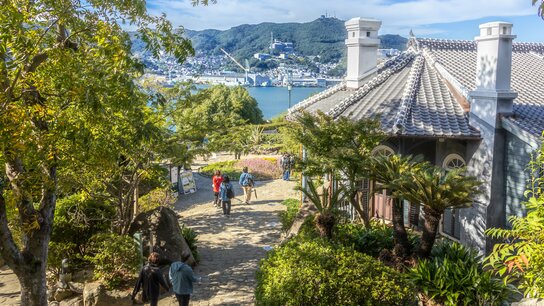
Western-influenced buildings from over a century ago attract hundreds of thousands of visitors to Glover Garden each year. It is named after British merchant Thomas Glover, a major figure in nineteenth-century Nagasaki who contributed to Japan’s industrial revolution.
Essential Stops in Nagasaki
When there were tight restrictions on entering or leaving Japan during most of the Edo period (1603–1868), Nagasaki was the only way in for European goods and ideas. In 1636, the Tokugawa shogunate built the artificial island of Dejima in Nagasaki Bay; the Dutch Trading Post established there five years later became a conduit for commerce.
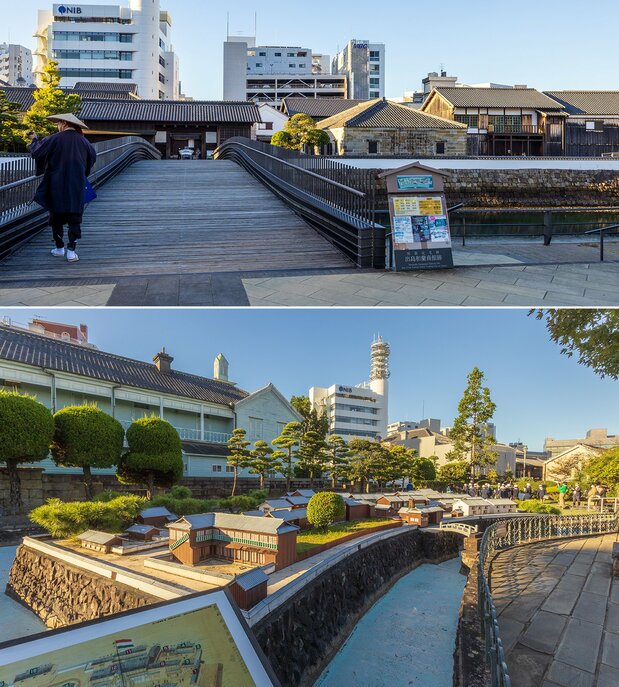
 The city government is working to reconstruct the remains of Dejima to make it into an open-air museum. The lower photograph shows a miniature reconstruction in the center. To the left is the former Protestant seminary, the oldest such building still standing, which was constructed in 1878. (© Nippon.com)
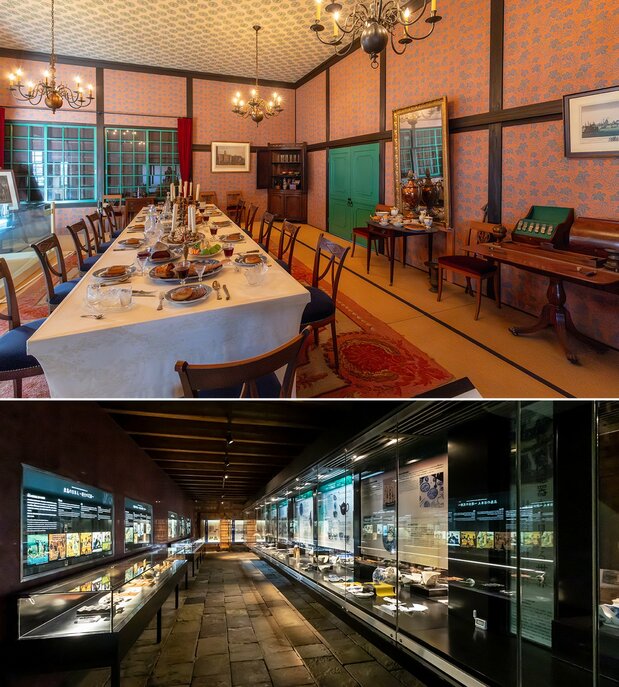 Visitors can see a reconstruction of a residence at the Dutch Trading Post (top) and some of the goods imported and exported. (© Nippon.com)
In 1858, the shogunate was forced to open up the country by signing treaties with five Western powers. Nagasaki became an open port and a new foreign settlement was established in a coastal area to the south of Dejima. Even today, there are old-fashioned Western-style buildings dotted around the center of the city. Of these, two are essential stops for visitors.
Ōura Church, constructed in 1864 for foreign residents, is the oldest church in Japan still standing and a component in the Hidden Christian Sites in the Nagasaki Region UNESCO World Heritage site.
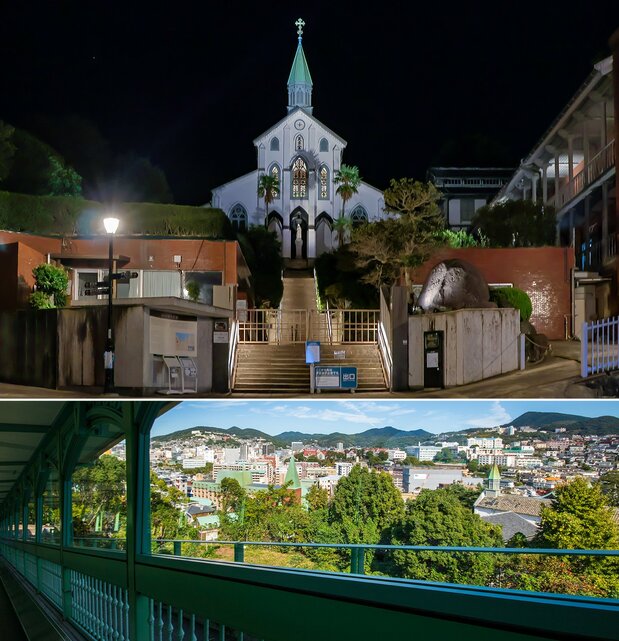 Ōura Church and its octagonal spire (top) can be seen from Glover Garden. (© Nippon.com)
A little way to the west is Glover House. Completed in 1863, it is Japan’s oldest surviving wooden Western-style building, and a component in the Sites of Japan’s Meiji Industrial Revolution, which is also in the UNESCO World Heritage listing. Glover Garden, centered on the main house, was completed in 1974, and has been an outstanding Nagasaki tourist site for half a century.
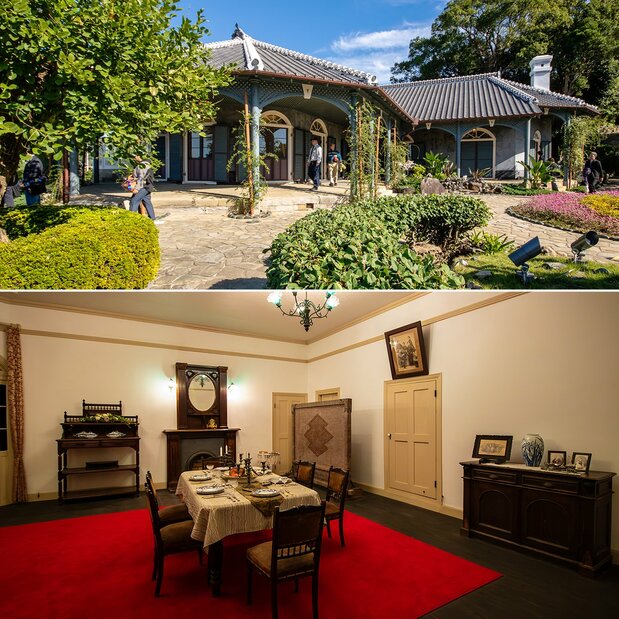 Glover House with its distinctive combination of chimneys and Japanese tiles (top); inside are re-creations of home life as it was. (© Nippon.com)
A British Merchant Who Helped Overthrow the Shogunate
The house was owned by Thomas Blake Glover, who arrived in Nagasaki in 1859 at the age of 21 as the representative of a British trading house.
Two years later, he founded his own company, Glover and Co. With Sakamoto Ryōma as an intermediary, Glover secretly sold weapons and ships to the domains of Satsuma (now Kagoshima Prefecture) and Chōshū (now Yamaguchi Prefecture), which wanted to overthrow the ailing shogunate. For this reason, he is seen as one of the figures behind the Meiji Restoration, in which a new government came to power.
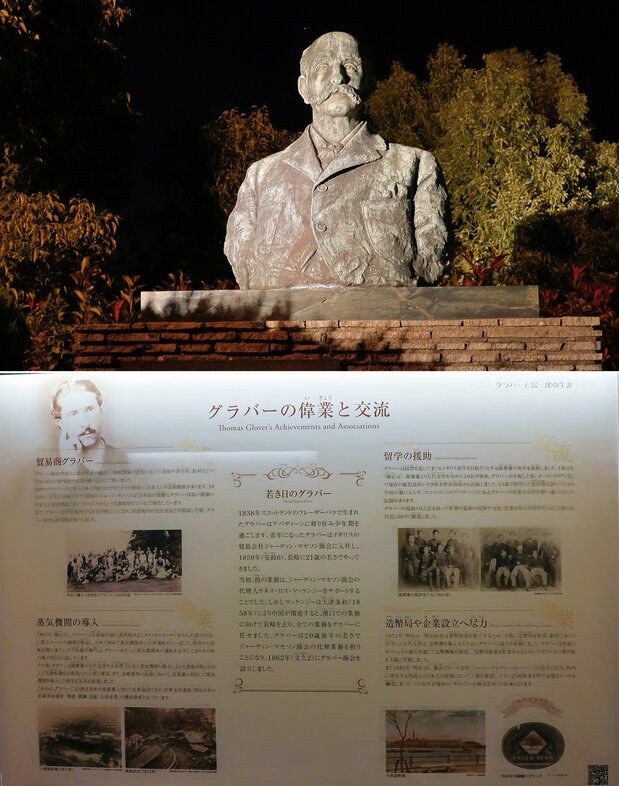 A bronze statue of Glover in the garden (top); many old photographs are on show inside the building. (© Nippon.com)
Glover’s true achievement, however, came in supporting Japan’s transformation from a nation of samurai to an industrialized country that ranked with the Western powers. He showed his mettle in joint projects with major domains in the last days of the shogunate and then with the Meiji government, introducing many kinds of Western technologies. One of these projects was the Takashima Mine constructed with British engineers on an island off Nagasaki in 1868. After a period of government management, it was acquired by Mitsubishi, led by its ambitious founder Iwasaki Yatarō, and provided essential fuel for steelmaking. Glover also invested in a dock in Nagasaki Bay for repairing imported ships using British machines, which was completed at the end of 1868. Kosuge Dock was developed further by Mitsubishi, and shipbuilding became a core Nagasaki industry. Both mine and dock were powered by Japan’s first steam engines and are assets in the Meiji World Heritage site.
Glover also helped to popularize beer in Japan, through his involvement in the founding of Japan Brewery Company, the forerunner of today’s Kirin Group.
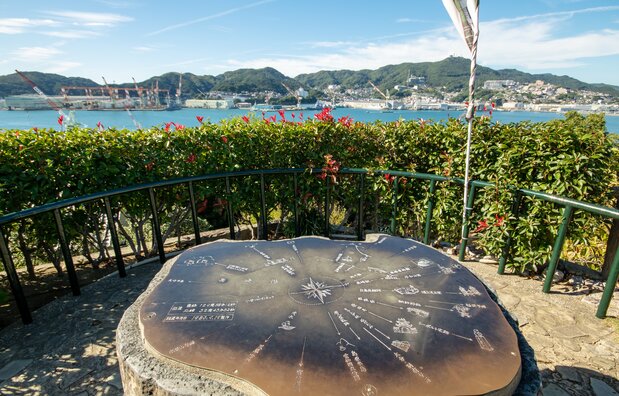 A view from the garden of Nagasaki Port and its shipbuilding facilities. (© Nippon.com)
As well as conveying the personal history and character of its owner, Glover House gives information about life for British people in Japan at the time. British architectural elements like the chimneys, fireplaces, and arched doors combine with Japanese-style tiles and the use of earth in walls in this unique building.
Glover’s favored flowering plants bloom in the garden and greenhouse. Visitors can enjoy the Southeast Asian orchids he was the first person to bring to Japan, as well as tulips, hydrangea, and other flowers that brighten the seasons.
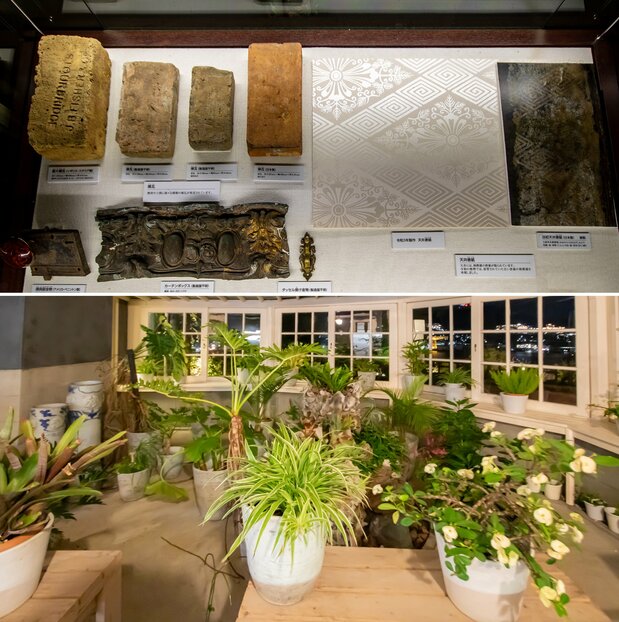 Building materials from Japan and abroad (top); Glover enjoyed spending time in the greenhouse. (© Nippon.com)
Historic Buildings a Window on the Past
Apart from Glover House, there are two other wooden residences still standing, both of which combine Japanese and Western features. These historical buildings help to draw 800,000 visitors to the site each year.
The former home of British merchant Frederick Ringer is notable for its paved veranda that extends around three sides of the building. Ringer joined Glover’s firm to oversee trade in tea before cofounding Holme Ringer & Co. After Glover’s company went bankrupt in 1870 and he became an adviser to Mitsubishi, Ringer’s became the only trading house in Nagasaki.
Ringer contributed to Nagasaki’s modernization through such projects as development of the city’s water system. Thomas Glover’s son Tomisaburō, who worked at Holme Ringer & Co., imported what became Japan’s first steam trawler. Incidentally, Nagasaki’s chanpon noodle chain Ringer Hut, which has outlets nationwide, takes its name from Frederick Ringer—although there is no direct connection between them.
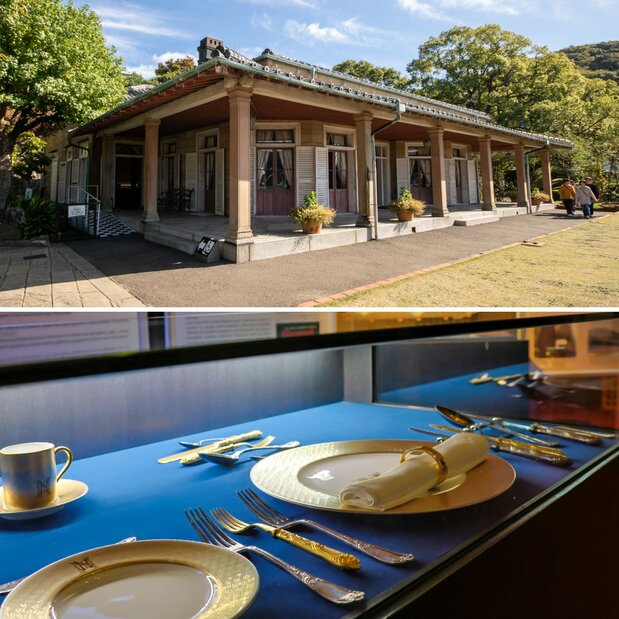 Ringer House (top); here cutlery from Nagasaki Hotel (1898–1908), which Ringer had hoped to make one of the finest hotels in the East, can also be seen. (© Nippon.com)
The remaining house belonged to William John Alt, another British merchant. This unique structure includes a veranda lined with Tuscan columns.
Koyama Hidenoshin, the main carpenter for all three houses, was a pioneer in Western-style architecture in Japan, and another contributor to the country’s modernization. He also built Ōura Church and was involved in the construction of Misumi West Port and development of coal mines at Takashima and Gunkanjima.
Six more Western-style buildings were relocated from elsewhere in the city to Glover Garden, offering further routes to imagining Nagasaki more than a century ago.
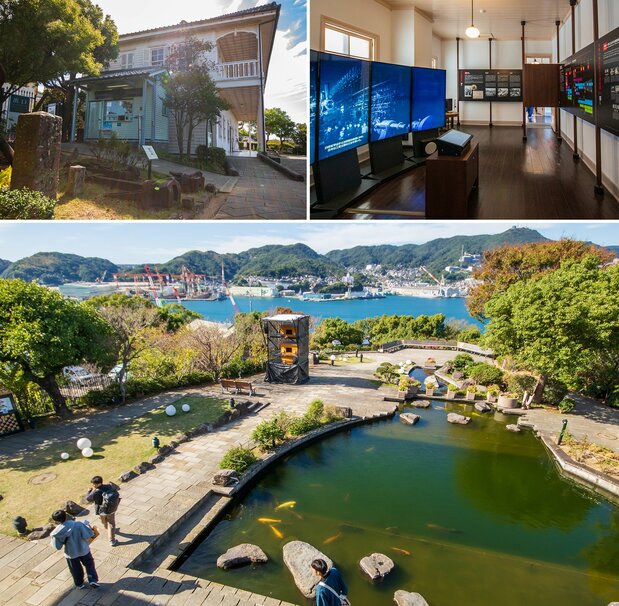 Clockwise from top left: A former Mitsubishi dock house; exhibits about the industrial revolution World Heritage site; and a view of the Mitsubishi Nagasaki Shipyard, another World Heritage component. (© Nippon.com)
Details on opening hours and admission fees can be found at the official Glover Garden website. Select English from the language menu.
(Originally published in Japanese on February 16, 2025. Reporting, text, and photos by Nippon.com. Banner photo: Glover Garden and a view of the sea. © Nippon.com.)



 Read in other languages