


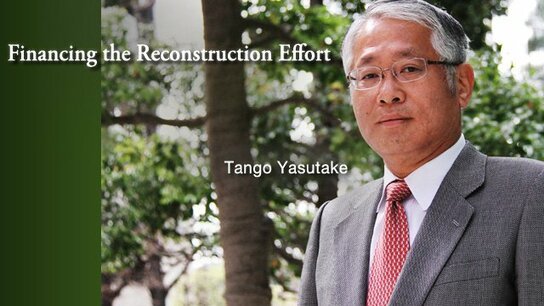
Japan’s former administrative vice-minister of finance believes that the process of reconstruction in the wake of the recent earthquake offers a chance to build a new Japan. Here he calls for the effort to be funded without new government bond issues to avoid scaring away foreign investment.
A Chance to Build a New Japan
The Great East Japan Earthquake of March 11 caused tens of thousands of fatalities and left many thousands of survivors homeless. On top of this, the disaster dealt a devastating blow to farming and fishing in the affected areas and caused radiation leaks from a nuclear power plant in Fukushima Prefecture that was knocked out of commission by the earthquake and ensuing tsunami. The disaster also destroyed numerous manufacturing plants and forced the Tokyo Electric Power Company (TEPCO) to implement rolling blackouts; these developments caused blockages and interruptions in supply chains, seriously disrupting the Japanese and global economies. The impact on people’s lives and on Japan’s economy has been on an unprecedented scale.
The Japanese government has taken the lead in responding to the disaster and is working at recovery and reconstruction together with the people of the nation. Recovering from a disaster on this scale represents a tremendous challenge, but the government and people are determined to tackle it together. The drive to rebuild is growing stronger by the day.
There is also some positive news. First of all, people around the world have been greatly impressed by the behavior and attitude of the Japanese, particularly those in the Tōhoku region directly hit by the quake and tsunami. The victims have shown fortitude, acted in an orderly manner, and demonstrated their resolve to rebuild their lives.
Second, we have seen remarkable numbers of young people traveling to the affected areas as volunteers, many contributing to the activities of nonprofit and nongovernmental organizations. The Japanese spirit of solidarity has revived.
Third, Japan has received generous offers of cooperation and support from countries and people around the world. And when the yen suddenly surged in value, the financial authorities from the other members of the Group of Seven (the finance ministers and central bank governors of seven major industrialized nations) quickly implemented a round of coordinated intervention. We can only say “thank you” for this help, which we will never forget. It has reminded us that we are not alone.
Fourth, Japan’s politicians have called a truce on unproductive clashes between the government and opposition parties and are now working together for the sake of recovery and reconstruction.
Despite the horrific damage, therefore, the disaster has also given rise to some promising developments.
Don’t Leave the Bill for Future Generations to Pay
The work of recovery and reconstruction involves two stages. First is the recovery stage. This includes building temporary housing, clearing away the wreckage, restoring utilities, and normalizing the situation at the nuclear power plant in Fukushima. Second is the reconstruction stage. This involves building new local communities, restoring employment and economic activity, ensuring a steady supply of electricity, adopting environmental and energy measures, taking steps to earthquake-proof buildings and facilities, and rethinking the heavy concentration of people and functions in Tokyo.
The government has decided to draw up a supplementary budget for fiscal 2011 (the current fiscal year, which started on April 1) by the end of April. Given the unprecedented scale of the disaster, the supplementary budget will also be bigger than anything previously adopted. One major problem is the question of where the money will come from.
Japan has a tremendous store of personal financial assets on the order of ¥1,400 trillion. It also has more than ¥300 trillion in assets overseas, and is running a surplus in its current account balance. But the country’s national debt is already about twice the size of its gross domestic product. And in the budget for fiscal 2011 the volume of bond issues is actually larger than expected tax revenues. Like many Western countries, Japan needs to take serious steps to put its public finances on a sounder footing. In fact, the situation in Japan is even graver than in most other countries.
Under these circumstances, Japan is in no position to pay for its recovery and reconstruction programs by resorting to massive additional issuance of government bonds. If our country tries to take that route, foreign investors with lose confidence in Japan, the interest rates on our government bonds will rise, and both the economy and the people will end up suffering. We face an extremely difficult problem.
Last year, when Australia was struck by massive flooding, the government decided to fund the recovery measures without additional bond issues. I understand the United States took the same approach in the wake of Hurricane Katrina. These decisions showed a determination to share the burden among members of the current generation and not leave the bill for future generations to pay.
Here in Japan, politicians from the ruling and opposition parties have agreed to review the recently enacted budget for fiscal 2011 and tap funds earmarked for low-urgency spending to help pay for the disaster effort. People have also started suggesting hikes in taxes and electric power charges. The idea is to avoid relying on government bond issues as the final source of funds, even if some short-term borrowing is required as a bridge.
Now is the time for everybody to put their heads together. At this juncture, our elected politicians must transcend party differences and provide leadership for the sake of the victims of the disaster and the sake of Japan’s revival. As one Japanese citizen, I hope they will act in this spirit, solving the problem of raising the necessary revenue and putting together the essential supplementary budget as a matter of priority.
Drawing On Ideas Locally, Nationally, and Internationally
The government has announced a new council that will bring together experts from the private sector. This body, which will be officially established on April 11, will serve as the nucleus for debate about reconstruction measures. Repairing the damage and rebuilding the affected areas so that people can have steady livelihoods and local economies can function normally as before will involve many difficult issues. But I hope we can look at this challenge with a positive mind-set, seeing it as an opportunity to revive the Japanese economy as a whole.
The first step is to listen carefully to local opinion. There also needs to be a thorough review of what was damaged in the disaster and what was not. For example, I understand there were no problems with the trains that were running at high speeds on the Tōhoku Shinkansen (the bullet train line serving the affected area) or with the Tokyo Sky Tree (the tallest structure in Japan, a multipurpose tower now in the final stages of its construction in Tokyo). We need to study the disaster damage record carefully. The findings of this study should then be reflected in future planning for measures to protect against tsunamis, earthquake-proofing technologies, and designs for communities incorporating the latest energy-saving, environment-friendly features. We should also take this opportunity to rethink the lopsided concentration of people and activities in Tokyo. The plans for reconstruction and revival should bring together the ideas of local residents, people in government, and the private sector elsewhere in Japan, and interested experts from around the world.
Six and a half decades ago Japan lay in ruins after its defeat in World War II. But our country was able to rise up out of the ashes. The disaster this time did not hit Japan as a whole. Surely we can recover from the Great East Japan Earthquake and build a new Japan. This is the task that lies ahead of us. It has got to be done.
(Originally written in Japanese on April 2, 2011.)




 Read in other languages