


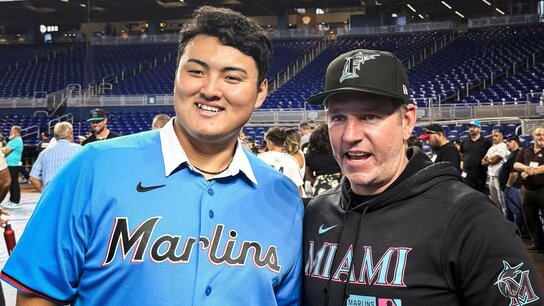
Sasaki Rintarō, who played college baseball at Stanford University before signing with the Miami Marlins, is part of a growing trend: Japanese high school baseball players bypassing the NPB and heading to US colleges in pursuit of careers in Major League Baseball. Young athletes in other sports are also going abroad to study, seeking opportunities to broaden their horizons both on and off the field.
Sasaki Refuses an Offer from SoftBank
Japanese high school baseball standout Sasaki Rintarō jolted the Japanese baseball world with his decision to forgo Nippon Professional Baseball to play in the US major leagues. Speaking to the press in Miami in July after joining the Marlins, the all-time Japan high school home run record holder shared his ambitions for his new club.
Speaking in English, Sasaki admitted that “it’s going to be hard,” but asserted his determination to succeed in the MLB. “I’ll work to get better. Hitting, defense, baserunning, everything physical.” He also listed improving his English and learning Spanish among his goals, a nod to Miami’s multilingual heritage.
Sasaki, who played for Hanamaki Higashi High School in Iwate Prefecture, follows in the footsteps of other Hanamaki Higashi alumni now in the MLB, the Dodgers’ Ohtani Shōhei and the Angels’ Kikuchi Yūsei. His father, Sasaki Hiroshi, is also a well-known figure, having coached both Ohtani and Kikuchi at Hanamaki.
All eyes were on the younger Sasaki, who during his high school career swatted a record 140 home runs. But rather than following the conventional path to the Japanese pro league after graduating, Sasaki headed to the United States to play college ball at powerhouse Stanford University.
In Japan, college students who aspire to turn professional must wait until at least their fourth year before they can submit an application to the All-Japan University Baseball Federation (JUBF).
Sasaki became eligible for the MLB draft when he turned 21 in April of this year, which under a special rule for college players also qualified him for the previous year’s NPB draft. In fall 2025, both the Fukuoka SoftBank Hawks and Yokohama DeNA BayStars vied for Sasaki, with the Hawks winning negotiating rights.
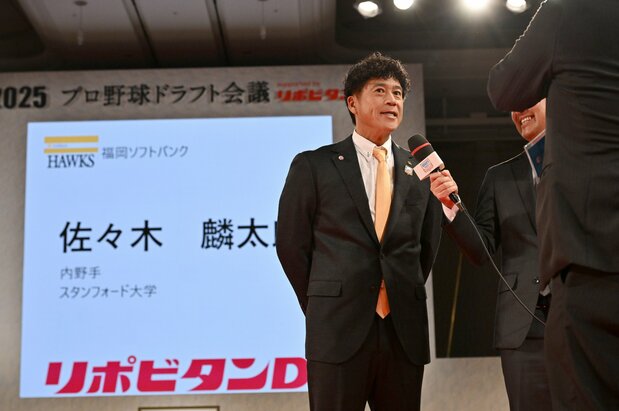
 Fukuoka SoftBank Hawks Chief Baseball Officer Jōjima Kenji speaks to reporters after the team secured the rights to negotiate with Stanford University infielder Sasaki Rintarō in the 2025 NPB draft, at a hotel in Tokyo on October 23, 2025. (© Pool photo/Jiji)
Despite the Hawks’ attempts to woo Sasaki, he remained focused on playing baseball in the MLB and was selected by the Marlins in the eighth round of July’s draft.
It has long been standard practice for Japanese players hoping to play in the major leagues to start their professional careers with a Japanese club before moving to an MLB team. Ohtani faced the difficult choice of turning professional in Japan or aiming for the MLB, ultimately deciding to join the Hokkaidō Nippon-Ham Fighters. Similarly, Kikuchi proved his worth over nine years with the Saitama Seibu Lions.
However, Sasaki’s end-around came as a shock to Japanese baseball for bucking the status quo. It offers players a new approach, one that provides them with more freedom in choosing their career path.
Young players are already looking to bypass Japan. Oda Shōki, a star pitcher for Yokohama High School, was naturally expected to enter the NPB draft, but later announced his decision to pursue his options in the United States, including possibly attending an American college.
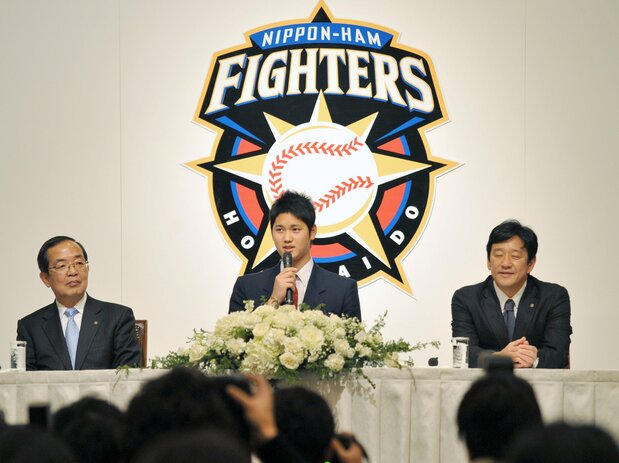 Ohtani Shōhei (center) answers questions at a press conference announcing his signing with the Hokkaidō Nippon-Ham Fighters in December 2012. (© Jiji)
A Path Pioneered by Nishida Rikuu
Japanese player Nishida Rikuu, an outfielder for the Chicago White Sox, made news when he was promoted to the majors for the first time mid-season this year. At just 168 centimeters and 68 kilograms, Nishida is small for a professional player, but he showed that size was no obstacle in his May debut against the Minnesota Twins, firing a throw to home plate from right field and recording his first major-league hit.
Although a native of Osaka, Nishida attended Tōhoku High School in Miyagi, a baseball powerhouse that produced Darvish Yū of the San Diego Padres. During Nishida’s time there, though, the school failed to qualify for Kōshien, the national high school baseball tournament. After graduating, Nishida chose to attend college in the United States, and was selected by the White Sox in the eleventh round of the 2023 MLB draft, making him the first Japanese player to reach the majors by way of an American college.
Nishida reflected on his journey in an interview following his debut: “I hit a triple in my college tryouts, which led to an offer from the school. It’s been a hard road, but thanks to that hit I could play college baseball in the US, which has led me to where I am today.”
Although Nishida was sent down shortly after joining the White Sox, he posted impressive figures playing for Chicago’s Triple-A affiliate, the Charlotte Knights.
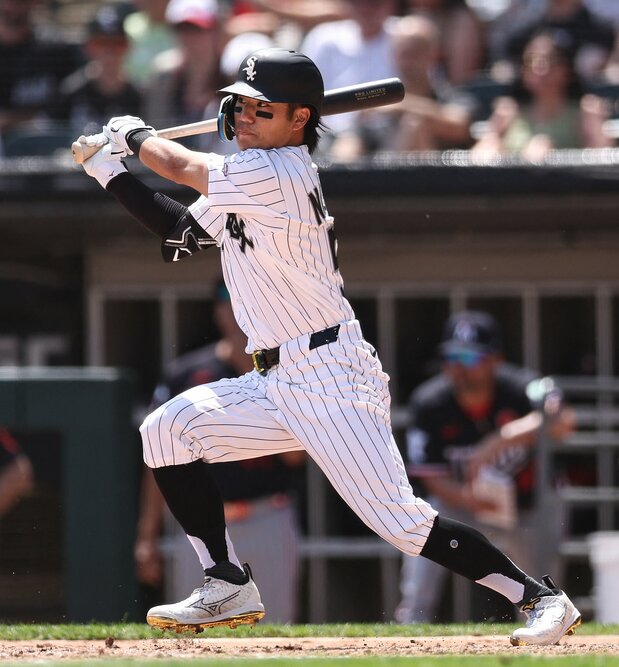 Chicago White Sox outfielder Nishida Rikuu gets a hit against the Minnesota Twins in his major-league debut in May 2026. (© AFP/Jiji)
Scholarships Earned Through On-Field Achievement
The attention that Sasaki and Nishida have attracted can be expected to inspire other Japanese high schoolers to apply to study and play at US colleges.
Nishida received support in studying abroad from Athlete Brand Japan, a company that helps Japanese students and athletes who hope to study and play overseas. Nemoto Shingo, the company’s president, once worked at the US headquarters of Japanese sporting goods manufacturer Mizuno. He left to found Athlete Brand Japan in 2003 with the aim of expanding career opportunities for Japanese athletes. To date, the company has helped nearly 1,400 Japanese athletes, mainly baseball and soccer players, study in the United States.
“The numbers have increased over these past two years,” says Nemoto. “There has been overwhelming interest since the media drew attention to Sasaki’s admission to such a prestigious school as Stanford University. This has helped bring a rapid rise in companies offering support for students to study abroad.”
This summer, Athlete Brand conducted two selection rounds in Japan targeting third-year high school students who play or have played on hardball baseball teams, with around 40 students joining their practice sessions. Video of their play was sent to several US colleges to gauge the schools’ interest. They followed up in September and October with two selection sessions in the United States. According to the company, around 20 players typically take part each year, with 10 to 15 ultimately deciding to study in the United States.
School fees and living expenses for studying in the United States typically run between $20,000 and $25,000 per year, a heavy burden for families. But US colleges offer scholarship programs for top-performing athletes, which Japanese students with enough talent may be able to secure.
A Future Beyond Baseball
Nemoto describes Nishida as a “model case” for studying abroad to play baseball. Initially, Nishida played for two years at Mount Hood Community College, a two-year school in Oregon. He then transferred to the University of Oregon, an NCAA Division I school. After playing for one year on a scholarship, he was selected in the MLB draft.
Nishida says that he dreams of being an entrepreneur in the future, and while continuing to play, he has already set up his own company to help Japanese baseball players and others to study overseas. He is now exploring new possibilities based on his own experience and the language skills he gained.
His example suggests that high school baseball players who choose to study abroad may do so not simply to advance their careers as players, but also to learn English and open up new career paths.
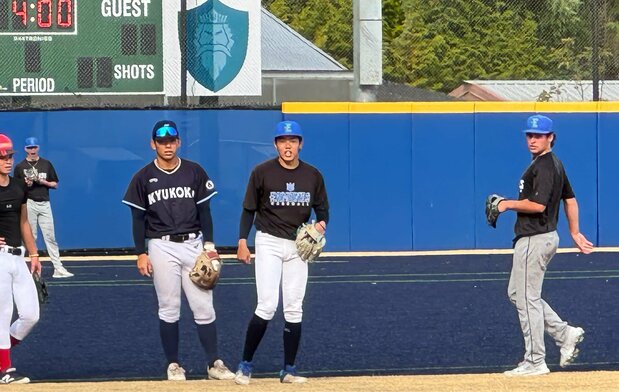 Japanese high school students take part in a college baseball tryout held in the United States in September 2025. (© Athlete Brand Japan)
Sport Can Transcend the Language Barrier
In recent years, the number of Japanese studying abroad has diminished, and many have pointed out that young people are becoming increasingly inward-looking. Japan’s Ministry of Education, Culture, Sports, Science, and Technology tallies the number of Japanese students studying abroad (mainly long-term students seeking degrees) based on figures published by overseas institutions. The number peaked at about 80,000 around the year 2000, but fell to just over 50,000 in 2023 and has yet to return to the pre-pandemic level of 62,000.
In fiscal 2024, a MEXT survey of high school students’ attitudes toward studying abroad found that 65.2% of respondents did not want to study overseas, citing reasons such as language barriers, concerns about safety, anxiety about the application process, and financial concerns.
But the opposite trend appears to be emerging in sports-related study abroad. The sporting world is increasingly global, and there are now more Japanese players making their mark in sports leagues in Europe and North America. The trend is particularly notable in baseball and soccer. Young people aiming to play at a higher level are using sport as a lingua franca to overcome language barriers and embark on new challenges.
Nemoto explains that “Japanese students display high proficiency in sport and music because of the effort they exert from the junior level. This gives them a powerful tool to connect with the world, even if their language skills are limited.” The examples of these young Japanese athletes may be a sign of a new approach that can help more young people to take a leap and strive to achieve their true potential.
(Originally published in Japanese. Banner photo: Sasaki Rintarō, at left, poses on July 24, 2026, with Miami Marlins manager Clayton McCullough at the team’s home ballpark, where he attended a game after joining the club. © Jiji.)



 Read in other languages