


Tokyo, Oct. 30 (Jiji Press)--The Japanese government is weighing how to respond to Germany's interest in joining a Japan-Britain-Italy project to develop a next-generation fighter jet, having acknowledged that Berlin's participation could cause delays and jeopardize plans to begin deployments in 2035.
German Chancellor Friedrich Merz expressed interest in participating in the Global Combat Air Program, telling a joint press conference with Japanese Prime Minister Sanae Takaichi after their meeting in Tokyo Wednesday that Berlin would like to explore the possibility of cooperation in fighter jet production. However, Takaichi made no mention of GCAP at the joint briefing.
Japanese Chief Cabinet Secretary Minoru Kihara confirmed at a press conference Thursday that Takaichi and Merz had discussed the fighter development project at their summit but provided few details, saying only that the government would "proceed while taking into account the development schedule and the impact on the defense industry."
GCAP, announced by Japan, Britain and Italy in 2022, is overseen by the GCAP International Government Organization, or GIGO, while an international joint venture called Edgewing handles design and manufacturing. The program aims to develop a sixth-generation fighter equipped with advanced stealth technology and networked combat capabilities.
Germany had initially pursued the development of a next-generation fighter with France and Spain, but the initiative collapsed due to disagreements over which company would lead development. British Prime Minister Andy Burnham told Merz in a meeting on Oct. 8 that he was open to Germany joining GCAP.
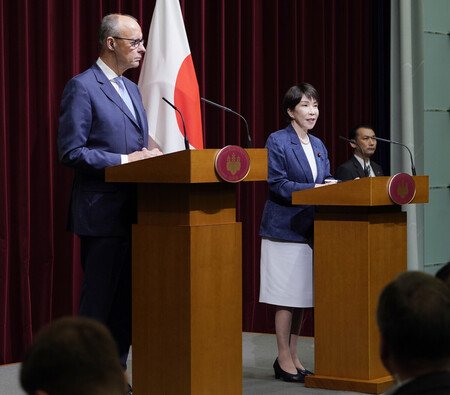
 Japanese Prime Minister Sanae Takaichi (right) and German Chancellor Friedrich Merz hold a joint press conference at the prime minister's office in Tokyo on Wednesday.
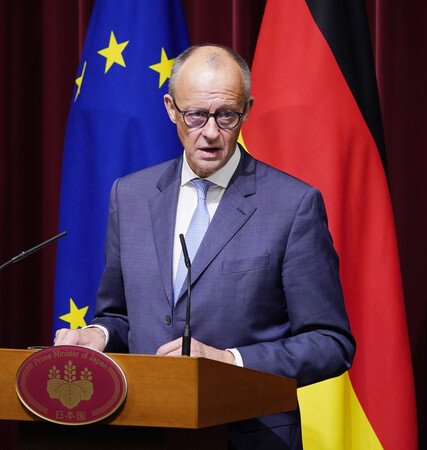 German Chancellor Friedrich Merz speaks at a joint press conference with Japanese Prime Minister Sanae Takaichi at the prime minister's office in Tokyo on Wednesday.
[Copyright The Jiji Press, Ltd.]







 Read in other languages