



The latest quarterly survey on generative AI use in Japan finds it to be more popular than ever, even among older users, although the main uses seem to be shifting over time.
Growing Number of Older Users
The Nippon Research Center has been conducting surveys regarding generative AI four times a year since 2023, targeting men and women aged 20 to 69. The June 2026 survey found that the percentage of respondents stating they “have used” this technology was 56.3%, the first time in these surveys that usage has exceeded 50%. At 50.4%, the percentage that answered they were “currently using” these tools was also in the majority for the first time since that question was added to the survey in December 2025.
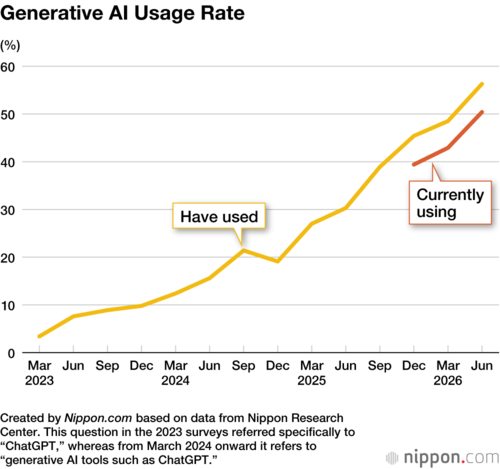

Looking at the different age ranges, the usage rate was highest among those in their twenties (68%), followed by those in their thirties (61%) and forties (58%). However, a significant rise was seen among respondents in their fifties (55%) and sixties (45%), compared to the March 2025 survey, where these older cohorts had still been in the lower 20% range. This seems to indicate that generative AI is being adopted more readily across all generations both for work and in daily life.
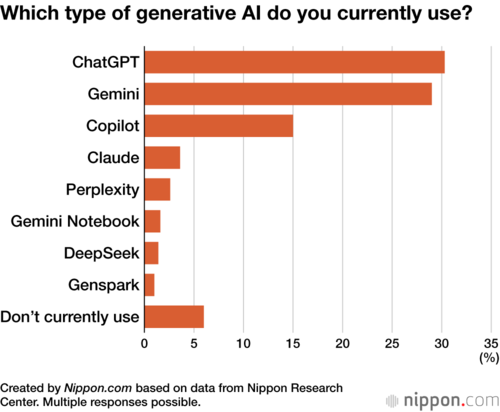
The most commonly used generative AI tool was ChatGPT (OpenAI) at 30.3%. Coming close behind was Gemini (Google) with 29.0%, and then Copilot (Microsoft) at 15.0%.
Are Users’ Needs Gradually Changing?
Asked why they used these tools, the top answer at 62.9% was “information gathering and research.” Other main uses included “generating ideas” for hobbies, creative projects, and everyday inspiration (29.2%) and “creating and proofreading emails and documents” (26.7%).
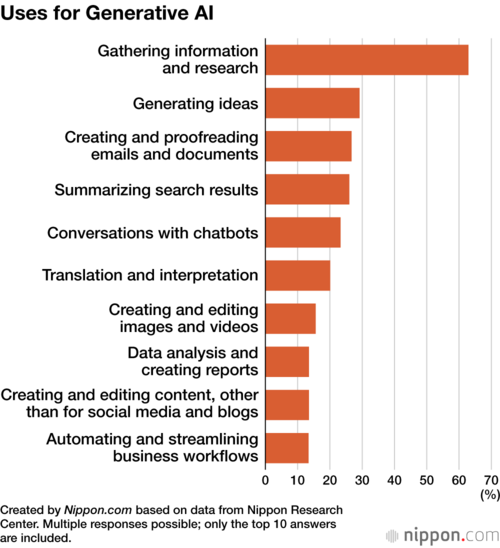
When compared to the results of the September 2025 survey, “information gathering and research” had risen by 7.8 percentage points, while “generating ideas” fell by 8.0 points. This suggests that users’ needs may be gradually changing when it comes to the use of generative AI.
- NRC Daily Tracking–Generative AI survey June 2026 (Japanese) from Nippon Research Center
(Translated from Japanese. Banner image © Pixta.)








 Read in other languages