Managing Difference: Rethinking Japan-China Crisis Prevention
Politics- English
- 日本語
- 简体字
- 繁體字
- Français
- Español
- العربية
- Русский
Japan-China relations have been in a state of upheaval since November 2025, when Prime Minister Takaichi Sanae—under questioning from an opposition politician in the lower house Budget Committee—suggested that a contingency in the Taiwan Strait might qualify as a “situation threatening Japan’s survival.” China’s response has gone far beyond sharp words to include restrictions on trade and people-to-people exchange. In the following, I identify some of the structural factors behind this extreme reaction and offer a new prescription for managing chronic Japan-China friction.
Charges of Resurgent Militarism
The inciting phrase, “survival-threatening situation” is a legal term denoting a category of situation in which the government could legitimately consider the limited exercise of Japan’s right to collective self-defense (the use of military force in situations other than a direct attack on Japan). This does not mean that the government would automatically exercise that right in any situation it deemed threatening to Japan’s survival. Nonetheless, the Chinese backlash to Takaichi’s off-the-cuff remark has been intense and unremitting.
Chinese officials, echoed by China’s party- and state-backed media, have hammered Japan for what they call the “new militarism.” Such language has even crept into Beijing’s summitry and diplomatic documents. According to several news reports, President Xi Jinping used the term to criticize Japan at the US-China summit in Beijing this past May. At the China-Russia summit held shortly thereafter, the two leaders adopted a joint statement calling on the Japanese government to reject neo-militarism and retreat from “remilitarization.”
What exactly is meant by the “new militarism”? In Chinese discourse on the subject, it is described as an updated version of pre–World War II militarism, adapted to today’s political and social circumstances. As the Chinese explain it, Japan’s conservative and rightwing politicians have teamed up with defense bureaucrats and the domestic arms industry to rearm Japan and expand its ability to use military force overseas. Working within the democratic process, they have conspired to incrementally weaken the constitutional constraints of Article 9 (renunciation of war) and Japanese statutes mandating an exclusively defensive defense.
In tandem with these verbal attacks, the Chinese government has tightened restrictions on the export of dual-use goods to Japan, adding more and more Japanese entities—including businesses with defense connections, as well as the National Defense Academy, the Japan Aerospace Exploration Agency, and the National Institute for Defense Studies—to its dual-use export control list (entities banned from receiving dual-use goods) and its dual-use export watch list (subject to restrictions on dual-use exports). People-to-people exchanges are also languishing.
While a single remark in a parliamentary context may have detonated the latest conflict, it cannot by itself explain the growing volatility of Japan-China relations. Prominent among the underlying factors fueling recent eruptions—although by no means the sole cause—is an asymmetry between the two governments’ basic perceptions of Taiwan and cross-strait issues. In the following, I examine this perception gap as a key factor hindering the de-escalation of tensions and prolonging bilateral friction. With this as a starting point, I assess the current state of Japan-China relations and explore the possibility of a crisis-management approach that does not presuppose a shared understanding of the issues.
Clash of Worldviews
In Japanese security circles, the escalation of tensions in the Taiwan Strait is discussed primarily in relation to the potential impact on Japan’s physical security, including ramifications for sea lanes, US military bases in Japan, and interoperability between Japan’s Self Defense Forces and American forces. Policies ranging from diplomatic management of tensions to the deployment of deterrent forces in the region are formulated on the basis of these assessments.
By contrast, in the public statements that come out of the Chinese government and the Chinese Communist Party, the Taiwan issue is characterized not simply as a matter of territorial integrity and national sovereignty but also as a fundamental goal linking Xi Jinping’s vision of “national rejuvenation” with the historical mission of the Communist Party and the Chinese state. The story of how China triumphed over foreign aggression and internal conflict to achieve national unity and autonomy ranks high among the factors (along with economic development, social order, and nationalistic sentiment) supporting the legitimacy of the CCP’s one-party rule. Within that national narrative, the reunification of Taiwan with the mainland is regarded as important unfinished business.
For China, in other words, the Taiwan problem represents a threat not to the country’s physical survival but to the continuity of the nation’s self-understanding of its history and identity. This is what scholars in the field of international politics term “ontological security.”
This is not to suggest that Japan is indifferent to ontological security or that ontological security is China’s sole concern. Japan has its own cherished self-image (centered on its postwar identity as a peace-loving nation, an ally of the United States, and a supporter of the rules-based international order), and China’s foreign and defense policies clearly incorporate such physical considerations as military capability and geography. The asymmetry lies in the relative importance of ontological versus physical security in the two countries’ framing of cross-strait issues.
This asymmetry helps explain the nature and persistence of tensions between our two countries. Tensions based on the perception of a physical threat tend to focus on the other side’s military capabilities and actions and thus can be managed (at least theoretically) through a combination of deterrence and reassurance—adjustments in the deployment of forces on the one hand and dialogue to enhance the transparency of each side’s actions and intentions on the other. When the conflict stems from a nation’s self-understanding and sense of historical mission, explanations and behavioral adjustments tend to be less effective in dialing down its perception of a threat.
The repeated use of the term “new-militarism” by Chinese officials and China’s party- and state-run media is a manifestation of the latter dynamic. The word creates a conceptual framework in which Takaichi’s reply to one Diet interpellator becomes an indicator of a historic change in Japan’s security policy and national strategy, rather than an isolated gaffe. The label also works to stigmatize Japan as a threat to the stability of the regional order.
The Limits of Reasoning
This asymmetry has important implications for Japan’s response to China’s outrage.
Within Japan, public figures are often urged to explain the purpose of their policies patiently and thoroughly to prevent or mollify public opposition. The problem here, however, is not the quantity or quality of public communication but the framework in which Japan’s words are received and interpreted.
China’s interpretation of the phrase “survival-threatening situation” is a prime example. In its original legal context, the term refers to a specific category, defined by rigorous criteria, that constitutes the minimum requirement for even considering a limited exercise of collective self-defense. Viewed within the broader context in which it was uttered, it hardly comes across as a policy statement calling for Japanese military intervention in the event of a Taiwan contingency. In China, however, the very act of mentioning a Taiwan contingency in the same breath as the term “survival-threatening situation” was taken as an overt expression of Japan’s “intent to intervene” in the cross-strait affairs. The words that we send take on new meanings when they enter the recipient’s conceptual framework. For the sender to control the recipient’s interpretation is no easy matter.
The interpretation and language described above is by no means limited to government officials and state- or party-controlled media. At the same time, judging by recent publications, it has not been uniformly embraced by Chinese scholars residing in China. From June 2026 on, the website Global China (a “global forum of Chinese political scientists”) launched a series on “Japan in an era of upheaval,” featuring Chinese-language commentary by 38 scholars based in countries around the world. Reviewing these papers, I encountered a range of analytical frameworks and terminology, even among those scholars residing in China.
To be sure, a number of commentaries cite not only Takaichi’s response but also Japan’s growing defense budget, deployment of long-range standoff missiles, arms exports, and integrated maritime policy to support the thesis that the nation has deviated from its postwar commitment to peace and may be heading toward a “new militarism.” However, other papers in the series eschew such language. One analysis characterizes the aforementioned changes in defense policy as a “radical strategic shift” predicated on a perception of the international environment and the Japan-US alliance that is detached from reality. To buttress its argument, it cites Japanese discourse suggesting that Japan might respond before the United States in the event of a Taiwan contingency, ultimately drawing the United States into the conflict instead of the other way around. Other analyses characterize Japan as a nation struggling to adapt to structural changes in the US-China relationship. In short, if the essays in this project are any indication, Japan’s alleged march toward a “new militarism” is by no means a concept unanimously embraced by China’s academic community.
The Chain of Perception
A noteworthy feature of some of these papers is the way they cherry-pick and carefully quote Japanese statements and policies taken out of context to support the thesis of a fundamental shift in Japan’s national strategy and foreign policy. “New militarism,” one of the strongest terms used in these analyses, represents the extreme end of the spectrum.
We should avoid lumping all these commentaries together as the same sort of “misreading” of Japan’s intentions. It is not my intent here to critique each work or dissect the motives of individual scholars. However, for the purposes of analysis, it is important to distinguish between honest misunderstandings (caused by insufficient information or legal background, for example) on the one hand and deliberate, politically driven distortions of intent on the other. The latter corresponds to what political scientists call ”strategic framing.” With respect to the interpretation of Takaichi’s Diet response as proof of Japan’s “intent to intervene” in the Taiwan Strait, honest misunderstandings and deliberate distortions may well exist side by side.
In any case, this perception of Japan’s motives, which appears in a number of recently published papers by Chinese scholars, raises two interconnected problems that have been the subject of many studies in the field of international politics: the difficulty of communicating one’s true intentions and the dangers posed by the “chain of misperception.” Measures that party A adopts for purely defensive reasons may appear to party B as a sign of aggressive intent, and the countermeasures party B takes in response are likely to reinforce the perceptions that inspired party A’s defensive measures to begin with. With issues of national self-understanding and historical narrative further complicating the picture, there emerges a vicious cycle that is difficult to break, however often one explains one’s intent. This is because, as new facts come to light, the tendency is for the other side to focus selectively on those facts that fit most neatly into its pre-existing narrative.
Moreover, even if Japan can succeed in limiting misunderstandings regarding its intentions, there is little it can do to eliminate deliberate misrepresentations. Accordingly, the way for Japan to lead the way in regional crisis management is not by trying to change the other side’s interpretation of the facts but by controlling the pathways by which misunderstandings and misrepresentations can lead to armed clashes in the field.
Setting New Goals
It is worth taking a look at systems that have been designed expressly to prevent unintended clashes as a matter completely separate from political conflict resolution. At the height of the Cold War, the United States and the Soviet Union, despite their fierce political rivalry, managed to establish the Washington-Moscow hotline in 1963 and conclude the Incidents at Sea Agreement in 1972. Their purpose was not to find ideological common ground but to establish protocols for communication, notification, and avoidance and lay the institutional groundwork for mutually predictable behavior. While the current situation in the Taiwan Strait obviously differs from the threat of nuclear war between the United States and the Soviet Union, the basic principles for averting incidents and preventing escalations are still applicable.
Nor need we look that far afield to find a precedent for this approach. Indeed, the 1972 Japan-China Joint Communiqué, which normalized diplomatic relations between Japan and the People’s Republic of China, stated that “in spite of the differences in their social systems . . . the two countries should, and can, establish relations of peace and friendship.” In the 2014 “discussions for improving Japan-China relations,“ the two governments agreed to engage in dialogue to “establish a crisis-management mechanism and avert the rise of unforeseen circumstances,” even while acknowledging that they had ”different views“ regarding the situation in the East China Sea. What the two documents have in common is the idea of building and maintaining stable relations despite unreconciled differences. Particularly relevant for our current situation is the 2014 document’s assertion of the need for crisis management amid persistent differences in perception.
In the spirit of these documents, Japan should shift the thrust of its China diplomacy from the building of shared understandings to crisis control. The fundamental goal of our policy toward China today should be breaking the chain of misperceptions and miscalculations and averting unintended escalations—not converting the other side to our worldview.
This is not to deny the importance of deterrence. Crisis management and deterrence complement one another; the former helps the outbreak or escalation of unintended clashes, while the latter increases the costs of intentionally altering the status quo.
The minimum requirement for crisis management at this juncture is to maintain the functioning of existing frameworks, such as the crisis-management mechanism agreed on in 2014, regardless of political tensions.
A basic condition for policy oriented to this objective is consistency in the government’s communication. The Japanese government should explain what concepts like “survival-threatening situation“ mean and do not mean from the outset, to establish an official frame of reference. The aim should be not to control Chinese perceptions but to limit the room for misinterpretation and to leave a record by which China and other countries can verify the Japanese government’s intentions. The criterion for judging the success or failure of this crisis-management approach should be the extent to which it averts miscalculations and escalations, not whether it leads to closer Japan-China relations overall.
Stability in Japan-China relations is not a matter of embracing identical views on security or the regional order. It stems from our ability to keep the lines of communication open during emergencies and control the repercussions of accidents and miscalculations. The idea expressed in both the 1972 and 2014 documents—building and maintaining relations while acknowledging differences—applies equally today, when our differences center on conflicting views of the regional order, including the Taiwan Strait. Restricting the pathways by which these conflicting perceptions can lead to armed clashes, even while upholding our own principles, is surely the most responsible route to regional stability. With this stability as a basis, our two societies can work to deepen their understanding of one another—including enduring differences—and continue the search for common ground.
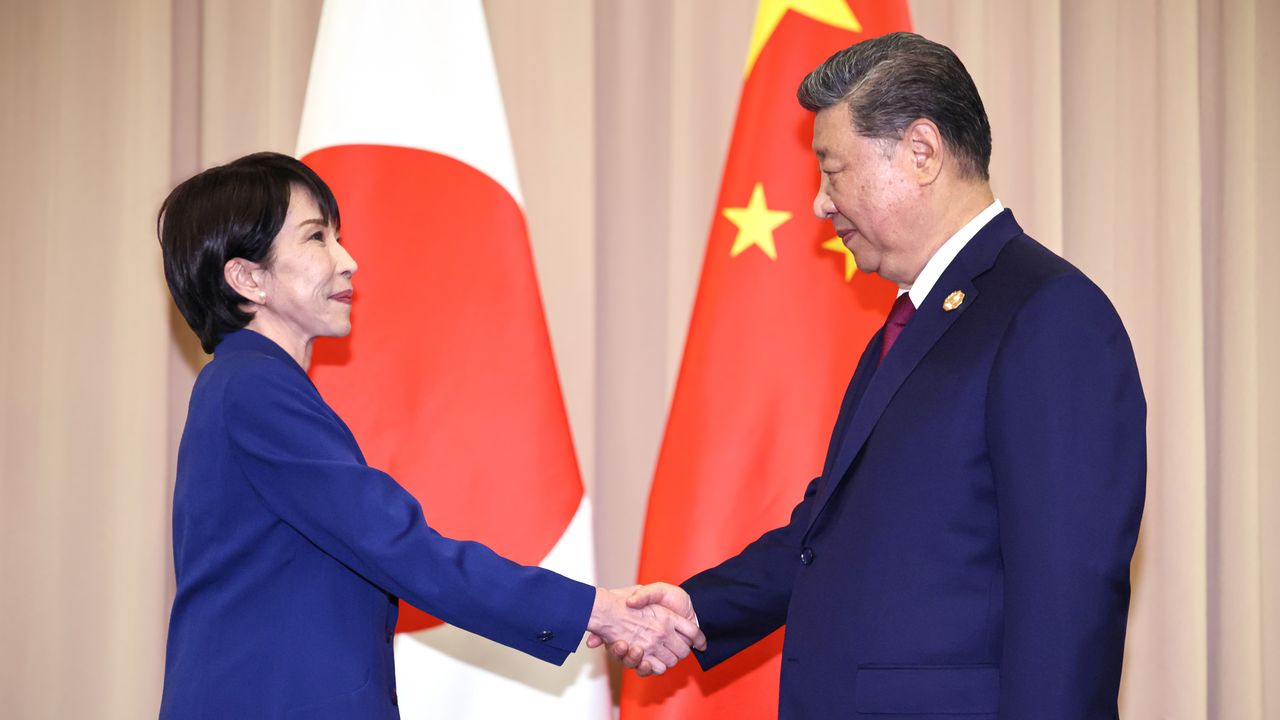
(Originally published in Japanese. Banner photo: Prime Minister Takaichi Sanae shakes hands with President Xi Jinping of China on the eve of a bilateral summit held in Gyeongju, South Korea, on October 31, 2025, just days before relations broke down over Takaichi’s response to a question in the Diet regarding “survival-threatening situations.“ © Jiji.)