



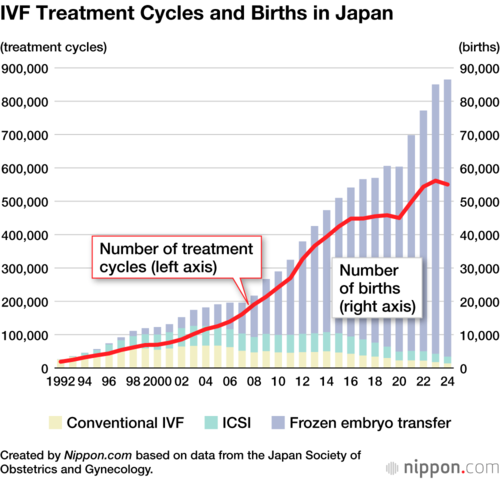
Babies born via in vitro fertilization reached a record 86,473 in Japan in 2024, representing approximately one in every eight births nationwide.
Supported by Public Health Insurance
A record 86,473 babies were born through in vitro fertilization in Japan in 2024, up 1,436 from the previous year, according to data from the Japan Society of Obstetrics and Gynecology. Demographic statistics show that there were 686,173 births in the country in 2024, meaning that IVF births accounted for 12.6% of all newborns, or around one in eight. Meanwhile, the total number of treatment cycles administered to patients fell by 11,399 to 550,265.
IVF is a fertility treatment in which eggs are fertilized with sperm outside the body and the resulting embryo is transferred back to the uterus. When the world’s first IVF baby was born in Britain in 1978, it drew global attention as a “test tube baby.” In Japan, more than 1 million children have been born through the procedure since the country's first successful case at Tōhoku University in 1983.
Fresh transfers using conventional IVF, where eggs and sperm are left in a petri dish to fertilize naturally, accounted for less than 2% of births. The vast majority of successful deliveries instead involved frozen embryo transfer. Under this approach, embryos—mostly created using ICSI, or intracytoplasmic sperm injection, where a single sperm is injected directly into an egg—are frozen and transferred only after the uterus has been prepared in a subsequent cycle.

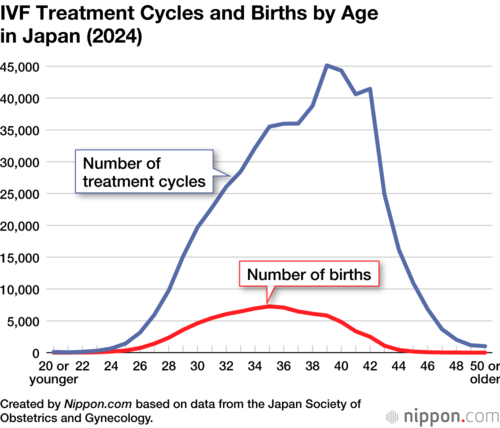
By age, treatment cycles were highest among women aged 39 (45,124 cycles), followed by those aged 40 (44,315) and 42 (41,447). As part of measures to address Japan’s declining birthrate, public health insurance coverage was expanded to fertility treatments like IVF in 2022. However, the system imposes age-based limits, capping coverage at six attempts for women starting treatment before age 40, and three attempts for those aged 40 to 42. This is believed to drive the surge in procedures among women in that age range. Even so, the number of successful births resulting from treatment peaks for mothers in their mid-thirties before steadily declining.
- Data on IVF treatment (Japanese) from the Japan Society of Obstetrics and Gynecology
- Information on fertility measures (Japanese) from the Children and Families Agency
(Translated from Japanese.)









 Read in other languages