



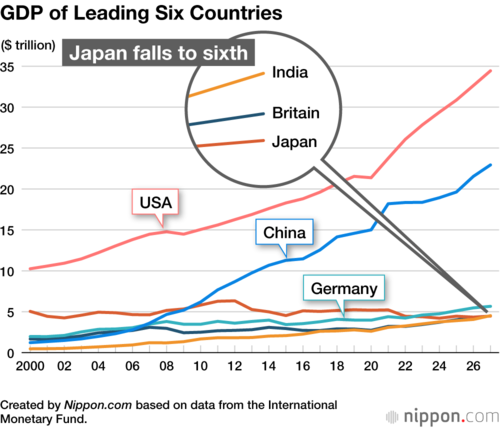
The International Monetary Fund projects that the Japanese economy will be overtaken by India and Britain in 2027.
Sliding Further
According to the International Monetary Fund’s World Economic Outlook, Japan’s gross domestic product, measuring the size of its national economy in US dollar terms, will drop from fourth to sixth place globally in 2027.
Japan’s economy enjoyed a postwar boom, growing rapidly to become the second largest worldwide in terms of gross national product in 1968, behind the United States. The country maintained its status as an economic superpower for nearly four decades. Following the collapse of its bubble economy, however, Japan suffered deflation in the 2000s, and slipped to third place behind China in nominal GDP in 2010, before falling further to fourth after being overtaken by Germany in 2023.
The World Economic Outlook estimates Japan’s 2027 nominal GDP at $4.47 trillion. This would see it fall to sixth place, narrowly overtaken by India with its still-growing population at $4.52 trillion, and Britain at $4.49 trillion.

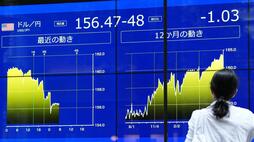
One factor behind Japan’s falling rank is the persistent weakness of the yen in recent years, which reduces its GDP when converted into US dollars. As Western central banks began raising interest rates in 2022, the yield gap widened with Japan, which maintained its ultralow interest rate policy for an extended period, accelerating the yen’s depreciation on foreign exchange markets. Many economists view exchange rate movements as a key factor in Japan being overtaken by the UK economy, which itself is hardly booming.
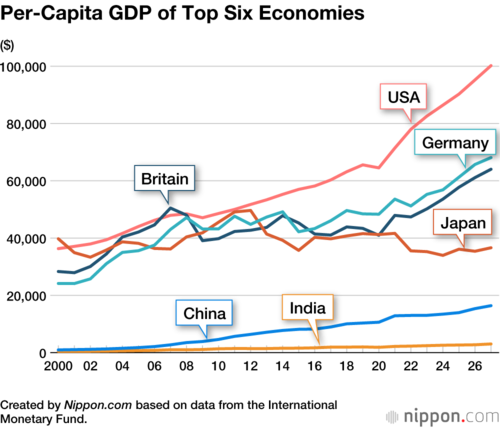
A more fundamental driver, however, is the persistent sluggishness of Japan's economic growth. Its growth rate for 2027 is projected by the IMF to fall below 1%, and is the lowest among the top six economies. Japan also ranks fourth in terms of per capita GDP, a measure of productivity. While Western nations have seen an upward trend since around 2020, Japan has experienced a decline, widening the gap.
Takayama Takeshi, a senior economist at the NLI Research Institute, identifies Japan’s shrinking labor force due to its aging population as a reason for its economic stagnation. The country also compares unfavorably with the United States, where industrial turnover is dynamic, with new startups emerging even as existing companies fail. By contrast, Takayama notes that “Japan’s traditional strength in manufacturing has declined, leaving automobiles and semiconductor-related sectors as virtually its only remaining growth industries.” He suggests that Japan should focus its efforts on fields with future growth potential, such as nursing care and healthcare.
- World Economic Outlook (October 2026) from the International Monetary Fund
(Translated from Japanese.)







 Read in other languages