


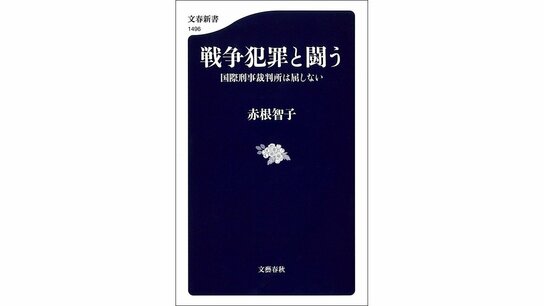
Akane Tomoko built her career as a public prosecutor before joining the International Criminal Court as a judge. Today head of the Court in the face of US sanctions, she has written a book explaining why the world must defend the institution before it is too late.
A Rise to the Top, a Blow from an Ally
In her 2025 book Sensō hanzai to tatakau (Fighting War Crimes), Akane Tomoko, who has served as a judge on the International Criminal Court since March 2018 and is now its president, laid out her concerns about the mounting pressure on the ICC and the threat it poses to international justice. “We must never forget that people around the world who are suffering from the ravages of war and other calamities have placed their hopes in our work,” she writes. “The light of their hope must not be allowed to be extinguished.”
In July 2023, Russia placed Akane and other ICC officials on its wanted list. The move came after she and other judges of the ICC’s Pre-Trial Chamber issued an arrest warrant for Russian President Vladimir Putin, finding reasonable grounds to believe he was involved in the forcible deportation and transfer of Ukrainian children to Russia, acts that constitute war crimes. However, Russia was not the only country from which Akane would face focused pressure.
In March 2024, six years into her statutory nine-year tenure as a judge at the ICC, Akane was elected president of the court. Later that year in November, the ICC issued an arrest warrant for Israeli Prime Minister Benjamin Netanyahu over alleged war crimes in the Palestinian territories. In response, US President Donald Trump signed an executive order authorizing sanctions against the court. The first target was Chief Prosecutor Karim Khan, followed by eight judges. In August 2026, Akane herself was designated for sanctions.
Until then, the sanctions’ targets had been individuals. That would change with the October announcement of the 2026 Nobel Peace Prize, awarded to former ICC judge Navi Pillay. Within hours, President Trump announced new sanctions, this time on the ICC itself.
“As Good as Dead”
Sanctioned individuals may be cut off from banking services outside the Netherlands, where the ICC is based. Their assets held in the United States are frozen and they are barred from traveling there. US companies are prohibited from conducting transactions with them. But what would happen if the ICC itself was targeted? “Banks and companies around the world may stop doing business with the court,” writes Akane in her book. She continues:
“We may no longer be able to pay our staff—paralyzing every aspect of the organization’s operations—or transfer funds to our field offices in Ukraine and Africa where investigations are conducted. The ICC’s information and communications technology systems are provided by US companies. Without these services, even our ability to store electronic data would be affected.”
Akane had warned that if such sanctions were imposed, the ICC would be “as good as dead.” Now, that scenario is becoming a reality. She laments that the ICC’s member states are not doing enough to stand up to US sanctions. “It is truly regrettable that the member states, including Japan, have been so slow to act. If we allow a great power to act as it pleases and destroy the ICC, the rule of law in the international community may very well collapse.” What’s more, according to Akane, the severity of this crisis is yet to be fully appreciated by the member states.
A Call for Unity to Protect the ICC
The ICC was established in 2002, drawing on the Nuremberg and Tokyo trials following World War II as well as later international tribunals dealing with crimes committed in the former Yugoslavia and Rwanda.
Whereas the International Court of Justice functions to adjudicate disputes between nation states, the ICC’s role is to prosecute individuals for war crimes and crimes against humanity. Its members are the 125 States Parties to the Rome Statute of the ICC. The United States, Russia, and China are not members, but the United States played an active role in the process of its creation. The ICC employs about 1,000 people, including judges and prosecutors.
Of all the States Parties, Japan is the largest contributor to the ICC’s budget, accounting for 14.7%, amounting to some ¥4.6 billion for 2025. Akane’s book offers an accessible overview of the court’s work and its record to date. It also traces the sincere efforts of a Japanese woman who has devoted her career in law to promoting peace in the international community.
Akane emphasizes the importance of the ICC and makes a passionate case for its continued existence. “By implementing universally recognized norms of international law, the ICC serves the interests of the international community,” she writes. “It performs an indispensable function at a time when atrocities continue around the world and countless lives are under threat.” She stresses that the court is committed to integrity, and that maintaining independence and neutrality is fundamental to its work. “I urge all countries around the world to unite in defending the ICC.”
The International Criminal Court is facing the greatest crisis in its history—one that could ultimately lead to the erosion of the rule of law on the international stage. “In Japan, people will often bring up the ‘rule of law,’ but if we merely pay lip service to it, it will prove fragile in the face of a major threat and disintegrate,” warns Akane. “If that happens, we may find ourselves in a world where ‘rule of force’ prevails. As defenders of the global rule of law, we must stand firm, whatever it takes.”
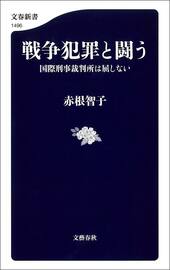
Sensō hanzai to tatakau (Fighting War Crimes)
By Akane Tomoko
Published by Bungei Shunjū in 2025
ISBN: 978-4-16-661496-7
(Originally published in Japanese.)




 Read in other languages