
Japan’s Regional Birthrate Divide: A Demographic Investigation
Economy Politics Health- English
- 日本語
- 简体字
- 繁體字
- Français
- Español
- العربية
- Русский
A Recent Phenomenon
In 2025, Japan’s total fertility rate, indicating the number of children a woman has in her lifetime, fell by 0.01 points to a new low of 1.14.
According to demographic statistics from Japan’s Ministry of Health, Labor, and Welfare, the prefecture with the lowest fertility rate was Tokyo at 0.96, remaining below 1 for the third successive year. This is thought to be mainly due to the large number of unmarried women moving to the prefecture from smaller cities and rural areas to study or work.
Leaving aside the special circumstances of heavily urbanized areas, there was a clear divide between lower fertility rates in the eastern half of the country—including Miyagi and Hokkaidō (both 1.00) and Akita (1.05)—and higher rates in the west, such as Okinawa (1.52), Miyazaki (1.46), Nagasaki (1.42), and Kumamoto (1.40). A simple average gives a fertility rate of 1.08 for Hokkaidō and Tōhoku combined, compared with 1.34 for Kyūshū.
This fertility rate divide is a relatively recent phenomenon. In 1975, the fertility rate for Hokkaidō and Tōhoku was 1.98, compared with 2.01 for Kyūshū; in 2000, there was still little difference, with Hokkaidō/Tōhoku at a rate of 1.48 and Kyūshū at 1.55. Japan as a whole saw a recovery in its fertility rate from 2005, but there was only slight improvement in Hokkaidō/Tōhoku, and the region’s rate plunged as the overall rate started to drop from 2017, leading to a clear divide.
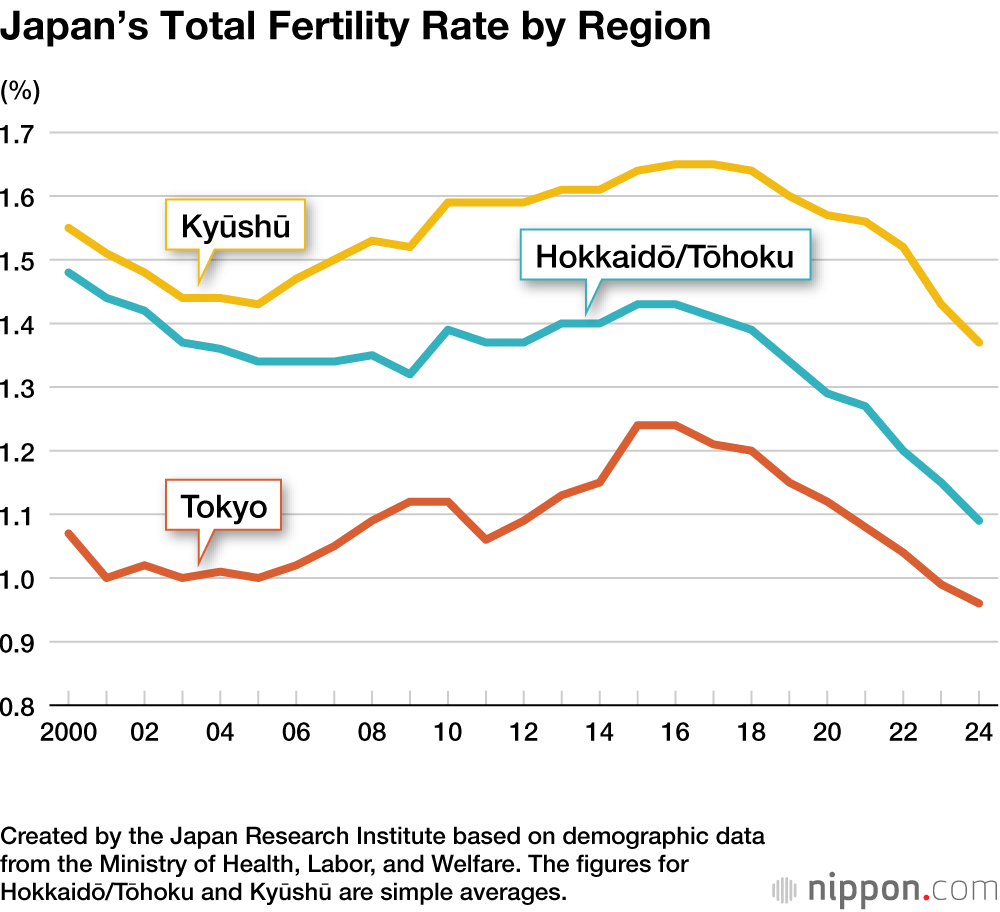
Many researchers have tried to find the reason for this disparity, but as yet no definitive cause has been identified.
This article analyzes the factors driving the fertility rate divide between Hokkaidō/Tōhoku, where there has been a significant drop, and Kyūshū, which has maintained a relatively high rate, and considers future measures to address the decline in the number of births in Japan.
Identifying Differences
Using census data and demographic statistics from 1990 to 2020, I examined the factors behind the changes in the number of births in the two regions.
This analysis breaks down changes in birth numbers based on shifts in the population of women of childbearing age, the marriage rate among those women, and the fertility rate of married women.
In Japan, the proportion of children born outside of marriage is relatively low, remaining at around 2.5%. Because the vast majority of children are born to married women, the total fertility rate is roughly equal to the proportion of married women multiplied by the marital fertility rate.
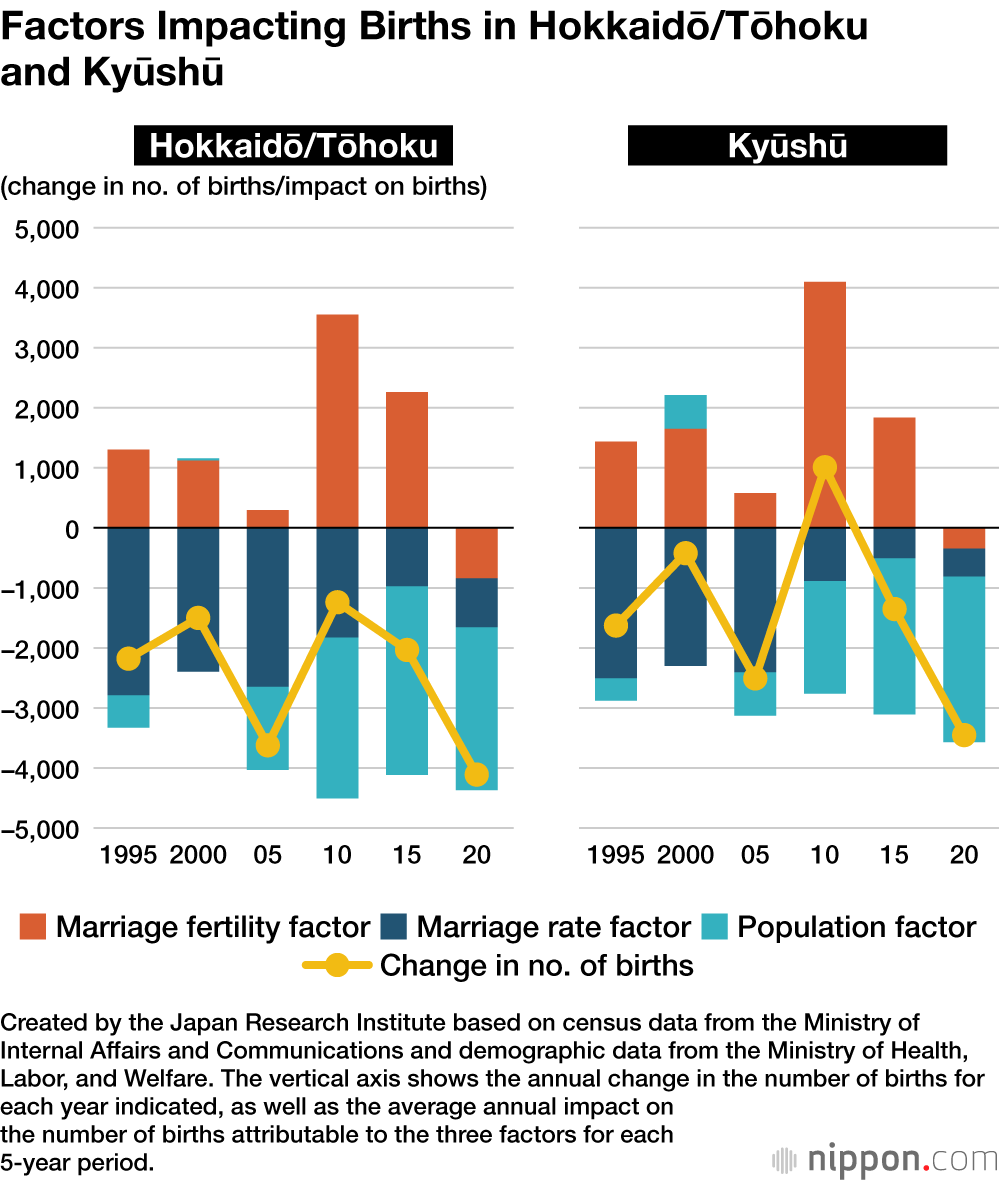
The graph above shows the positive and negative effects of the three factors. It can be seen that the two regions share common trends. Until 2005, the marriage rate was the primary driver of the decline in births, but from 2010, population became the main driver in both regions. The marriage fertility rate, which was a positive contributor through to 2015, became a negative factor in 2020.
However, a closer look reveals that from 2010, declining marriage rates had a greater negative impact on births in Hokkaidō/Tōhoku than in Kyūshū.
Similarly, while marriage fertility became a negative factor in both regions in 2020, Hokkaidō/Tōhoku experienced a more pronounced swing and a larger downward impact. Because the marriage rate and marriage fertility rate combine for changes in the overall fertility rate, the sharp drop in the northern region stems from this dual negative impact. In Kyūshū, by contrast, both factors had a more limited influence, and around 80% of the decline in births can be attributed to the shrinking population of women of childbearing age.
To understand why these shifts occurred, I will examine the marriage and marriage fertility rates separately.
Higher Education, Later Marriage
Few would dispute that trends toward remaining single or marrying later in life contribute to a decline in births. Later marriages are closely linked to the increasing number of women pursuing higher education, and as educational attainment rises, marriages may continue to be pushed back.
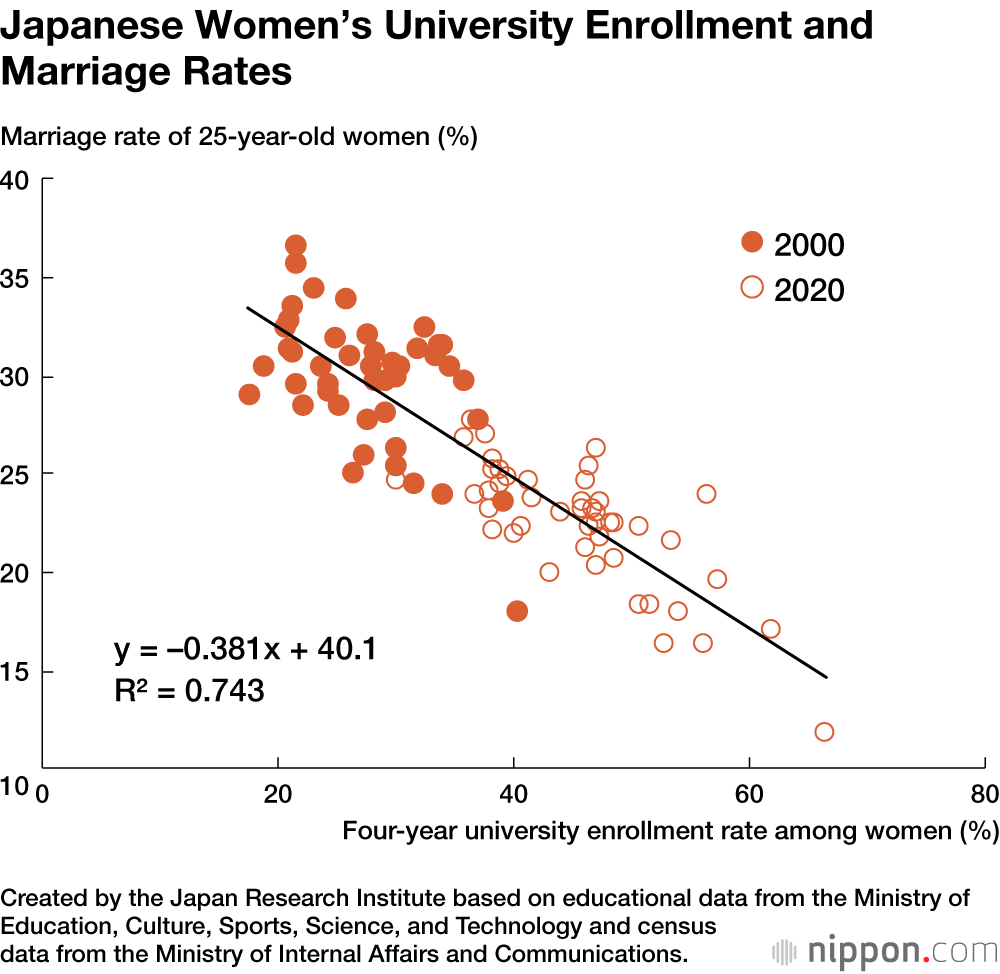
I plotted the relationship between the percentage of women enrolling in four-year universities and the marriage rate of 25-year-old women by prefecture for the years 2000 and 2020. The results show that whether women marry young can be almost entirely explained by the proportion who attend university. The values for each prefecture shifted downward and to the right along virtually the same linear path from 2000 to 2020, meaning that as university enrollment increased, the marriage rate at age 25 declined by a corresponding amount.
A comparison of annual weighted averages for women’s university enrollment reveals that although Hokkaidō/Tōhoku lagged significantly behind Kyūshū in 2000, there is virtually no gap between them today.
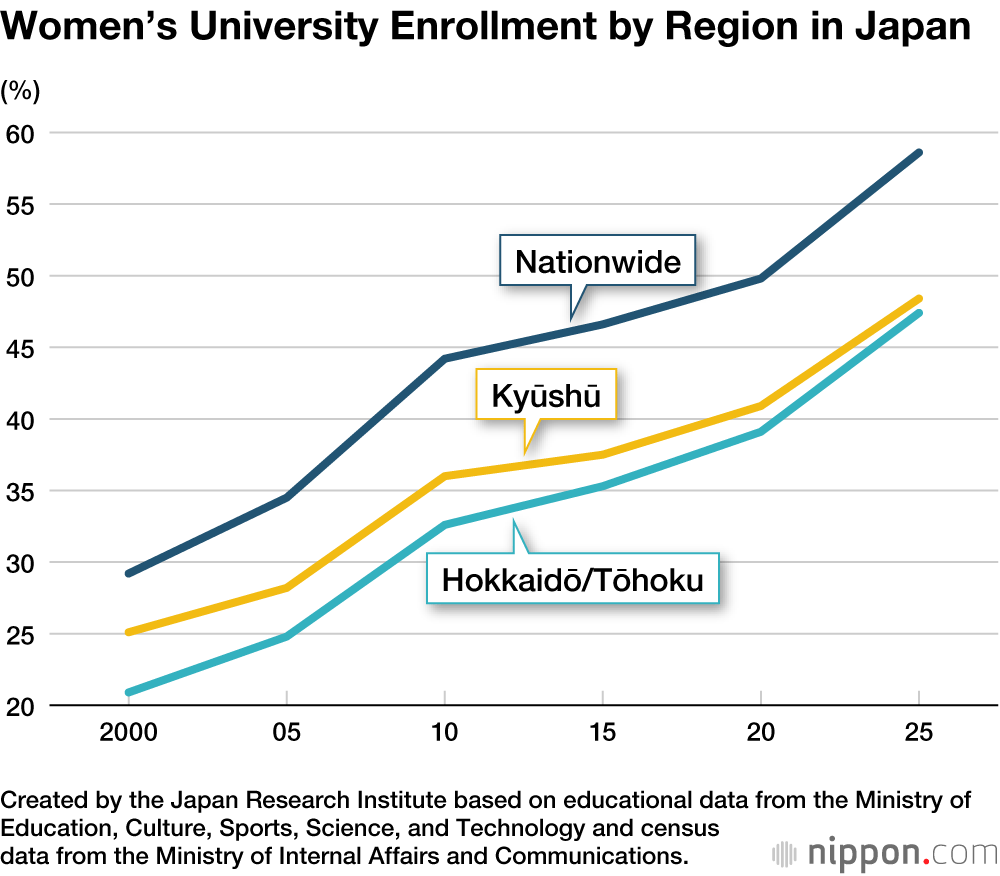
In other words, the rapid rise in women’s university enrollment in Hokkaidō/Tōhoku in recent years has driven down marriage rates among the younger generation. Given that university entry among women in areas outside Japan’s main urban centers is projected to keep climbing, it will be essential to design fertility policies that adapt to these changing social realities.
What Affects the Marriage Fertility Rate?
A comparison of marriage fertility rates in the two regions in 2000 and 2020 found that Hokkaidō/Tōhoku was at 80%–90% of the total for Kyūshū in all age groups during both periods, showing no change over two decades.
This suggests that lower marriage fertility rates in Hokkaidō/Tōhoku were not previously apparent, as lower university enrollment and women marrying relatively young kept the number of births from dropping further. However, with increased enrollment and later marriage, the underlying issue with marriage fertility came to the fore.
Why is the marriage fertility rate low in Hokkaidō/Tōhoku? I tested correlations between the rates in different prefectures and variables that might explain them, such as income and other economic factors, women’s participation in the workforce, education, the composition of families and households, stress, and daycare availability. None of these showed any definitive connection.
However, the gap between men’s and women’s attitudes toward traditional gender roles may be one explanation for the low marriage fertility in Hokkaidō/Tōhoku. I explore this possibility using data from the Cabinet Office’s 2024 Survey on Women’s Participation and Gender Equality in Regional Communities.
In the survey, respondents were asked if nine specific gender-role stereotypes existed in their hometowns or current communities, with results broken down by gender and region. For the stereotype that “housework, childcare, and nursing care are women’s work,” roughly 30% of women across all regions answered that it did exist, showing minimal regional variation. In contrast, men logged lower rates of agreement in every region, but here there was considerable variation. The figure was particularly low among men in Hokkaidō and Tōhoku, indicating a stark gap in perceptions.
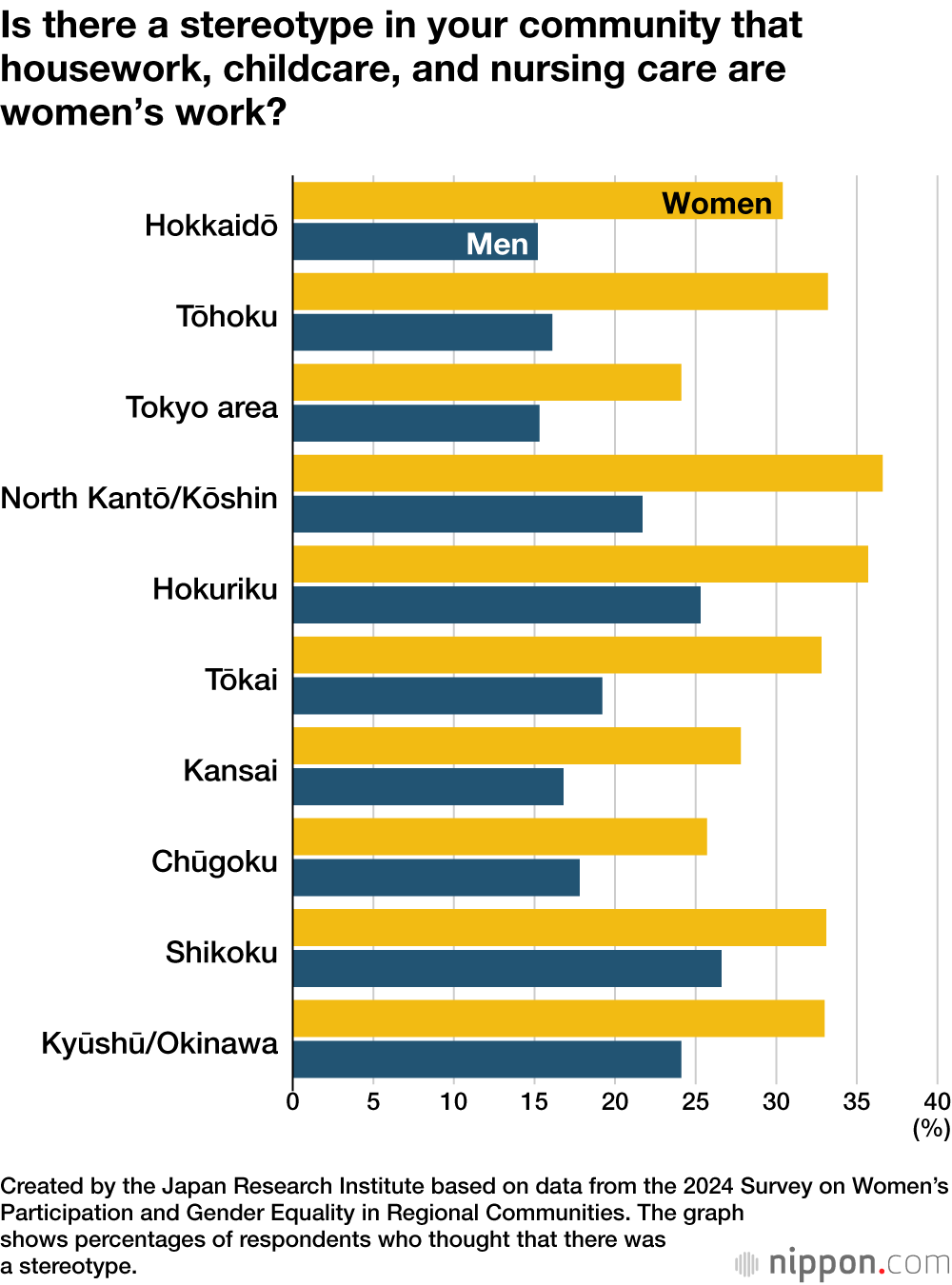
There was a similar trend for the idea that “after a child is born, women should spend less time working.” Regions with a wider perception gap on this point tend to show lower marriage fertility rates.
These findings imply that in regions where men are unaware of entrenched gender roles, couples face greater difficulty reaching agreement on having a first child or subsequent children, which lowers marriage fertility.
However, as this survey does not provide data at the prefectural level and cannot track changes over time, the connection to marital fertility rates remains hypothetical for now, and further investigation is needed.
Nonetheless, persistent gender stereotypes affect more than fertility, as they push women away from smaller communities toward the big cities. To encourage women to remain, it is essential to overcome these stereotypes, particularly by raising awareness among men.
(Originally published in Japanese on September 1, 2026. Banner photo © Pixta.)