JFL Today: Considering Japanese-Language Education for Foreign Residents
A Gifu City’s Japanese-Language Training Gets Foreign Kids Up to Speed for School
Society Education- English
- 日本語
- 简体字
- 繁體字
- Français
- Español
- العربية
- Русский
A Four-Month Course in All Things Japanese
Kani, a city with a population of 99,000 in Gifu, is a part of the Nagoya metropolitan area home to many industrial facilities. Over the past several decades, the number of foreign residents in the city has grown dramatically, and foreign residents now account for 10% of the population. As Kani has become increasingly diverse, building a community where Japanese and foreign residents can live together harmoniously has become an important priority.
One key effort addressing this issue, particularly in integrating the children of these migrants into Japan’s public education system, is playing out in the day-to-day activities of a small learning center in the city.
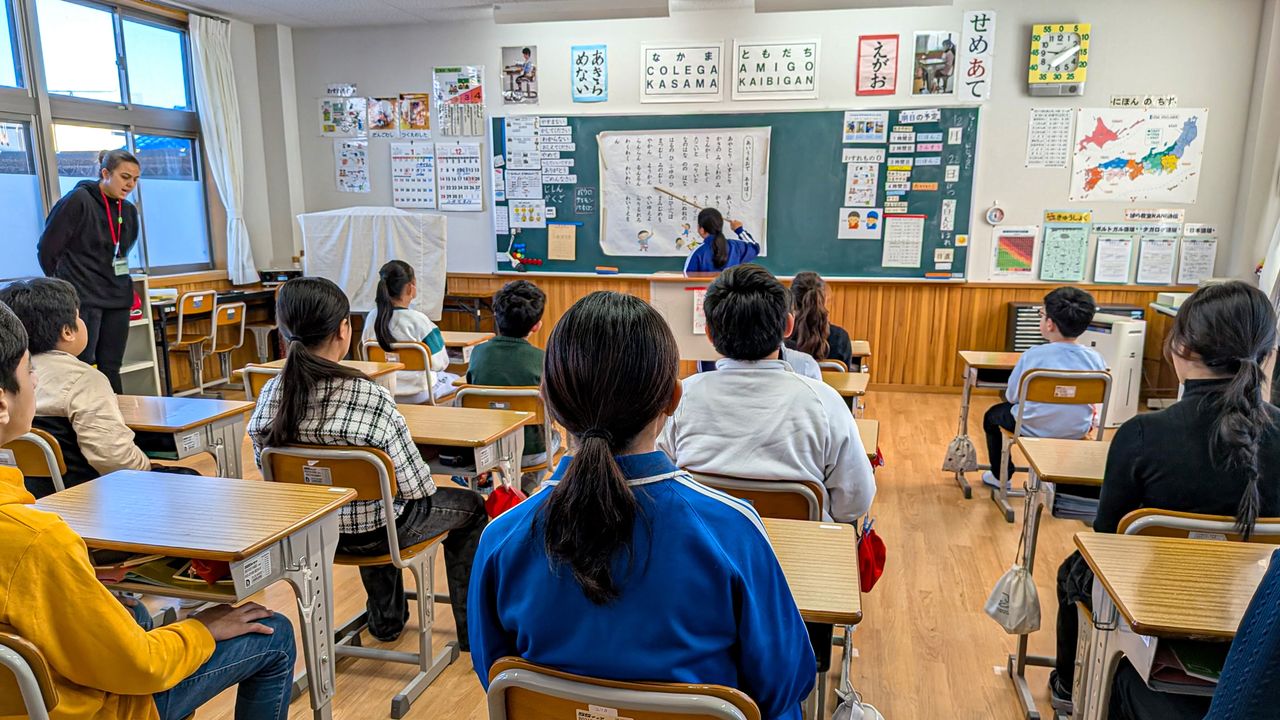
Every morning, the center—located in a residential area next to farmland—comes alive with children’s voices as they sing a song teaching the Japanese phonetic sounds, familiar to Japanese first-graders from their elementary school textbooks.
On this day, the teacher is introducing three new children to the group. The instructor, herself a Filipino woman, speaks slowly to the class in Japanese, using plenty of body language and hand gestures.
“Okay, class! Three new children will be joining us. Until now, there were twelve of you. Now we have three more. So how many altogether? What’s twelve plus three?”
“Fifteen!” the children shout, their faces beaming as they compete to answer first. At the front of the room, three visibly nervous newcomers begin introducing themselves. The three have just arrived from Pakistan. The children welcoming them are from places like the Philippines and Brazil.
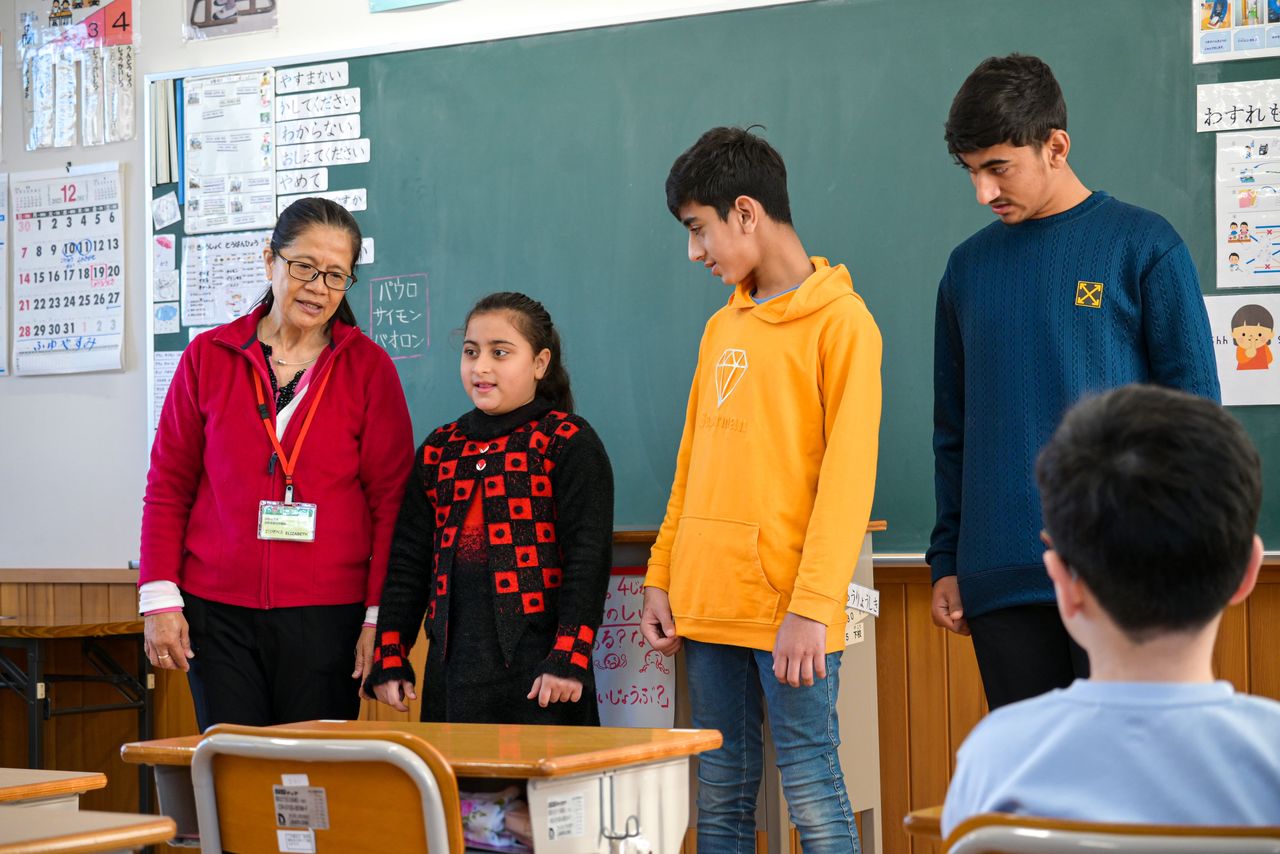
Three siblings from Pakistan introduce themselves. As of December 2025, there were 23 children attending classes at the center. (© Kumazaki Takashi)
The class is a preparatory program called Bara Kyōshitsu Kani. Here, at Kani’s “Rose Classroom,” foreign children receive instruction from foreign-national staff in basic Japanese and age-appropriate levels of subjects like mathematics. They also learn Japanese school rules and routines—taking turns as the class helpers and cleaning the school—as well as aspects of Japanese culture and customs, such as how to use chopsticks. The program is for children from ages 6 to 15, corresponding to the compulsory education of grades 1–9. The children spend four months in the program before beginning regular classes at schools in the city.
In Japan, school attendance is not compulsory for non-Japanese children. Families must apply to the local board of education, which then authorizes their enrollment. Still, the city of Kani guarantees foreign children the opportunity to attend school just as Japanese children do. It established the Bara Kyōshitsu in 2005 to help ease children’s anxieties and familiarize them with school life as they prepare to enter the Japanese school system. Today this program is emblematic of the city’s efforts toward integrating its foreign population.
The Ministry of Education, Culture, Sports, Science, and Technology has announced that, as part of efforts to promote Japanese-language education for foreign children, it will launch a model project in fiscal 2027 to establish “preclass” programs, aimed at acclimating newcomers to the Japanese educational environment, in places throughout Japan. Kani, meanwhile, has already been implementing such a program for more than 20 years.
Sparked by a Researcher’s Passion
The Bara Kyōshitsu was established after local government officials and residents responded to the passion of Kojima Yoshimi, a researcher who now serves as director of the Tokyo University of Foreign Studies Center for Intercultural Studies. In the wake of the 1995 Great Hanshin-Awaji Earthquake, she became aware of the existence of foreign children not attending school during her involvement in reconstruction efforts in Kobe. She went on to work with Japan’s official development assistance programs; her experiences only deepened her concern about the situation of those foreign children.
“In the 1990s, Japan was the world’s largest provider of ODA,” Kojima points out. “When I visited Latin American countries, people would express their deep gratitude that Japanese aid had enabled children in their countries to attend school and receive meals there. But Japan isn’t paying nearly as much attention to foreign children within its own borders. They are unprotected, being outside the scope of compulsory education. In fact, foreign children have often been excluded from the education system.”
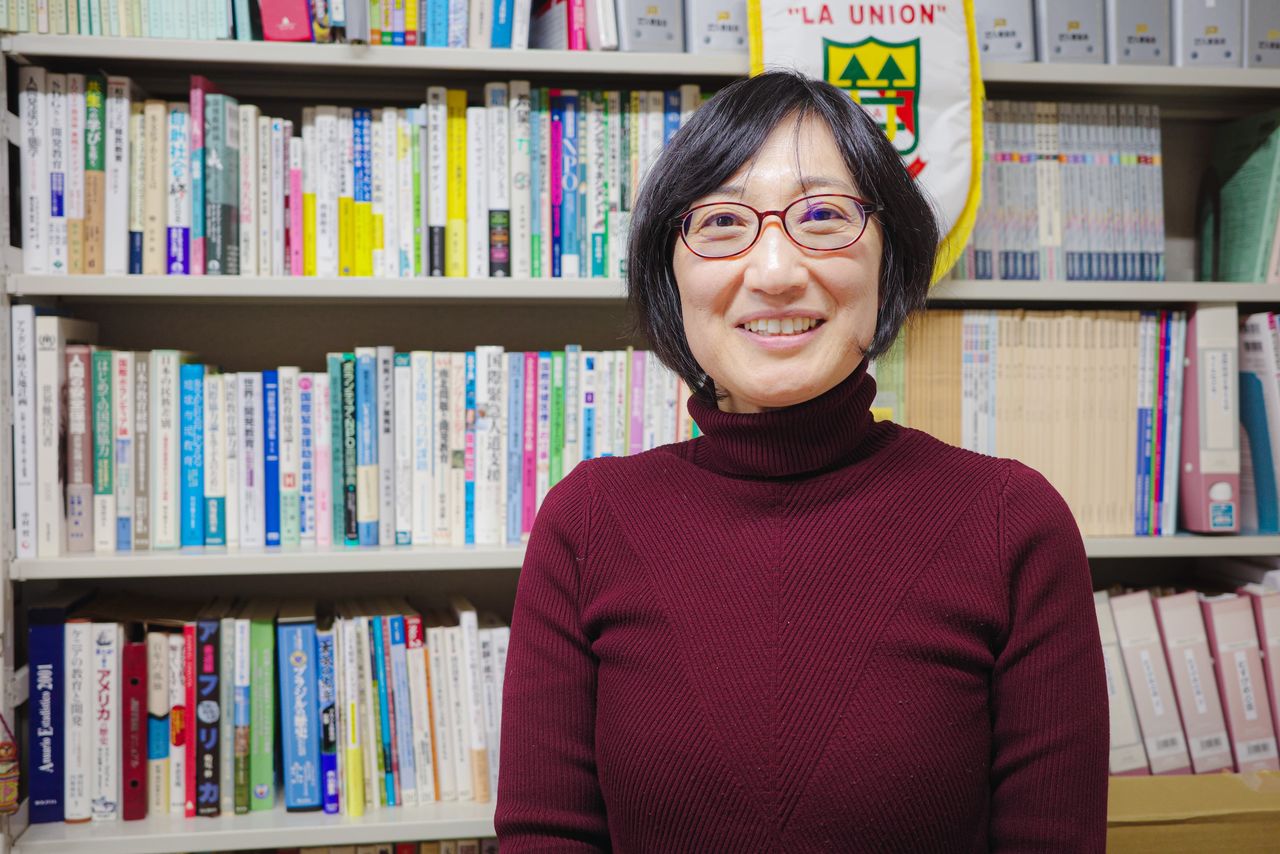
Kojima Yoshimi previously worked as a public elementary school teacher and was involved in ODA projects in Guatemala and Bolivia. (© Kumazaki Takashi)
Moved to find a solution to this issue of school non-enrollment, in 2001 Kojima participated in the first meeting of a governmental council focusing on issues faced by municipalities with large foreign populations. The gathering brought together 13 cities across Aichi, Gifu, Mie, Shizuoka, and Gunma that had experienced a rapid influx of Brazilians and other South American Nikkei immigrants. It was there that she first learned about the situation in Kani.
Compared to the number of foreign children moving into the city, the number of such students enrolling in Kani’s public elementary and junior high schools was small. The city was aware of the problem and had tried to grasp it through questionnaires delivered by post, but few families responded. Kojima decided to step in. She proposed moving to Kani and visiting every household with foreign children herself to conduct a field survey; the city government readily accepted.
Thus began a door-to-door survey that would last for two years. Considered the first comprehensive survey in Japan of the school enrollment status of foreign children, it confirmed that 10% of them were unenrolled. When it was extended to a broader set of children whose whereabouts or school attendance could not be confirmed, however, the findings were even bleaker: More than 30% of foreign children living in Kani could be considered as not attending school.
The truant children came from a range of nationalities. Many were young carers responsible for looking after younger siblings or doing household chores. What shocked Kojima even more, though, was that some children as young as 12 or 13 were working in factories. “I thought this was something that happened only in developing countries. The fact that child labor was taking place in Japan, and in such a small city at that, was shocking,” she says.
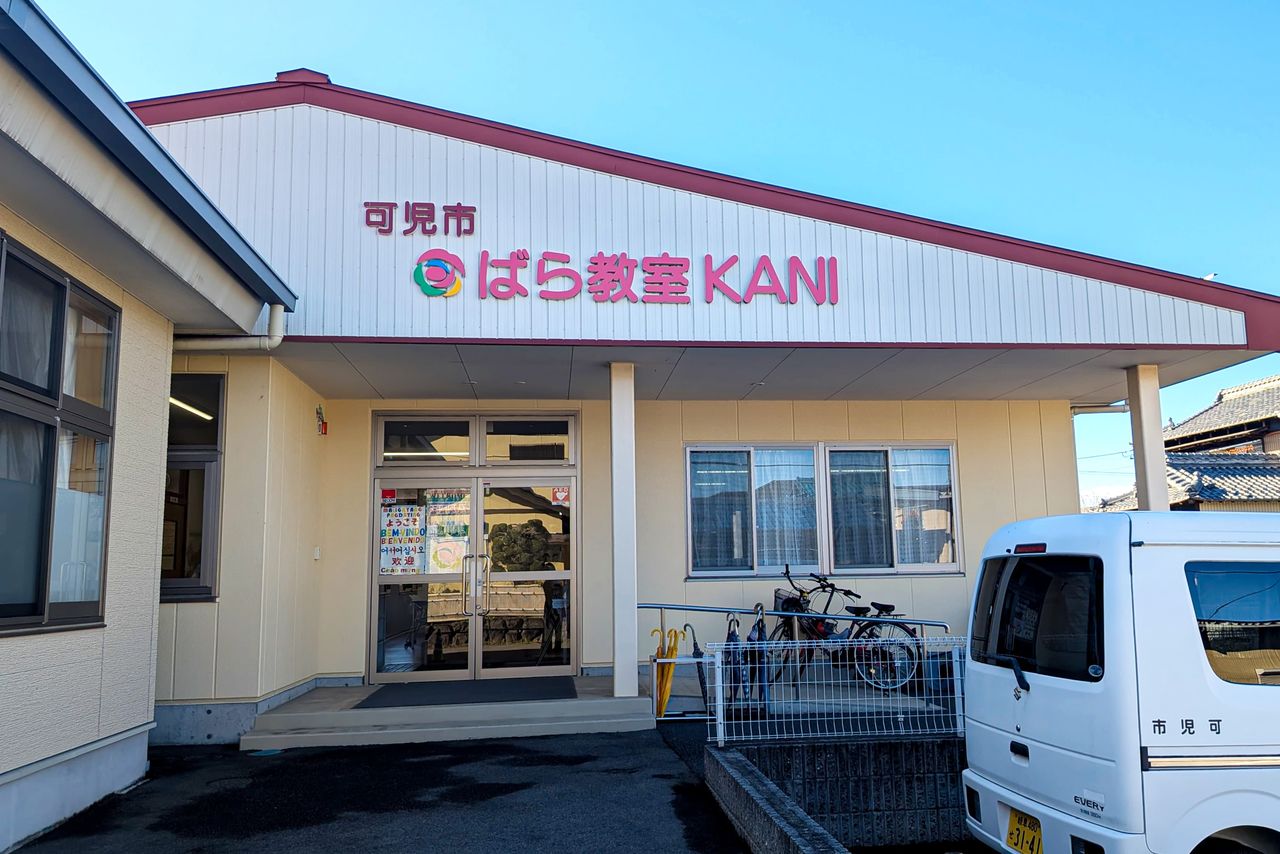
Bara 1, Kani’s first Bara Kyōshitsu, is located in an area of the city with a large foreign population. The entrance bears words of welcome in many languages. (© Kumazaki Takashi)
Schools at a Loss at How to Cope
Kojima became acquainted with a junior high principal in Kani whose school had a particularly large number of truant students. She visited the school to learn more about the situation. There, the principal told her: “If you intend to make proposals or spread awareness about these children, make sure you understand what is happening in the schools first. If you’re prepared to share in our struggles, you can start visiting this school, even as early as tomorrow.”
Kojima eagerly accepted the offer, and from the very next day, she began visiting the school almost daily. There, she encountered teachers struggling to deal with foreign children’s unexpected behavior. At the time, there were many Brazilian students, often engaging in rowdy behavior, playing music on speakers and dancing in the hallways, all while bewildered teachers tried to rein them in.
Kojima could see things from the children’s perspective, too. They were struggling with the difficult task of learning Japanese, only to find themselves at the bottom of the class academically. Subjected to harsh criticism—“Why can’t you even do this simple work?”—they were losing interest in their classes and drifting away from education as a whole.
Whenever the principal would become frustrated and write the children off as a lost cause, Kojima would offer another perspective. “That child is from a single-parent family and does an enormous amount to help out at home,” for instance, or “That one spends all her time looking after her younger siblings.”
Eventually, the principal came around as a strong ally of Kojima and played a role in reforming the school’s Japanese language instruction system.
“The principal changed the name of the class from ‘Japanese Adaptation Class’ to ‘International Class’ and lined up teachers with the skills needed for the job,” recalls Kojima. “He also introduced Portuguese, Brazil’s official language, as an elective subject within the regular curriculum. As a result of these efforts, the number of foreign students moving on to high school began climbing in the following school year.”
Kojima’s survey had an impact on the city’s policy by providing concrete evidence of the problem, which eventually prompted the city to adopt a “no children left out of school” policy. In April 2005, the municipal government formally established a program to guarantee educational opportunities for foreign children, giving rise to the preparatory class that Kojima had envisioned. Because the city had opened one of the world’s largest rose gardens at the time, the program was named the Bara Kyōshitsu.
Kakamu Mayumi, secretary-general of the Kani International Exchange Association, believes the city’s swift action was attributable in part to the outlook of the city’s mayor at the time. “At the meeting of the council of heavily foreign-populated cities that I attended, some local leaders were saying that if they could not attract foreign residents, it would affect their municipal finances. I think Kani’s mayor at the time was also thinking about the future.”
Helping Children Find Their Confidence
The Bara Kyōshitsu teaches the basics of Japanese language and customs, but that is not all.
“These children come to Japan because of their parents’ work, and it often doesn’t make sense to them that they have to be separated from their friends and family back home. Some don’t know what the point of their lives is. For some, it’s constant struggle and tears,” says Wakahara Toshikazu, who is now in his seventh year as head of the Bara Kyōshitsu.
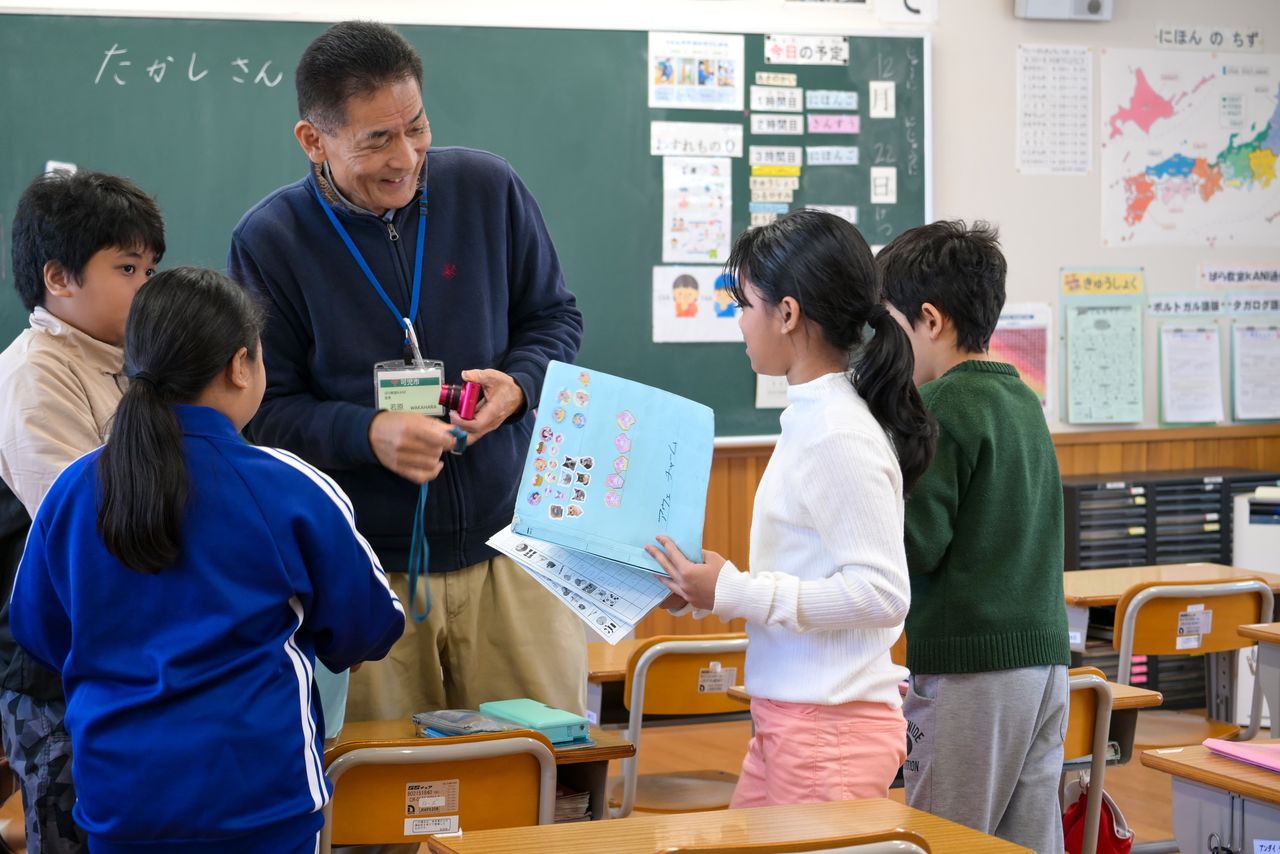
Bara Kyōshitsu head Wakahara (at center) interacts with children. “We want the kids to feel comfortable coming here, so we make a point of praising them for even the smallest signs of progress,” he says. (© Kumazaki Takashi)
As part of its efforts to support children facing major changes in their lives, the Bara Kyōshitsu employs foreign instructors from countries such as the Philippines and Brazil who have themselves experienced student life in Japan. In July last year, a former Bara Kyōshitsu student who attended the program during junior high school also joined the staff.
Another feature of the program is that the children are enrolled at local public schools. Each child therefore has a homeroom teacher and classmates at these schools. They can participate in events like field trips, receive school health checkups, and eat school lunches.
In August 2020, as a response to the surge in the number of children from abroad, a second class was created. Since then, the children follow a two-stage program, spending two months in the original classroom, now called “Bara 1,” and then another two months in “Bara 2,” established at the junior high school level.
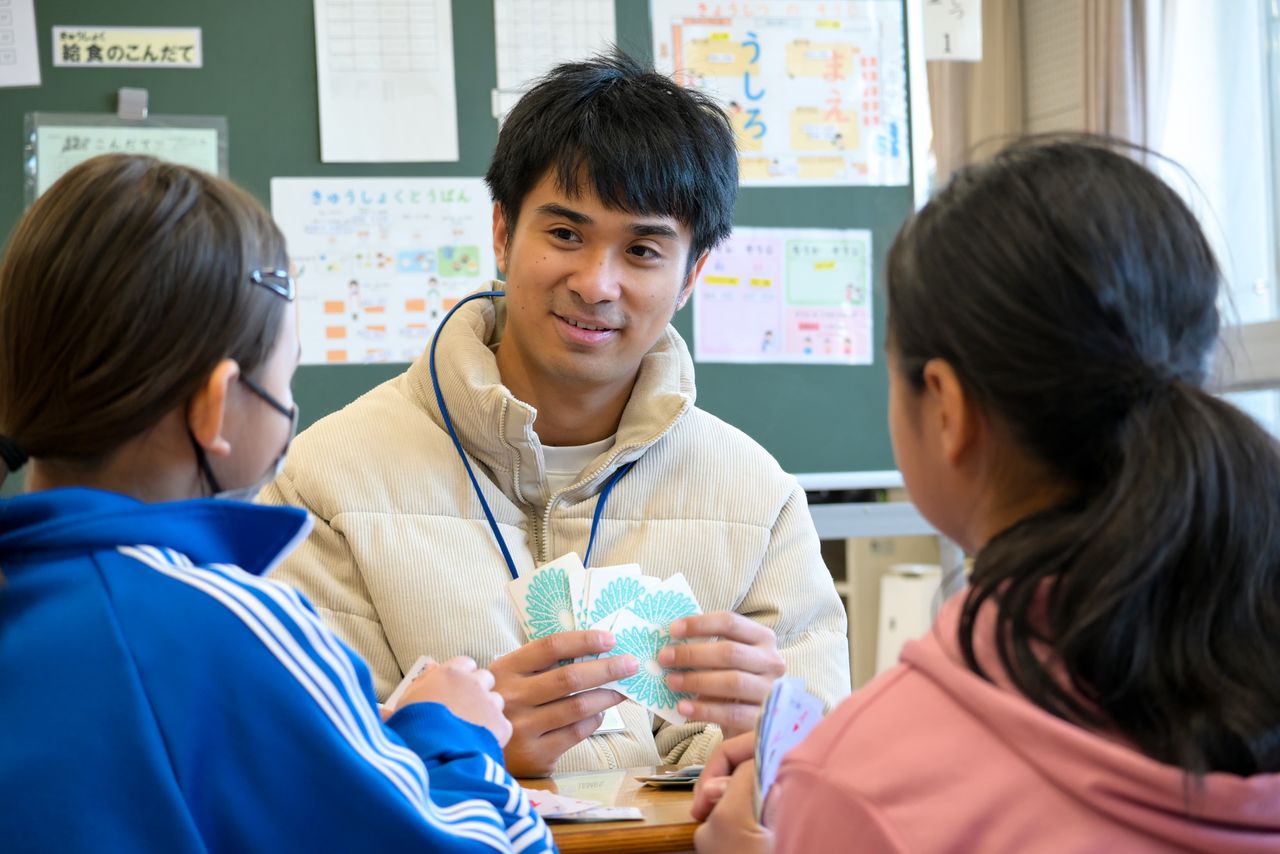
James from the Philippines, an instructor at Bara 2, is an alumnus of the Bara Kyōshitsu. He teaches with the hope that the children won’t have to go through the same difficulties he experienced during his junior high school years. (© Kumazaki Takashi)
“In Bara 1, it’s important that they simply show up to class,” says Wakahara. “We help the children make friends so they feel comfortable and can smile. We encourage them not to give up even when they don’t understand Japanese. In Bara 2, we focus more on helping the children build confidence. One of the activities we have for this is the You-Can-Do-It Presentation Day.”
The purpose of the presentation event is to give the children completing the Bara Kyōshitsu an experience of achievement. In order to bring out the children’s potential, the instructors—who have seen the students’ growth up close—interview them in their native language and work out a plan for what they will present.
Students may write kanji in calligraphy or perform music with their classmates. By doing a little of what they like, are interested in, or are good at, they gain confidence and a desire to improve, sending them off into school life with a positive outlook. The sight of these Filipino children performing with such happiness and confidence is sure to touch the hearts of those watching.
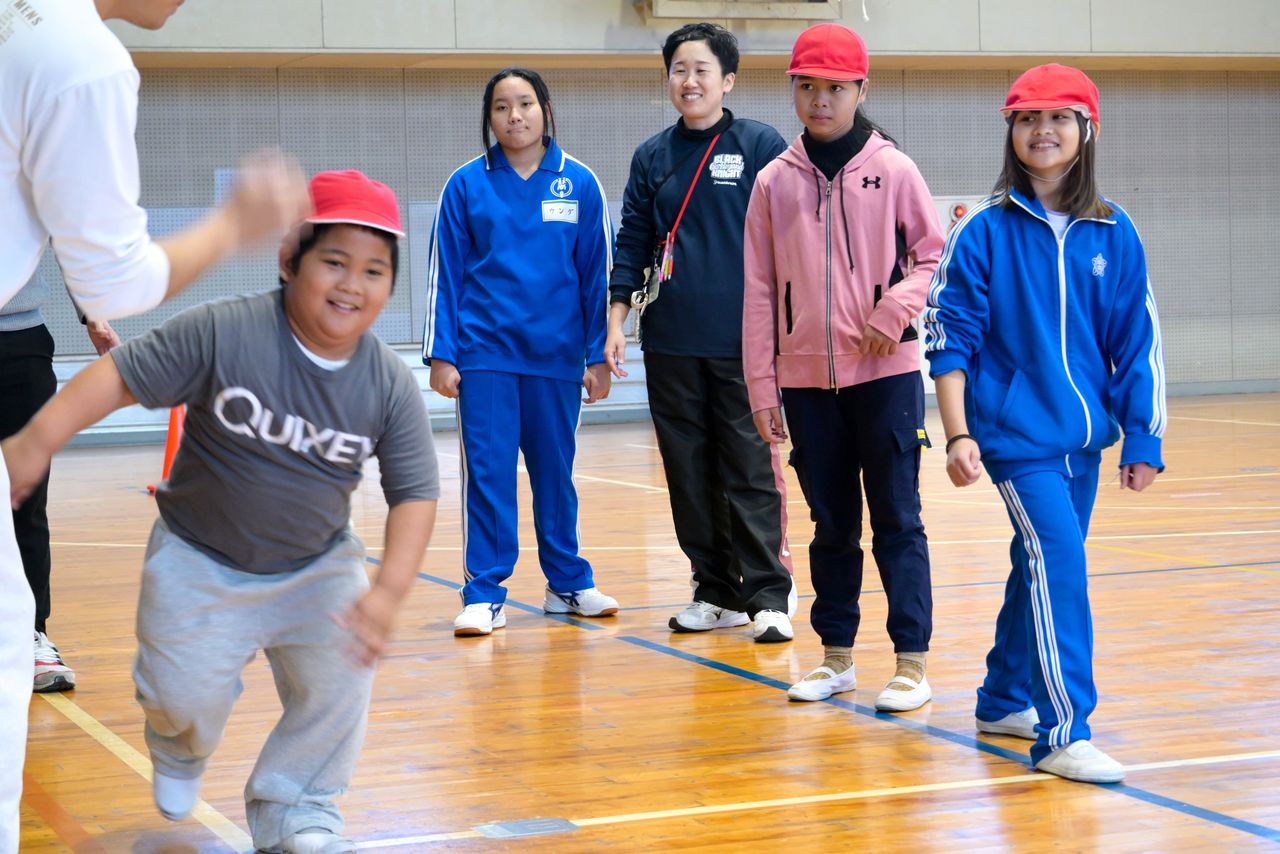
Filipino children having fun during a scavenger hunt race held at a Bara 2 physical education class. (© Kumazaki Takashi)
It has now been 22 years since the inception of the Bara Kyōshitsu. As of December 19, 2025, fully 1,155 children had completed a program there.
The number of children dropping out during junior high school has fallen sharply, and more have begun setting their sights on high school and vocational schools. Meanwhile, the nationalities of foreign workers have become more diverse, and more are settling in Japan rather than coming only as temporary migrant workers. Some have started families in Kani and even launched businesses that create jobs.
Looking back at the program’s progress so far, Kojima says what is important is that the children have a place where they can feel valued and accepted. “If, from the outset, these children are given a space where they are positively affirmed and told that their multicultural, multilingual backgrounds are something to be proud of, they will be able to have confidence in who they are. Also, the existence of children who learn Japanese alongside their native tongues may change how people in Japan with foreign roots are perceived, helping people recognize them as contributing members of regional communities. Preparatory classes like this exist in other parts of Japan, but I believe the Bara Kyōshitsu is a pioneer, including in the way children participate in the program while being enrolled at their schools.”
One hopes that Kani’s spirit of providing all children with an education, regardless of where they come from, will become more deeply rooted. After all, with 4 million foreign residents now living in Japan, it is clear that a substantial foreign population is already an integral part of communities across the country.
(Originally published in Japanese. Banner photo: A class at the Bara Kyōshitsu. © Kumazaki Takashi.)