Takaichi’s Delhi Visit Highlights Deepening Japan-India Economic Ties
Economy Politics- English
- 日本語
- 简体字
- 繁體字
- Français
- Español
- العربية
- Русский
A Deepening Partnership
Takaichi Sanae’s recently completed first visit to India as prime minister turned out to be a meaningful one for the bilateral relationship. Tokyo and New Delhi enhanced security and defense collaboration while also committing to greater energy security cooperation and strengthening critical mineral supply chain resilience.
The visit also highlighted Japan’s ongoing Indian investment contributions. Warmly welcomed by New Delhi, the steadily accelerating growth of business cooperation between Japan and India now outpaces the growth of Japan-China business engagement.
Critically, bilateral cooperation continues to expand beyond the realms of commerce. Minilateral initiatives involving both Japan and India like the Quad (together with Australia and the United States) support Tokyo’s implementation of its “Free and Open Indo-Pacific” vision, but both sides are also forging enhanced people-to-people connections through international student exchanges, cultural initiatives, and strengthened expert human resource collaboration in IT and AI domains. Both countries anticipate further deepening of these ties in the future.
Focusing on Defense, Economic Security
Defense and security cooperation featured prominently in the sixteenth Japan-India Annual Summit Joint Statement. The statement explicitly commited the Indian Navy and Japan’s Maritime Self-Defense Force to enhancing maritime security through strengthened naval engagement and training exercises (such as JAIMEX 25 in Yokosuka). New Delhi also welcomed Tokyo’s recent reform of the Three Principles on Transfer of Defense Equipment and Technology.
At the summit, held on July 1–3, 2026 in India, the two countries also reached a broad agreement on the technology transfer of UNICORN (Unified Complex Radio Antenna), the shipborne composite antenna that augments stealth and is already featured on Japan’s state-of-the-art Mogami-class frigates. High Indian expectations point toward much greater cooperation in defense equipment and technology in the future and greater deepening of the defense partnership.
Economic and energy security also featured prominently in the joint statement. The two governments agreed to prioritize cooperation in five key sectors: semiconductors, minerals (such as rare earths), information and communication technology, clean energy, and pharmaceuticals. This cooperation is of potential geopolitical significance given recent global concerns about maintaining supply chain access to strategic resources such as semiconductors, critical minerals, and energy supplies.
The bilateral India-Japan relationship has a long history, but in the half-century up until Prime Minister Koizumi Jun’ichirō’s 2005 visit, only five Japanese prime ministers made official visits to India. The expansion of Japan’s commercial engagement with India also did not begin until the late 1990s, with the major exception of Maruti Suzuki India, the Indian subsidiary of Suzuki Motor Corporation founded in 1981.
The relationship’s significance has changed substantially over the last 20 years. Koizumi’s 2005 visit began the “annual summit” custom, with Indian and Japanese prime ministers visiting each other’s country. Semiregular foreign and defense minister “2+2” dialogues and other political bilateral programs were subsequently initiated.
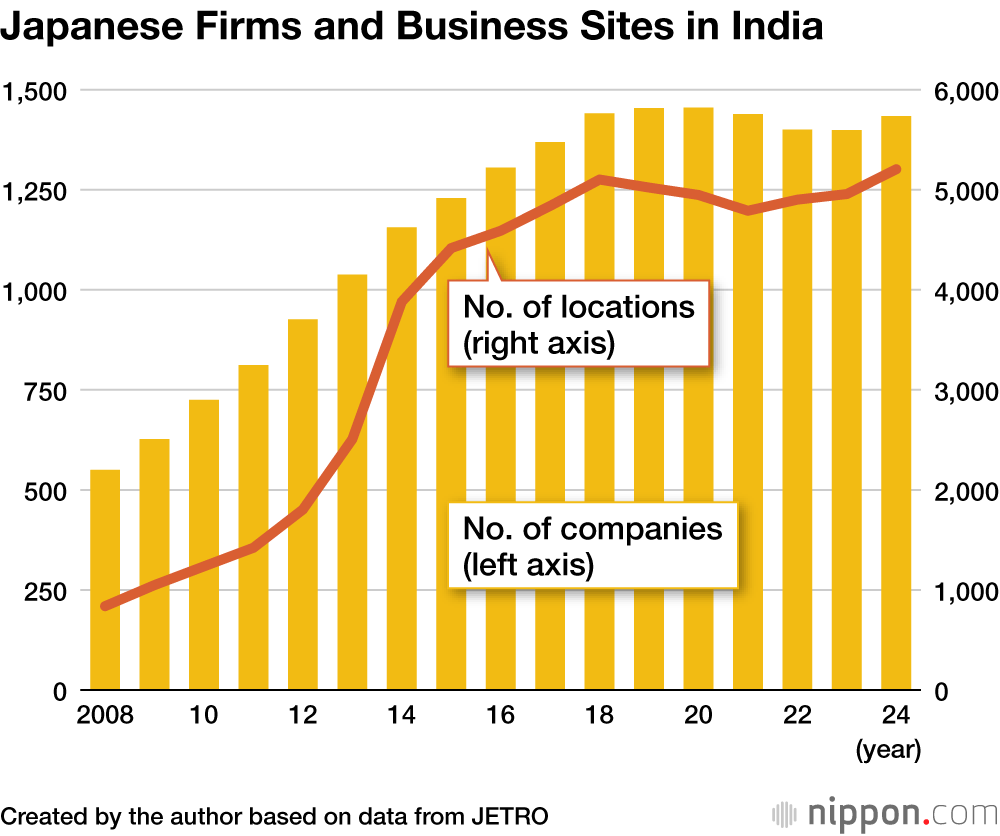
The economic relationship has also grown rapidly. According to JETRO, the Japan External Trade Organization, there were 1,434 Japanese companies operating in India at 5,205 locations as of October 2024. This pales in comparison to Japanese businesses’ 30,000 operational locations in China, but Japanese companies resumed expansion into India following the COVID-19 pandemic slump. Suzuki, Bridgestone, and Unicharm are all building their second or third India-located factories.
Diversified Industries and India Entry Points
These developments owe much to Japan’s past political and commercial commitments and deserve high praise for leading Japanese business interests to diversify their entry points into India. Particularly noteworthy are accelerated corporate acquisitions, joint ventures, and investments in Indian startups involving Japanese companies.
Diversification is also apparent beyond the traditional automotive and home appliance industries as consumer goods manufacturers and retailers show an interest in India. Uniqlo (Fast Retailing) already operates 20 stores in India and has announced plans to expand to 100 stores within five years. While Indian retail sector investment restrictions have prevented Seven & I Holdings from making direct investments, the company already operates more than 60 7-Eleven stores in India through a franchise system. The home furnishings giant Nitori also opened its first store in Mumbai at the end of 2024. Logistics companies supporting Japanese firms’ expansion are also constantly opening new offices in India.
In the heavy industry sector, Nippon Steel, together with European steel giant ArcelorMittal, formed a joint venture in 2019 to acquire Essar Steel, a major Indian steelmaker. With a goal of producing competitive automotive steel sheets and other products in India, ArcelorMittal Nippon Steel India has subsequently purchased infrastructure assets and built more steelmaking plants, with investment totaling more than ¥1 trillion. Companies from a wide variety of sectors like Suntory, Sumitomo Realty and Development, Osaka Gas, MonotaRO, and Ichishin Holdings are all working on their Indian plans.
Prime Minister Takaichi’s predecessor, Ishiba Shigeru, also helped push the relationship along when he hosted Indian Prime Minister Narendra Modi in Japan in August 2025. During this summit Ishiba announced the goal of facilitating the investment of ¥10 trillion by Japanese public and private sector actors into India over a decade. This year’s summit, however, helped make Japanese business activities in India more visible to domestic and international audiences through the signing of various memorandums of understanding and the dissemination of detailed fact sheets highlighting the ¥2 trillion of investment commitments in the year leading up to the summit. This would have likely impressed New Delhi, given calls for greater Japanese investment in India that date back to previous Indian administrations.
The premiers of both nations also attended the Japan-India Joint Economic Forum together. Participants from more than 150 Japanese companies and 80 Indian companies took advantage of a valuable opportunity for direct dialogue, while the Forum also demonstrated the benefits of enhanced cooperation through joint public-private sector initiatives, a vehicle for development codified at events including the Tokyo International Conference on African Development.
Energy, Environment, Transport, and More
The leaders’ summit also produced commitments to strengthen joint efforts to secure energy and other strategic resources, an increasingly urgent and global challenge due to persistent tensions surrounding the US-Iran conflict and China’s reduction of rare earth supplies.
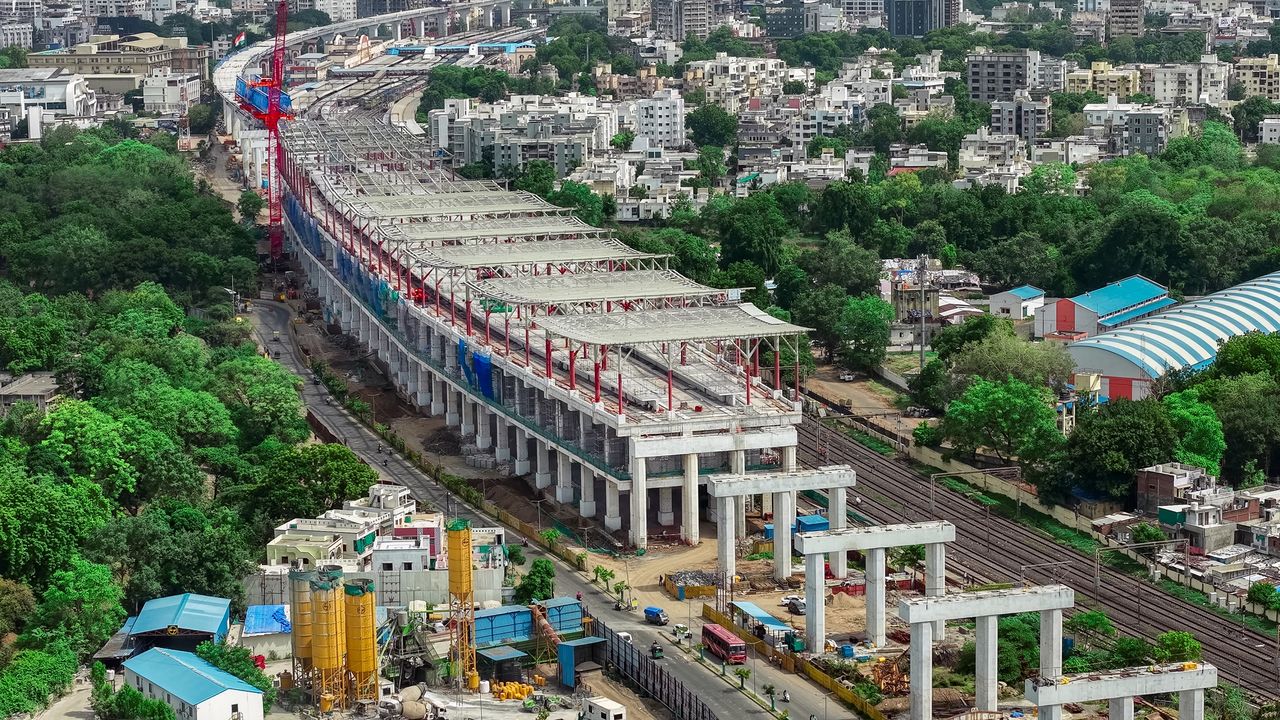
Construction of India’s “Shinkansen” is proceeding at a rapid pace, as seen at Badodara Station in the northwestern state of Gujarat. (Courtesy of the National High-Speed Rail Corporation of India)
The MOUs and other agreements signed during the summit provide several noteworthy examples of future Indian-based projects with extensive Japanese involvement. Bilateral discussions reaffirmed cooperation between Indian and Japanese space agencies on the Lunar Polar Exploration (LUPEX) to explore the Moon’s south pole for water and resources while giving diplomatic backing to Japanese robotic spacecraft startup Ispace to deepen commercial linkages in India in the space situational awareness domain. A joint venture by Japanese manufacturer IHI and Indian energy company Acme received government backing for their Indian renewable ammonia production plant; Suzuki and Sojitz committed to launch biomethane production projects in India; and the Japanese industrial gases firm Air Water Inc. signed a long-term operation and maintenance contract for a large-scale gas plant at Tata Steel’s Jamshedpur Steel Plant. JFE Engineering also reaffirmed its investment in a joint venture with an Indian company in the waste-to-energy business. These initiatives all align with the Modi administration’s strong emphasis on environmental and energy policies.
Better known is Japan’s persistent support for Indian infrastructure development, one of the primary pillars of the now 12-year-old Modi administration. Concessional yen loans have been provided for the construction of urban rapid transit in Delhi, Mumbai, Bengaluru, and other cities. The Delhi Metro, initially opened in 2002, has undergone repeated extensions, and the network is now longer than the Tokyo subway system (including both Tokyo Metro and Toei Subway lines) at 416 kilometers. Few people would disagree that this infrastructure investment has dramatically improved the lives of Delhi residents by enhancing the convenience of commuting to work and school.
The success of this metro system was the deciding factor in Japan being tasked with building India’s first high-speed train. With full support from Japan’s Ministry of Land, Infrastructure, Transport, and Tourism and the JR Railway Technical Research Institute, the 508-kilometer line between Ahmedabad and Mumbai has been financed by yen loans covering approximately 80% of the ¥1.8 trillion total construction costs. Scheduled to begin partial operations in August 2027, the Indian Shinkansen project is notable for many reasons, including the construction of an underground terminal station in Mumbai and India’s first undersea railway tunnel.
Japan’s “Most Promising” Market
Two annual surveys conducted by the Japan Bank for International Cooperation and JETRO in 2025 showed the positive momentum of the Japan-India commercial relationship. For the fourth consecutive year, India took the top spot in JBIC’s Report on Overseas Business Operations by Japanese Companies as the “most promising” business expansion destination over the next three years. JETRO’s Survey on Business Conditions of Japanese-Affiliated Companies Overseas also reported that 75.5% of Japanese companies operating in India expected to turn a profit in the current financial year. Achieving profitability in the challenging Indian market is no easy task, and analysts and government officials attribute such results to the long-term efforts of the various Japanese companies.
The cumulative total of direct Japanese investment in India between April 2000 and March 2026 came to $48.1 billion, putting Japan in fifth place behind countries including the United States and the Netherlands. However, in 2025 alone, Japanese businesses invested $3.74 billion in India, while bilateral trade exceeded $25 billion during the same fiscal year. Japan continues to maintain a substantial trade surplus with India, but India is redoubling efforts to diversify its own export sectors (including seafood, textiles, and jewelry) and destinations as a response to the “Trump tariffs” imposed on India. Indian exports to Japan are therefore likely to expand in the future.
Many experts have noted that mutual understanding and friendship can be difficult to forge in relations with India. The nation prides itself on refusing to kowtow to major powers and avoids making hasty diplomatic compromises. This has been on full display in New Delhi’s refusal to yield to tariff pressure emanating from the Donald Trump White House. While both Tokyo and New Delhi want to remove diplomatic hurdles to a closer economic relationship, India may prove to be a rather formidable negotiating partner for Japan, accustomed as it is to the diplomatic flexibility and respect shown by nations in Southeast Asia and the Middle East.
That said, Japan has long recognized India’s actual and potential contributions to its own economic and business wellbeing. Faced with a shortage of science and technology talent, Japan’s public and private sectors are redoubling their efforts to recruit Indian engineers and technical experts through internships and corporate partnerships. While there will likely be bumps along the road, Indian democracy and the rule of law is firmly established, which contributes to the high expectations Tokyo has for the bilateral relationship.
India pursues a “weighted” omnidirectional diplomatic approach where it tends to favor or prioritize relations with the West (and Japan) but not to the point where it sacrifices the national interests it potentially derives from relationships built with other major powers. India, for example, did not terminate its constructive relationship with Moscow or halt Russian oil imports, even when the Trump administration imposed punitive tariffs in 2025. Even though India considers China a potential security threat and economic adversary, in spring of 2026 it decided to resume the acceptance of Chinese investment under certain conditions.
India is a country that is confident in its ability to be circumspect while making difficult decisions like bringing in Chinese technology and capital if it believes it will improve its long-term growth prospects. Conservative “anti-China” voices in Japan often advocate teaming up with India simply to “contain” China. India, however, sees right through such a shallow calculation, and its relationships with China and Russia are part of a carefully crafted diplomatic strategy.
Indian politics and society certainly appear extremely complex to Japanese, and Indians often come across as “assertive.” However, as a nation facing a declining birthrate and a shortage of skilled workers, we must push forward with India in developing new markets, strengthening supply chains, and forging new people-to-people relations. The current turbulent period in international relations is precisely the right time to acquire a more mature understanding of India and strengthen ties with a nation of great future importance.
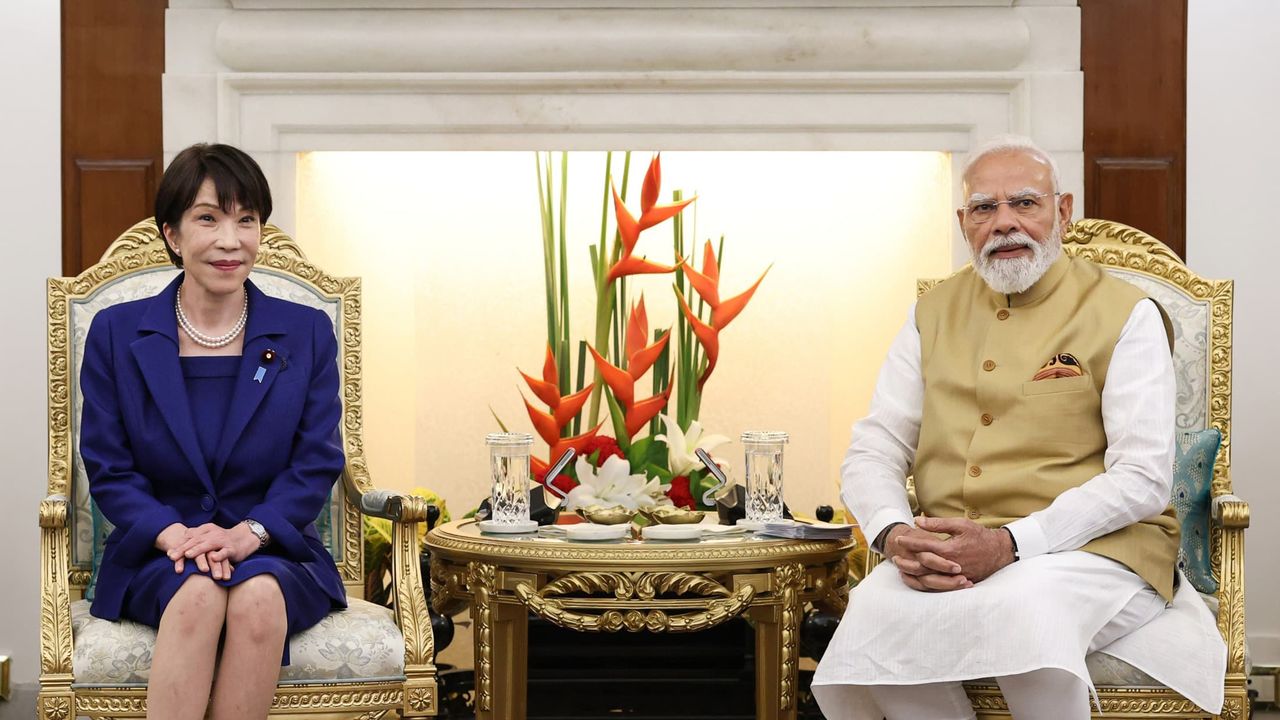
(Originally published in Japanese. Banner photo: Prime Minister Takaichi Sanae, at right, in her summit meeting with Prime Minister Narendra Modi in Delhi, India, on July 2, 2026. Courtesy of the Indian Press Information Bureau.)