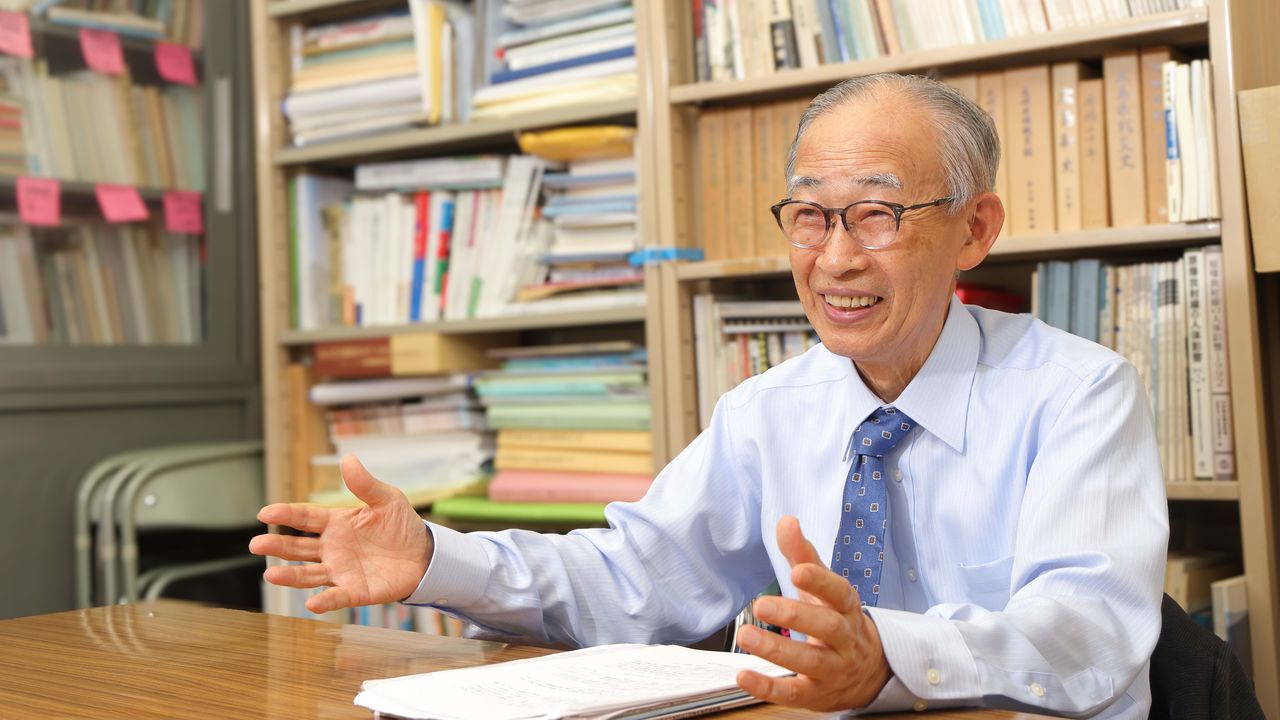
Nobel Prize Helps Aging Hibakusha Pass Antinuclear Torch: An Interview with Hamasumi Jirō of Nihon Hidankyō
Politics- English
- 日本語
- 简体字
- 繁體字
- Français
- Español
- العربية
- Русский
Anti-Nuclear Activism Gets a Boost
INTERVIEWER It’s been two years since we learned that the 2024 Nobel Peace Prize was being awarded to your organization, Nihon Hidankyō [Japan Confederation of A- and H-Bomb Sufferers Organizations]. In 2025, Japan marked the eightieth anniversary of the bombing of Hiroshima and Nagasaki, and this year Nihon Hidankyō is celebrating the seventieth anniversary of its founding. Have you noticed any change in Japanese attitudes toward the nuclear disarmament and peace movements over the past two years?
HAMASUMI JIRŌ The announcement about the Nobel prize came on October 11, and from that time until the award ceremony the following December, our phones were ringing nonstop, and there was an almost constant stream of media coverage. The attention wasn’t limited to Hidankyō’s central headquarters, either. The local press descended on various regional branches, and there was a huge surge in requests for speakers. Last year as well, the eightieth anniversary of the bombings occasioned a good deal of news coverage, and between that and the events we organized ourselves, we were kept quite busy.
There’s been an increase in requests from international peace and anti-nuclear groups for hibakusha [A-bomb survivors] to travel abroad and share their stories. In 2025, we participated in programs in France and Spain, and this year we’re sending members to Italy, Spain, South Korea, and Singapore. Winning the Nobel Prize has also encouraged us to pursue our activities with a renewed sense of urgency in hopes of reenergizing the peace movement.
Another positive outcome of the Nobel Prize and the attention it brought us is that we’ve received a spate of inquiries from people who want to learn more about Hidankyō and its programs. That’s given us more opportunities not just to broadcast our core message—No More Hiroshimas, No More Nagasakis—but also to educate people about the organization’s history and the trials the hibakusha have faced since the end of World War II.
For years after the war—even after Japan regained its sovereignty—the Japanese government provided no support to the victims of the atomic bombings. After the Daigo Fukuryū Maru Incident(*1) in 1954, a movement to ban the bomb gained momentum in Japan, and in 1956, the hibakusha found the courage to join forces under the banner of Nihon Hidankyō. Before that, survivors had a very tough time of it.(*2)
There are hibakusha all over. Many survivors left Hiroshima and Nagasaki to find work or start a new life. Among the hibakusha were quite a few Koreans and Japanese who are now living in other countries around the world. These are facts that aren’t widely known even in Japan, and I feel that there’s a better understanding now, since we’ve had the opportunity to speak to more people.
We’ve also gotten a strong sense of renewed fervor among nuclear disarmament activists overseas. France’s decision to build up its nuclear arsenal seems out of step with popular sentiment. Hidankyō members who’ve been invited by international groups to testify at dozens of grassroots rallies overseas have been impressed by the number of people who reject the whole concept of nuclear deterrence.
Connecting with Youth Online
INTERVIEWER Do you feel that you’re making progress connecting with a new generation of activists?
HAMASUMI In 2020, when I was gathering signatures for the Hibakusha Appeal,(*3) I was lamenting the lack of opportunities for hibakusha to share their experiences owing to the COVID-19 pandemic. At that time, a young supporter suggested that we start holding events online using videoconferencing. In our first remote event, I used a desktop computer to speak to 50 or 60 students from schools all around the country—elementary, secondary, and college. There was lots of audience interaction in the form of questions and comments, and I realized that this was a very doable format. Later that year, I spoke and solicited signatures during a videoconference with about 400 participants.
Also, after receiving a number of comments from young people regarding the difficulty of arranging in-person meetings with hibakusha, we began holding online meetups, or “virtual cafes.” I used one such event to tell my own story, and immediately afterward, one of the participants organized a screening of a film on the topic at their university. Some of these college students are real go-getters. I’m also seeing more young people on the staff and steering committees of the various peace organizations that we’ve partnered with over the years.
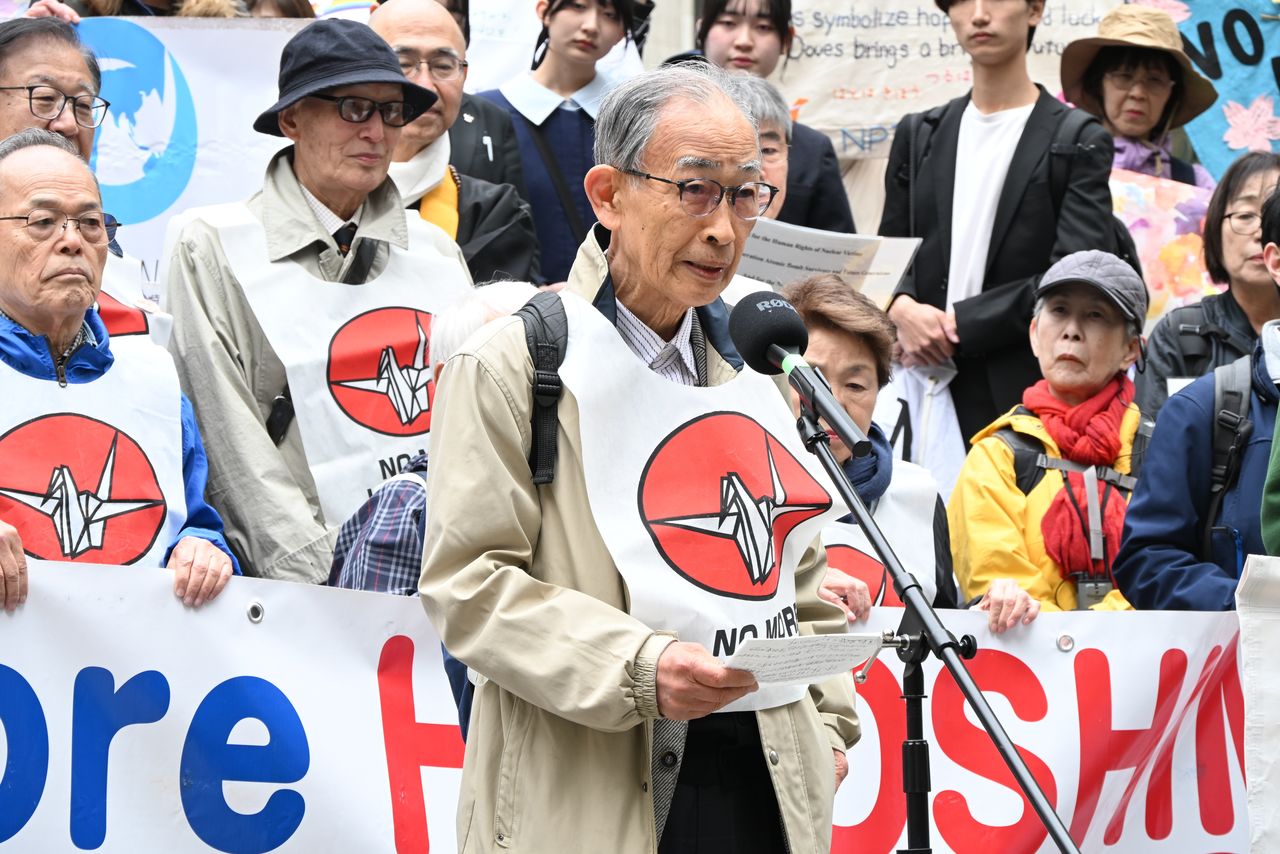
Hamasumi Jirō speaks in New York on April 26, 2026, at an event protesting nuclear weapons during the eleventh Review Conference of the Parties to the Nuclear Non-Proliferation Treaty, held in the city. (© Jiji)
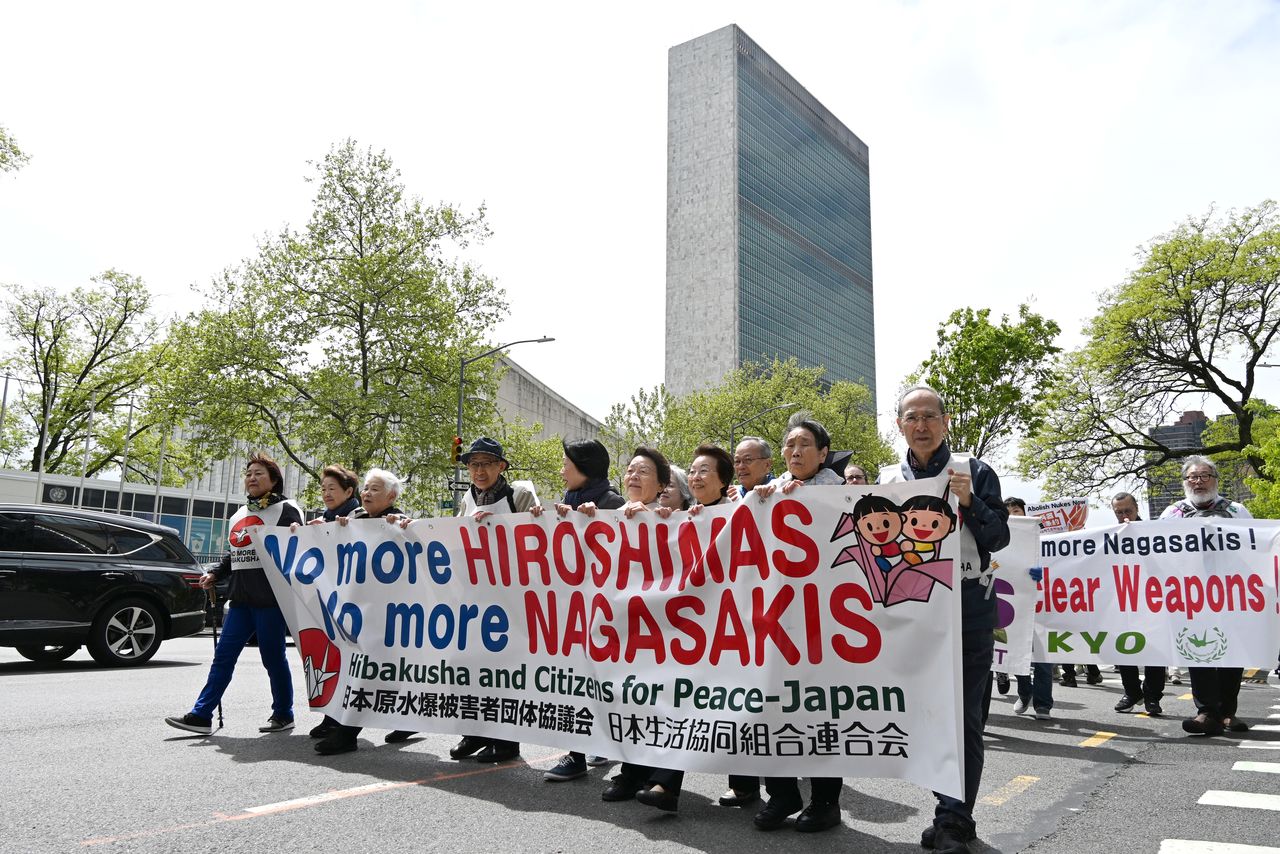
Protesters march outside the United Nations headquarters in New York on April 26, 2026. (© Jiji)
Limits of Nonproliferation
INTERVIEWER While Japan’s nuclear disarmament movement has been gaining momentum over the past two years, the international situation has been deteriorating. There were the ongoing conflicts in Ukraine and Gaza, and on top of those, the United States and Israel decided to launch a war on Iran. What’s your reaction to this wave of crises?
HAMASUMI A delegation of hibakusha traveled to New York for the eleventh Review Conference of the Parties to the Nuclear Non-proliferation Treaty [NPT] held last spring, and I spoke at the session devoted to presentations by nongovernmental organizations, but the parties were unable to agree on a final document. At a press conference back in Japan, I remarked that that was unfortunate. But if you really think about it, the treaty as it stands flouts international law by allowing the nuclear-armed states to dominate the nonnuclear countries by force. Israel, the United States, and Russia are all nuclear powers. China and France, two other nuclear-armed states, are busy building up their arsenals.
The three foundational pillars of the NPT are non-proliferation, disarmament, and the peaceful use of nuclear energy. But lately the sole emphasis has been on non-proliferation in the sense of denying countries like Iran a nuclear capability. The nuclear-armed states now act in open disregard and won’t even mention disarmament anymore.
In the final document of the 2000 Review Conference, the parties agreed on “an unequivocal undertaking by the nuclear-weapon states to accomplish the total elimination of their nuclear arsenals.” This was reaffirmed at the 2010 conference, but it was ignored in 2015. The buzzwords you hear most often nowadays are “nuclear expansion” and “usable” nukes. This is an intolerable state of affairs.
Japan’s Stance on Nuclear Disarmament
INTERVIEWER The first Review Conference of the Treaty on the Prohibition of Nuclear Weapons is coming up in November. Would you say that the primary goal of the anti-nuclear movement today is to promote the TPNW?
HAMASUMI Yes, the main thing now is to get more countries to sign and ratify the TPNW. Hidankyō began lobbying the United Nations to draw up such a treaty around 1975, and a special UN session on disarmament was launched soon after. It wasn’t until 2017 that TPNW was finally passed by the General Assembly. A major contributing factor was the concept of human security, on which the UN unanimously passed a resolution in 2012. This pointed to the need to approach nuclear weapons with a focus on how they impact human beings—not just from the standpoint of international security. That concept powered the birth of the TPNW.
The first Review Conference coming up is a unique opportunity, and we want to make the most of it to convey Hidankyō’s position—that nuclear arms are inherently evil weapons that deny people the right to live and die like human beings. I want to remind everyone assembled of the terrible impact nuclear weapons have had on real people.
INTERVIEWER Why do you believe Japan should sign and ratify the TPNW? Can you share Hidankyō’s thinking with us?
HAMASUMI The Japanese government claims that its top priority must be supporting the non-proliferation treaty, which is to say, nuclear-weapon states like the United States, Japan’s ally. That’s the government’s basic position.
The hibakusha have always maintained that Japan, having started the war, needs to take responsibility for the suffering of the hibakusha. Japanese officials are always referring to Japan as the only country to suffer a nuclear attack, but the fact is that the suffering has been borne by the victims and survivors—not the country. Yet the government has ignored the needs and pleas of the hibakusha, who have suffered more than anyone.
That’s why now, wherever we go, we challenge Japan’s refusal to sign the TPNW. Seeing Japan turn its back on this bid to abolish nuclear weapons, we can only wonder whether the government actually thinks nuclear war is permissible.
Existential Lessons
INTERVIEWER There are now fewer than 100,000 certified hibakusha, and their average age is over 86. Last June, you said that Nihon Hidankyō would spend the next year deliberating the future of the organization. Is dissolution one of the options under consideration?
HAMASUMI We began discussing the issue of aging and the future of the organization a while back, but the conversation was interrupted by the pandemic. Then, more recently, deliberations were placed on the back burner amid the hubbub surrounding the Nobel Prize. At our annual meeting last June, we decided to take another year to debate and gather opinions on the question. Should the organization be run by second-generation hibakusha? Should they share control with general supporters? Or, as some people think, should we just let the curtain fall on Hidankyō once the hibakusha are all gone? Part of the problem is that the situation differs from one region to another. Some of the local branches are run primarily by the children of hibakusha, while elsewhere supporters play the leading role.
It all comes down to how many people are serious enough about the movement spearheaded by Hidankyō to step up and take our place. It doesn’t matter whether our successors are second-generation or not so much as whether they can embrace and delve into the accumulated experiences of their predecessors. The nonprofit organization No More Hibakusha is building an Inheritance Center whose purpose is to gather and preserve the memories and records of the survivors’ far-flung struggles and activities and pass them on to future generations. The fate of the organization going forward will depend in part on how people make use of and learn from those materials.
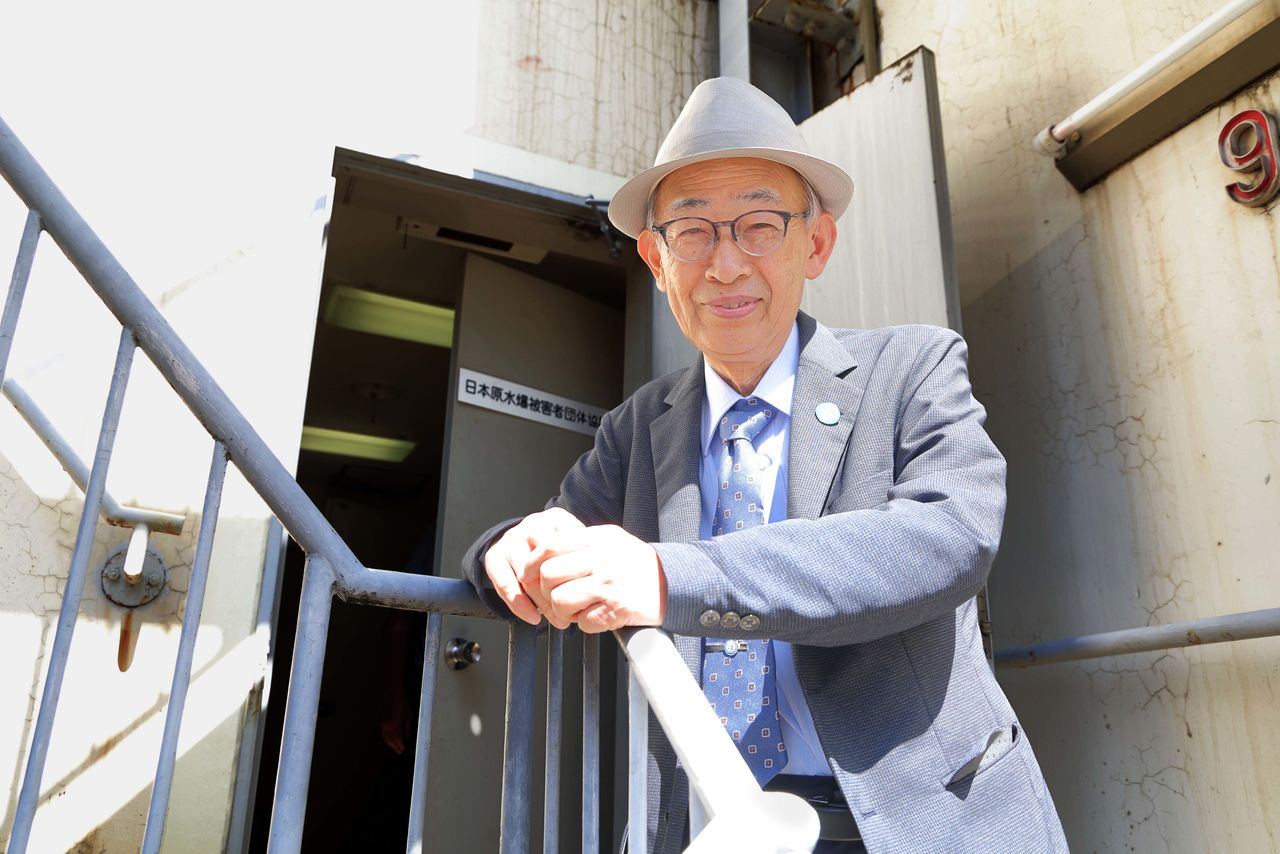
Hamasumi outside Hidankyō’s Tokyo headquarters. (© Hanai Tomoko)
INTERVIEWER It’s often said that Japanese youth are becoming more conservative. What’s your take on that? Is there a message you’d like to relay to the young people of Japan?
HAMASUMI We have to consider the economy first of all. Young people are living in a time of growing economic anxiety, partly due to the decline in regular employment, and many of them feel that it’s all they can do to keep their heads above water, let alone worry about the bigger picture. I get that, but I still believe one needs to think a little more deeply about issues like how to conduct one’s life in today’s world and how humanity is going to survive. We’re living in a world with 12,000 nuclear warheads. I think there’s something to be learned from the way the survivors of Hiroshima and Nagasaki have lived their lives.
The chair of the Norwegian Nobel Committee, Jørgen Watne Frydnes, gave an excellent speech at the 2024 Nobel Peace Prize award ceremony, which I would encourage everyone to read. Wrapping it up, he said this: “It is naive to believe our civilization can survive a world order in which global security depends on nuclear weapons. The world is not meant to be a prison in which we await collective annihilation. No matter how long and difficult the path, we should learn from Nihon Hidankyō: We must never give up.”
(Originally published in Japanese based on an interview conducted in Tokyo on September 25, 2026, by Ishii Masato of Nippon.com. Banner Photo: Hamasumi Jirō, Secretary general of Nihon Hidankyō. © Hanai Tomoko.)
(*1) ^ The contamination of a Japanese fishing boat by radioactive fallout from US thermonuclear testing on Bikini Atoll, resulting in the death of one of the crew members. Also known as the Lucky Dragon Incident.—Ed.
(*2) ^ Legislation guaranteeing free health checkups and medical care to hibakusha was enacted in 1957, but the Japanese government has consistently refused to compensate the victims for their suffering.—Ed.
(*3) ^ The International Signature Campaign in Support of the Appeal of the Hibakusha for the Elimination of Nuclear Weapons, calling for an international treaty to ban nuclear weapons, was held from 2016 to the end of 2020. It gathered some 13.7 million signatures in Japan and around the world.—Ed.