Number of Japanese Citizens Drops Below 120 Million
Politics Society Family Economy- English
- 日本語
- 简体字
- 繁體字
- Français
- Español
- العربية
- Русский
Tokyo Sees Only Rise in Japanese Citizens
Japan‘s population stood at 123,767,642 as of January 1, 2026, according to a demographic survey published by the Ministry of Internal Affairs and Communications, based on resident registration data. This was a 0.45% year-on-year decrease.
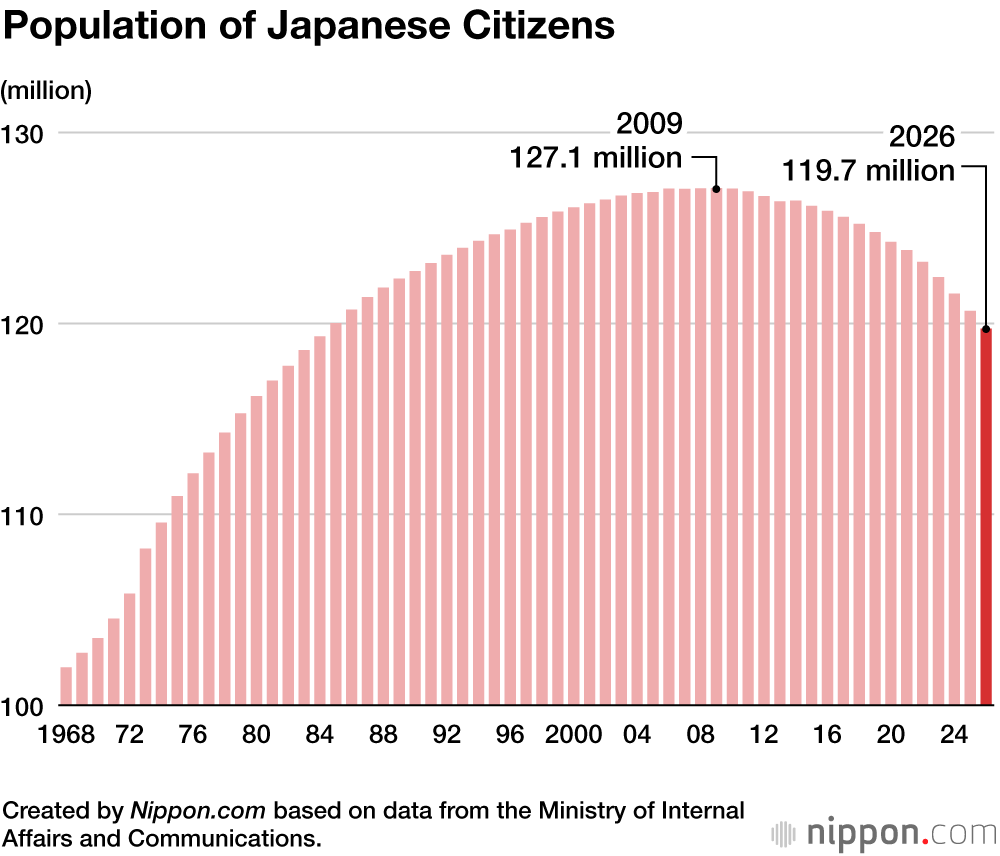
The number of Japanese citizens was 119,736,483, after a decrease of 916,774, or 0.76%, compared to the previous year. Since 2009, the number of Japanese citizens has fallen for 17 consecutive years. Tokyo was the only prefecture to see a rise in its Japanese population, which increased by 12,540 (0.09%). By percentage the largest drops were in Akita (–1.95%), Aomori (–1.70%), Kōchi (–1.70%), Yamagata (–1.69%), and Iwate (–1.65%), mainly concentrated in the northern Tōhoku region.
The number of births of Japanese citizens in 2025 fell for the tenth successive year to 670,476. The natural population decline (the difference between the number of births and deaths) was 923,008, rising for the eighteenth straight year.
Meanwhile, the population of foreign residents, which has been climbing rapidly since the easing of pandemic entry restrictions in 2023, rose by 353,696 (9.62%) to 4,031,159. This is the highest total since statistics on foreign nationals were first collated in 2013.
The prefecture with the highest population (including foreign residents) was Tokyo with 14,077,553 residents, followed by Kanagawa at 9,194,723, and Osaka at 8,775,326. The least populated prefecture was Tottori, with just 527,236 residents, or one twenty-sixth the number of Tokyo.
The combined population of the three major metropolitan areas centered on Tokyo, Osaka, and Nagoya was 65,979,272. Although this figure declined for the sixth consecutive year, it represents 53.3% of the total population. The concentration of foreign residents in metropolitan areas is even more pronounced, with 68.7% of the overall foreign population living there.
Prefectures with the Highest and Lowest Populations (All Residents)
| Tokyo | 14,077,553 |
| Kanagawa | 9,194,723 |
| Osaka | 8,775,326 |
| Aichi | 7,473,297 |
| Saitama | 7,368,548 |
| Chiba | 6,313,748 |
| Hyōgo | 5,364,773 |
| Fukuoka | 5,076,856 |
| Hokkaidō | 4,996,492 |
| Shizuoka | 3,544,228 |
| Tottori | 527,236 |
| Shimane | 634,459 |
| Kōchi | 654,213 |
| Tokushima | 691,229 |
| Fukui | 739,412 |
| Saga | 787,887 |
| Yamanashi | 794,684 |
| Wakayama | 889,455 |
| Akita | 890,524 |
| Kagawa | 931,812 |
Created by Nippon.com based on data from the Ministry of Internal Affairs and Communications.
Prefectures with the Highest and Lowest Populations (Non-Japanese)
| Tokyo | 783,702 |
| Osaka | 369,529 |
| Aichi | 347,971 |
| Kanagawa | 309,815 |
| Saitama | 286,262 |
| Chiba | 254,956 |
| Hyōgo | 152,381 |
| Shizuoka | 128,273 |
| Fukuoka | 123,731 |
| Ibaraki | 109,520 |
| Akita | 6,255 |
| Tottori | 6,437 |
| Kōchi | 7,174 |
| Aomori | 9,212 |
| Tokushima | 9,569 |
| Yamagata | 10,882 |
| Wakayama | 11,357 |
| Shimane | 11,437 |
| Iwate | 12,278 |
| Saga | 12,629 |
Created by Nippon.com based on data from the Ministry of Internal Affairs and Communications.
Data Sources
- Population data (Japanese) from the Ministry of Internal Affairs and Communications
(Translated from Japanese. Banner photo © PhotoAC.)