Japan’s Centenarian Population Tops 100,000 for First Time
Health Lifestyle- English
- 日本語
- 简体字
- 繁體字
- Français
- Español
- العربية
- Русский
A Historic Milestone
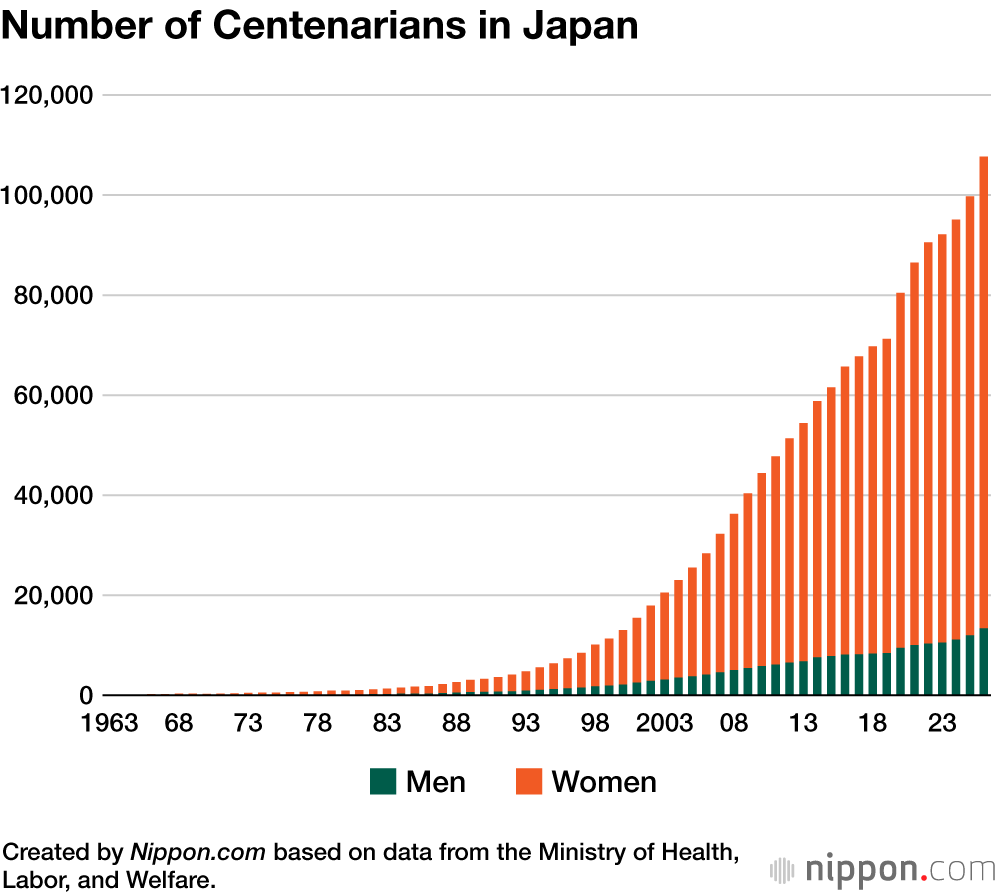
Japan now has more than 100,000 people aged 100 or over. According to resident registration data from the Ministry of Health, Labor, and Welfare, the number of centenarians increased by 7,914 from the previous year to 107,677, as of September 1, 2026. This is the highest total since statistics were first collected in 1963, and the figure has risen for 56 consecutive years. Women account for an overwhelming majority at 94,298, or 87.6%, compared to 13,379 men.
Japan’s oldest woman is 114-year-old Kishimoto Fuyo, who lives in Kyoto. She is the last living Japanese born in the Meiji period (1868–1912). The oldest man in Japan is Katō Hikaru, aged 112 and living in Kumamoto.
In 1963, when the government enacted the Act on Social Welfare for the Elderly, there were 153 centenarians counted nationwide. That figure passed 1,000 in 1981 and 10,000 in 1998, and has continued to climb steadily since.
The prefecture with the highest ratio of centenarians per 100,000 people is Shimane at 186.7, which is more than three times as many as Saitama, the lowest at 51.3. Western Japan tends to have higher ratios than the east of the country, and figures are particularly low in the Kantō region, centered on the Tokyo metropolitan area.
Centenarians Per 100,000 Population in Japanese Prefectures
Highest Ratios
| Shimane | 186.7 |
| Kōchi | 169.5 |
| Tottori | 152.5 |
| Kagoshima | 148.3 |
| Nagano | 146.9 |
Lowest Ratios
| Chiba | 62.9 |
| Tokyo | 62.4 |
| Osaka | 60.1 |
| Aichi | 57.8 |
| Saitama | 51.3 |
Created by Nippon.com based on data published by the Ministry of Health, Labor, and Welfare.
Data Sources
- Data on centenarians (Japanese) from the Ministry of Health, Labor, and Welfare
(Translated from Japanese. Banner image © Pixta.)