


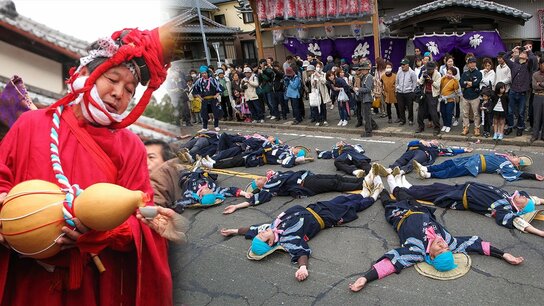
Japan’s matsuri, or festivals, are often events at which people let themselves go wild with the blessing of the kami. We look at three famed festivals with alcohol at their core.
Sake and Matsuri Go Hand in Hand
As the adage goes, “No kami would refuse a drink of sake,” Japan’s deities love their tipple. Sake brewing supposedly began even before rice cultivation reached Japan more than 2,000 years ago, and sake has long been part of religious rituals.
Sake brewed from newly harvested rice is offered in gratitude first to the kami. Humans then partake, in the belief that doing so will confer the deities’ power on them. Festivals begin with a toast with the kami to ensure the success of the festivities and end with the naorai rite of sharing sake offerings to give thanks for successful completion of the event.
Here we highlight three festivals focused on getting merry with the kami to regain strength depleted by the year’s endeavors.
Doburoku Matsuri
(October 14–19, Shirakawa, Gifu Prefecture)
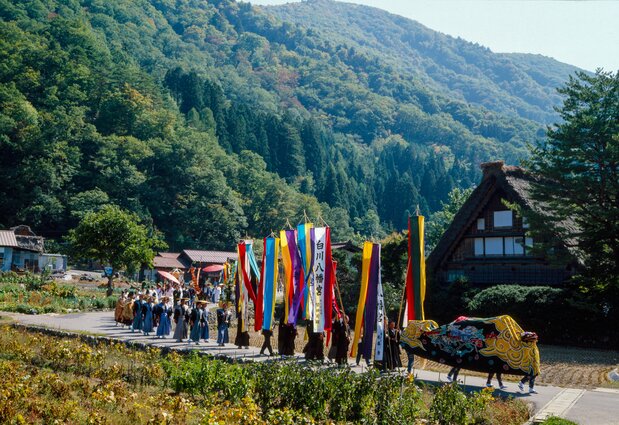
 Colorful banners enliven autumn in Shirakawa-gō. (© Haga Library)
Shirakawa-gō, in the northwestern corner of Gifu Prefecture, is a UNESCO World Heritage site and a prime tourism destination. This cluster of traditional dwellings built in the gasshō-zukuri style features steeply pitched thatched roofs to handle the region’s heavy snowfall; inside, silkworms were raised in the attic. In this unspoiled landscape, against a backdrop of forested mountains, the sight of villagers turning out en masse to rethatch the homes’ roofs symbolizes this region’s deeply ingrained culture of neighbors helping each other.
The Doburoku Matsuri, an annual fall event, reinforces this solidarity. Festival proceedings rotate between the shrines of Shirakawa Hachiman, Hatogaya Hachiman, and Iijima Hachiman for two days each, as participants celebrate the harvest with cloudy doburoku sake. Visitors can also enjoy doburoku along with performances of traditional entertainment.
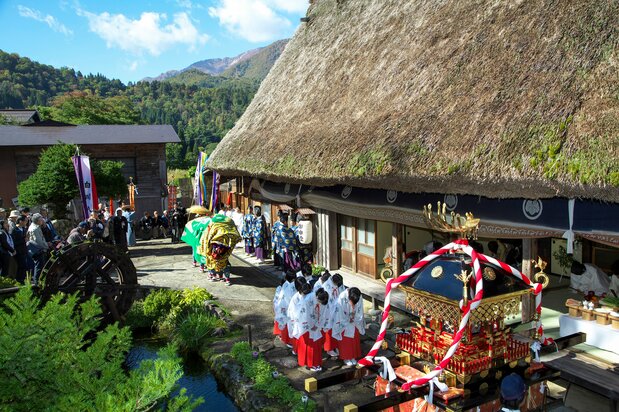 The mikoshi portable shrine procession visits all the village’s districts. (© Haga Library)
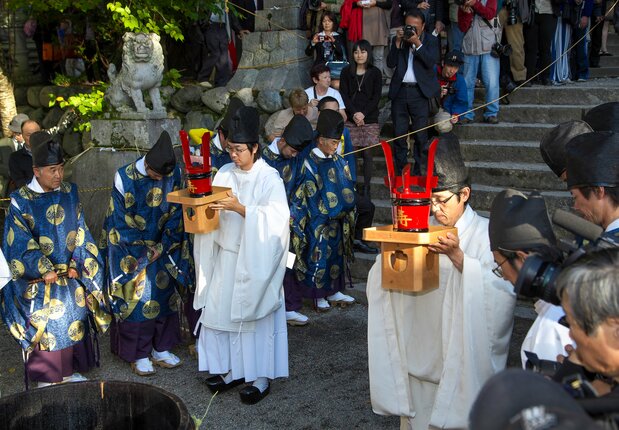 The doburoku ceremony begins after the procession. (© Haga Library)
The village of Shirakawa began offering doburoku sake to the mountain kami some 1,300 years ago to pray for a good harvest. Today, while the Liquor Tax Act prohibits home brewing, the shrines obtain a special permit to allow sake brewing for the festival. Brewing preparations begin in January.
Sake is normally fermented for 20 to 40 days, but the village follows the traditional brewing method, which takes almost 200 days. The resulting brew is thick, silky, and sweet. Each shrine’s sake has its own flavor and alcohol content; one of the delights of this festival is an opportunity to taste the different varieties.
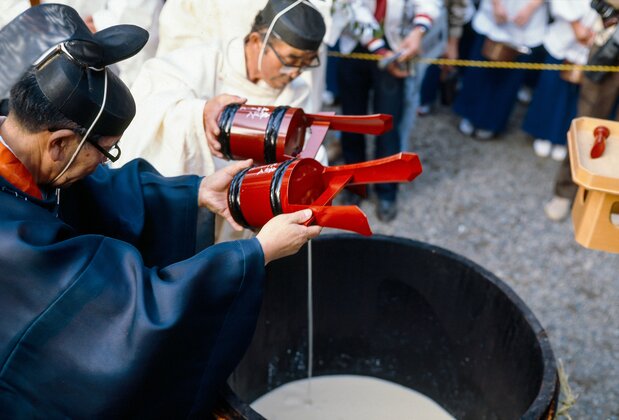 A single shrine may brew up to 5,000 liters of its beverage. (© Haga Library)
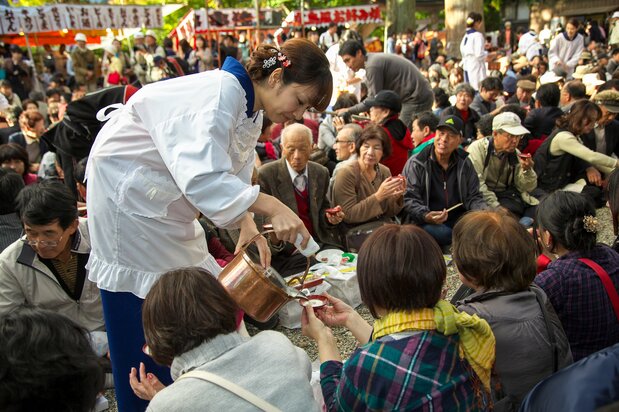 Sake cups can be refilled ad infinitum. (© Haga Library)
The festival begins with a morning ceremony at the shrine; shishimai lion dancers and banner bearers make the rounds of the village. The procession returns to the shrine at 3:00 pm, when the kami are offered doburoku in gratitude for the harvest and to pray for the next year’s bounty. Now comes the highlight of the festival, when participants hold up the sake cups they have purchased at the shrine to receive the sake being served. As the sun sets, the rich aroma of the sake wafts through the village and attendees settle down to enjoy performances of folk songs and other traditional entertainments.
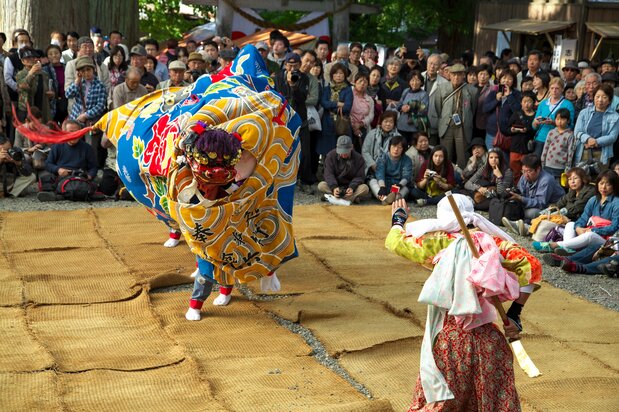 Shishimai lion dance and other traditional entertainments are performed. (© Haga Library)
Hyōtan Matsuri
(First Sunday in December, Bungo-Ōno, Ōita Prefecture)
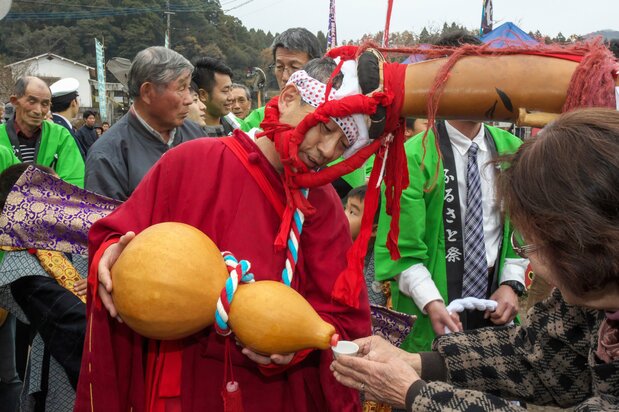 This giant gourd holds 5.4 liters of sake. (© Haga Library)
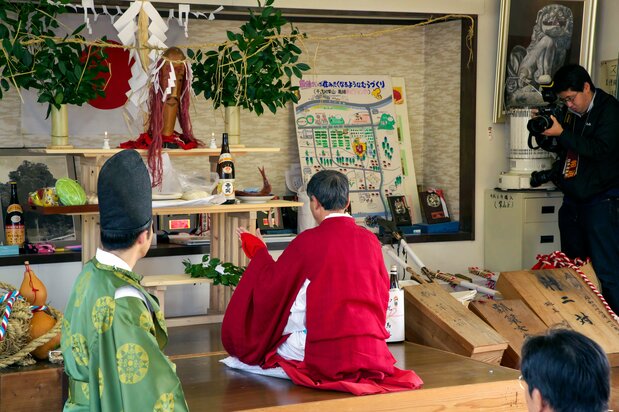
An incarnation of the deity Hyōtan-sama, a scarlet-clad figure wearing a hyōtan gourd 80 centimeters long on its head parades in a procession. Taking its name from this strange apparition, the festival is familiarly known as Hyōtan Matsuri. This is the Shimotsukisai of Bungo-Ōno’s Shibayama Hachiman Shrine; shimotsuki refers to November in the lunisolar calendar, equivalent to December nowadays.
With civil war raging in the area 800 years ago, villagers welcomed the kami with entertainment and sake poured from a gourd to pray for peace, a good harvest, and good health. This was the dawn of this festival, which takes place late in the year when days are short. It is also a ceremony for beefing up a weakened constitution by channeling the energy of the kami. Somewhere along the way, Hyōtan-sama became the main figure, and sake came to be shared to ensure good health.
 A senior from the community plays the role of Hyōtan-sama. (© Haga Library)
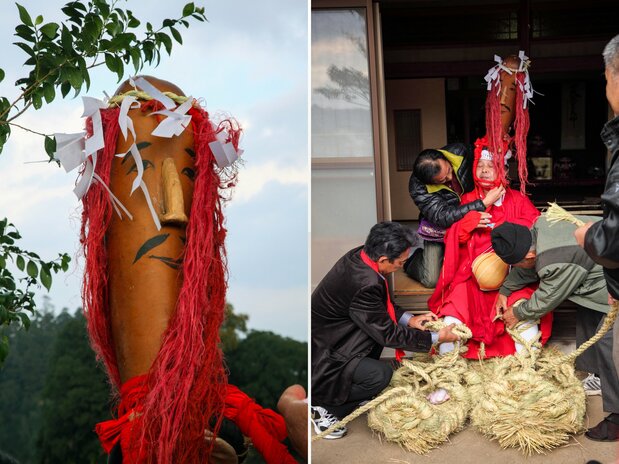 It takes nearly an hour to don the elaborate costume that features eboshi headgear fashioned from a gourd and giant straw sandals. (© Haga Library)
Hyōtan-sama departs from the shrine at noon on festival day and walks through the district in a grand procession that includes a sacred horse-mounted messenger, a mikoshi, and shishimai and kagura dancers.
The huge straw sandals Hyōtan-sama wears are 130 centimeters long and weigh 10 kilograms each. This footwear makes walking difficult, and attendants equipped with ropes pull the sandals along.
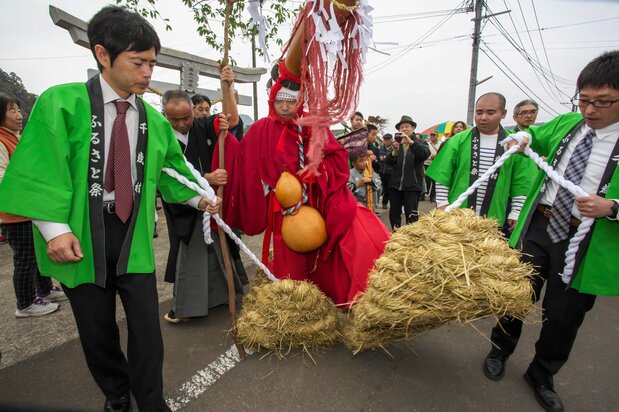 Attendants help haul the straw sandals as Hyōtan-sama ambles along. (© Haga Library)
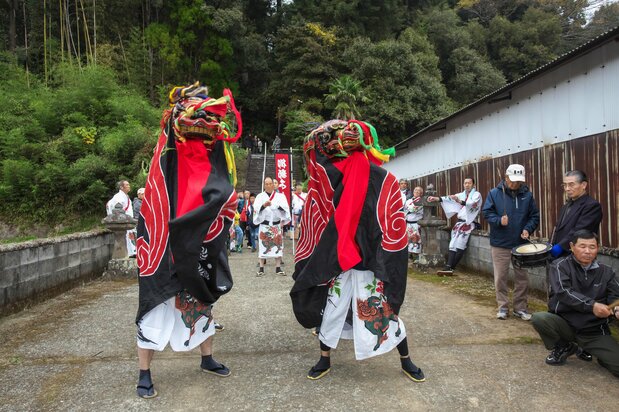 Shishimai dancers and shrine parishioners join the procession. (© Haga Library)
Along the procession route, Hyōtan-sama stops to pose for photos, lifting a sandal high, or pours sake for the crowds proffering drinking vessels. Although spectators might want just a few sips, their cups are filled to the brim. With so many stops of this sort along the route, the procession can take three or four hours to cover a round trip of just two kilometers.
Hyōtan-sama and his retinue return to the shrine around four in the afternoon. A hush falls over the crowd as the mounted messenger makes seven round trips at a gallop along the procession route. The festival ends with shishimai and kagura dancing.
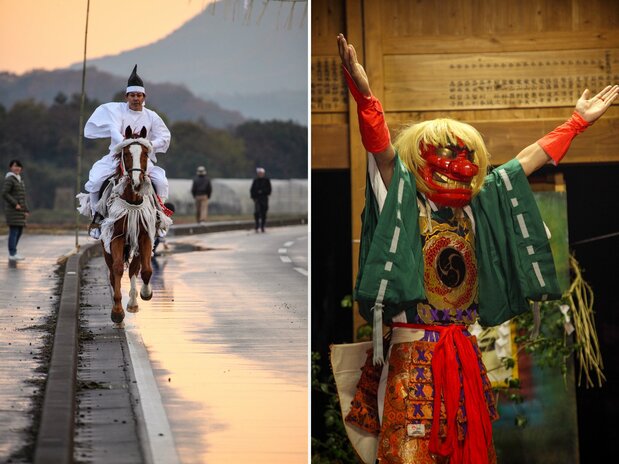 Entertainment for the deity includes a ceremony with roots in yabusame mounted archery and kagura dances. (© Haga Library)
Unagōji Matsuri
(Saturday and Sunday closest to April 7 and 8, Toyokawa, Aichi Prefecture)
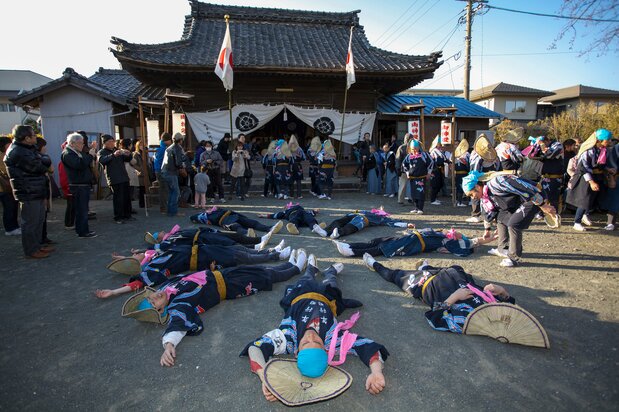 Reenacting the “too much sake” incident. (© Haga Library)
The Wakabasai festival of Ushikubo Hachiman Shrine in Toyokawa is a yearly spring event. At this humorous festival, men playing the role of the yan’yō-gami deity sprawl on the road wriggling like onaga-uji maggots, from which the name Unagōji derives.
The festival dates from the Warring States period some 500 years ago, when the local lord invited everyone in the town to his castle to reward them for their hard work on a fortification and hosted a splendid feast. The guests partook liberally of the sake offered and ended up falling-down drunk. The sight of men lying on the road is a reenactment of this event, making for a singularly strange matsuri.
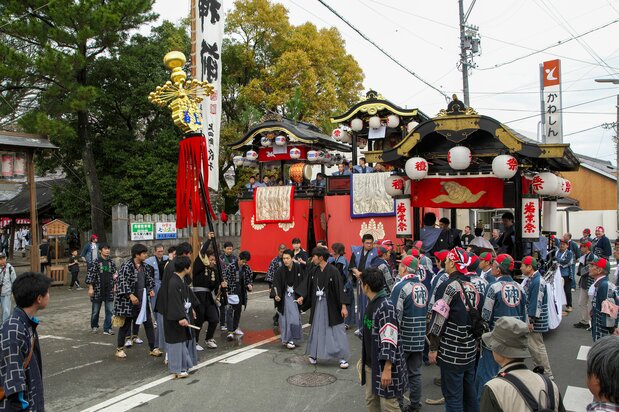 Parishioner groups are identified by distinctive matoi ornamented poles. (© Haga Library)
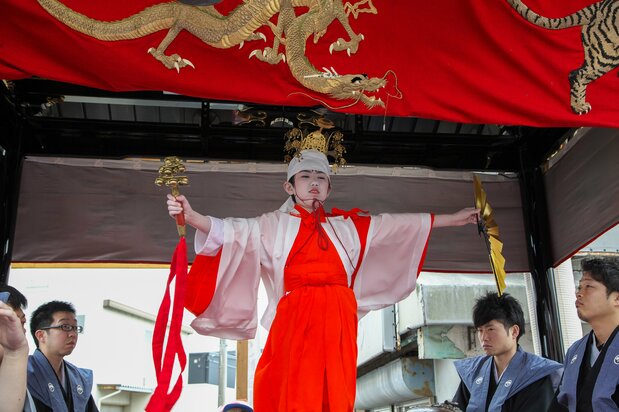 A young boy dressed as a shrine maiden dances in time to the music. (© Haga Library)
Over the festival’s two days, a procession headed by two men bearing a lion mask, the shrine’s object of worship, leaves the shrine and parades through the district. A young boy riding on a lavishly decorated parade float performs the sasaodori dance, accompanied by three drummers.
The men in the role of the yan’yō-gami deity handle the musical accompaniment. Chanting the festival refrain, they suddenly fall and sprawl in a circle, where they must wait until a partner helps them up. Until then, they roll around on the ground, eliciting laughter from the crowd.
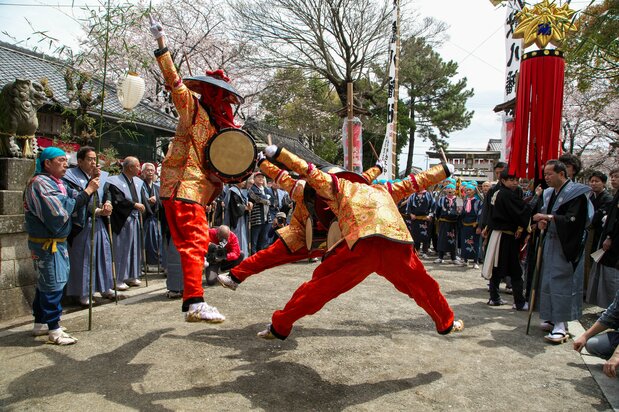 The sasaodori is performed to the sound of drums. (© Haga Library)
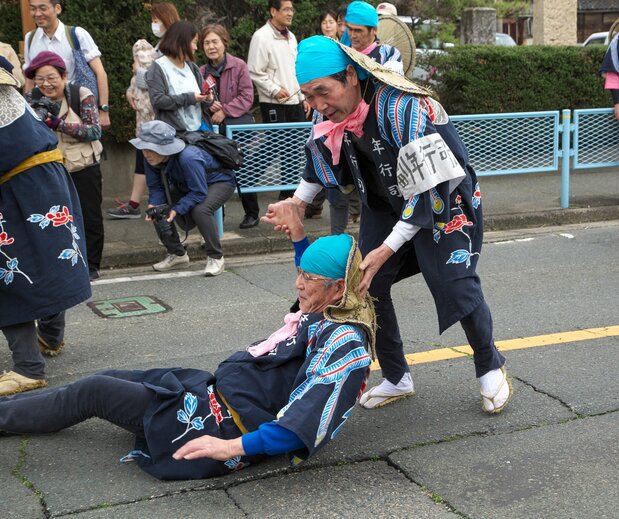 A participant impersonating a drinker who has had a few too many is helped up. (© Haga Library)
Sake is served to onlookers and the yan’yō-gami. The captivating aroma of the drink fills the air and a peaceful atmosphere prevails.
The mood changes in the evening, when the parade floats assemble at the shrine and the festival reaches a climax. Children dance the sasaodori and other dances, and those playing the drums perform in imitation of ayatsuri ningyō puppet dolls as an offering to the deity. The mood reaches a fever pitch as young men maneuver the floats to crash into each other to pray for a good harvest.
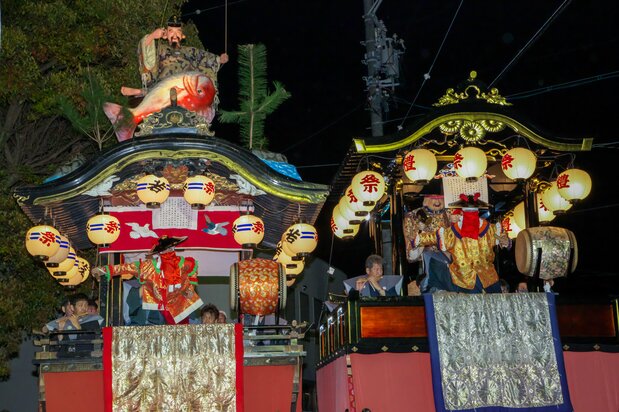 The drummers on the floats put on an impressive display imitating puppet dolls. (© Haga Library)
(Originally published in Japanese. Dates given are those on which the festivals are usually held. Banner photo © Haga Library.)



 Read in other languages