


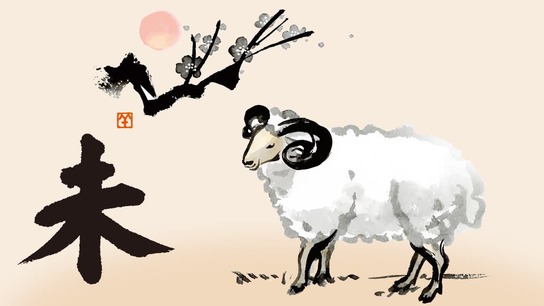
Although 2027 is the Year of the Sheep in Japan, traditionally these woolly beasts were little known through much of the country’s history. We introduce the history of Japanese sheep and a few local connections.
Unfamiliar Creatures
In 2027, it will be the Year of the Sheep according to the 12-year cycle of zodiacal animals known in Japanese as eto. Sheep motifs will appear on themed displays, nengajō cards, and calendars that are common sights across the country from December into January.
Sheep were first brought to Japan in 599. A record in the eighth-century chronicle Nihon shoki states that in that year the Kingdom of Baekje on what is now the Korean Peninsula made a tribute gift of one camel, one donkey, two sheep, and one white pheasant.
While sheep continued to occasionally be presented in tribute or imported from the Asian continent, unlike cattle and horses, they did not become established because they could not be used for plowing or transporting goods, and people in Japan did not know how to process wool.
Although Japanese people knew that the sheep existed because it was one of the 12 eto, almost nobody had ever seen one. In a picture scroll from the Muromachi period (1333–1568) depicting anthropomorphized zodiacal animals, a creature representing the sheep appears in a fine kimono, but it has a long beard so it looks unmistakably like a goat. Even in the Edo period (1603–1868), illustrations of sheep in encyclopedias like the Wakan sansai zue still had a strong resemblance to goats.
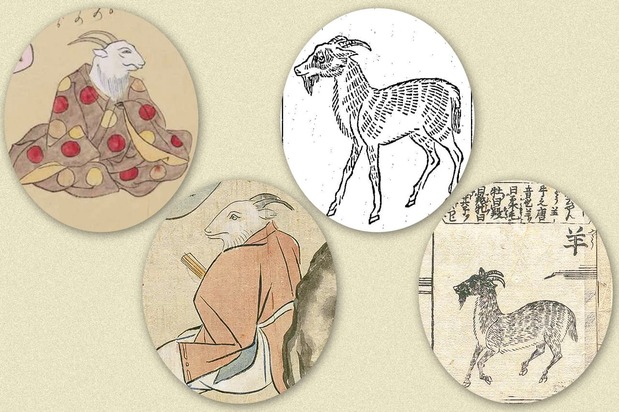
 Illustrations of goatlike sheep from medieval and early modern Japanese scrolls and encyclopedias, from left: Chōjū emaki: jūnirui uta-awase (Courtesy National Institute of Japanese Literature); Jūnirui makimono, Wakan sansai zue, and Kinmō zui (All courtesy National Diet Library).
Japan only began importing sheep in earnest after the 1868 Meiji Restoration. With the outbreak of the First Sino-Japanese War, the Russo-Japanese War, and World War I, sheep farming was encouraged to meet the demand for military supplies. After World War II, sheep raising was again promoted due to food and clothing shortages. However, as Japan moved from postwar reconstruction into its period of rapid economic growth, cheaper, higher-quality imported wool took over, causing domestic wool production to plummet once more and sheep numbers to enter a steady decline.
Thus, sheep have never been a major form of livestock in Japan. Unlike cattle and horses, there are almost no place names, surnames, or idioms using sheep, which may indicate the limited associations the animals have for Japanese people.
Yōkan
The classic Japanese confectionery yōkan (羊羹) is made by cooking adzuki bean paste and setting it with kanten (agar). Why is it written with the character for sheep (羊)? Originally the word referred to a kind of mutton soup, said to have been brought to Japan by Zen monks who studied in China during the Kamakura (1185–1333) and Muromachi periods. However, because Buddhism in Japan prohibited eating meat, adzuki beans were substituted for mutton and the dish gradually went through a long evolutionary process into its current sweet, jellied form.
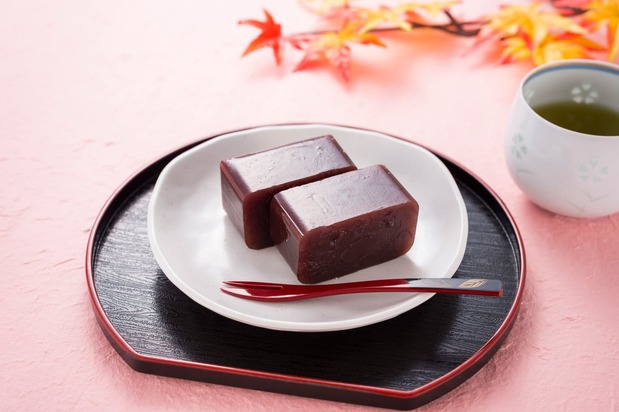 (© Pixta)
Jingisukan (Genghis Khan)
The grilled mutton dish jingisukan, a Hokkaidō specialty, has its origins in the promotion of sheep farming during World War I. The island’s farmers initially raised sheep for wool, but as competition increased from imports and synthetic fibers, they shifted toward rearing them for meat. Prepared using a special dome-shaped pan to grill the mutton together with vegetables, the dish is the centerpiece of jinpa (jingisukan parties), which are popular outdoor gatherings in Hokkaidō during spring and summer.
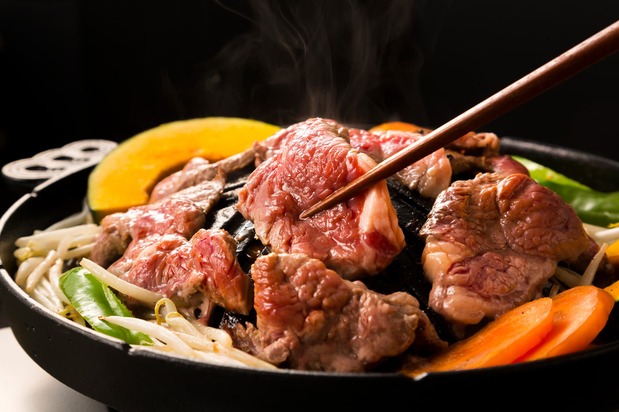 (© Pixta)
Mount Yōtei
One of the few Japanese place names to include the character for sheep is Mount Yōtei (羊蹄山), near the Niseko ski resorts. In Japan, there are hundreds of mountains that are thought to resemble Mount Fuji, but the 1,898-meter Hokkaidō peak is considered to be its closest lookalike. However, Mount Yōtei has no connection to sheep, as yōtei (羊蹄) is the classical name for a common weed. Austro-Hungarian officer Theodor von Lerch, a pioneer of Japanese skiing, ascended the peak in 1912, and today it attracts international visitors with attractions like backcountry skiing in winter and hiking in summer.
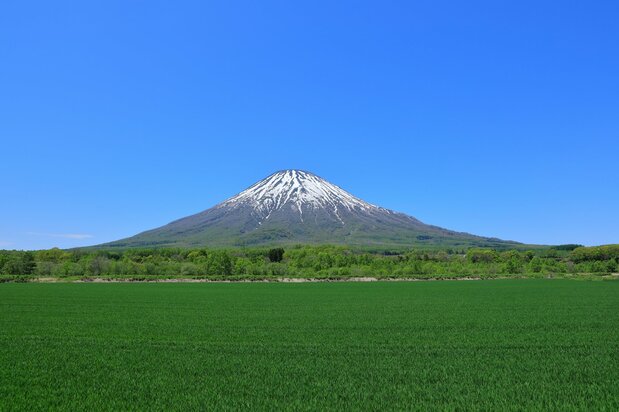 (© Pixta)
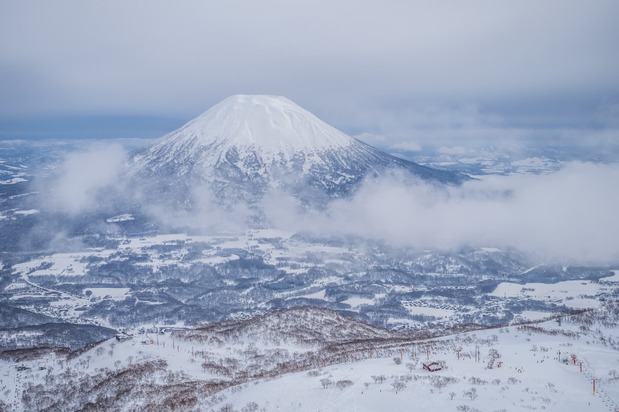 (© Pixta)
Time and Direction
Special kanji are used for the eto that are different from everyday usage. When talking about sheep in general 羊 is used, but the eto kanji for sheep is 未.
Historically the eto cycle was also used for compass directions and times of day. In the system whereby the day was divided into 12 “hours,” the hour of the sheep took place in the early afternoon, from around one until three. The sheep’s compass direction is south-southwest.
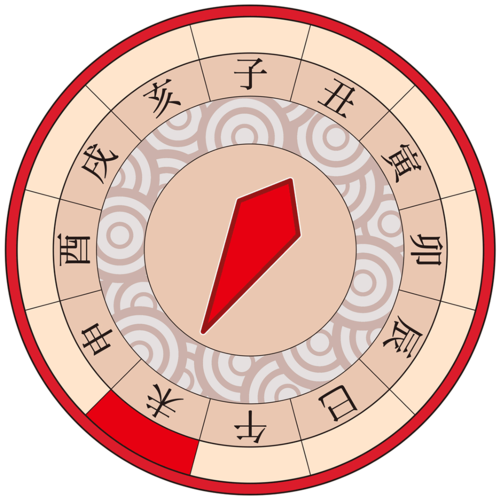 Kanji for the 12 eto line up in order around a circle. Clockwise from the top, they represent the rat, ox, tiger, rabbit, dragon, snake, horse, sheep, monkey, rooster, dog, and boar. (© Pixta)
(Translated from Japanese. Banner photo © Illust AC/Pixta).




 Read in other languages